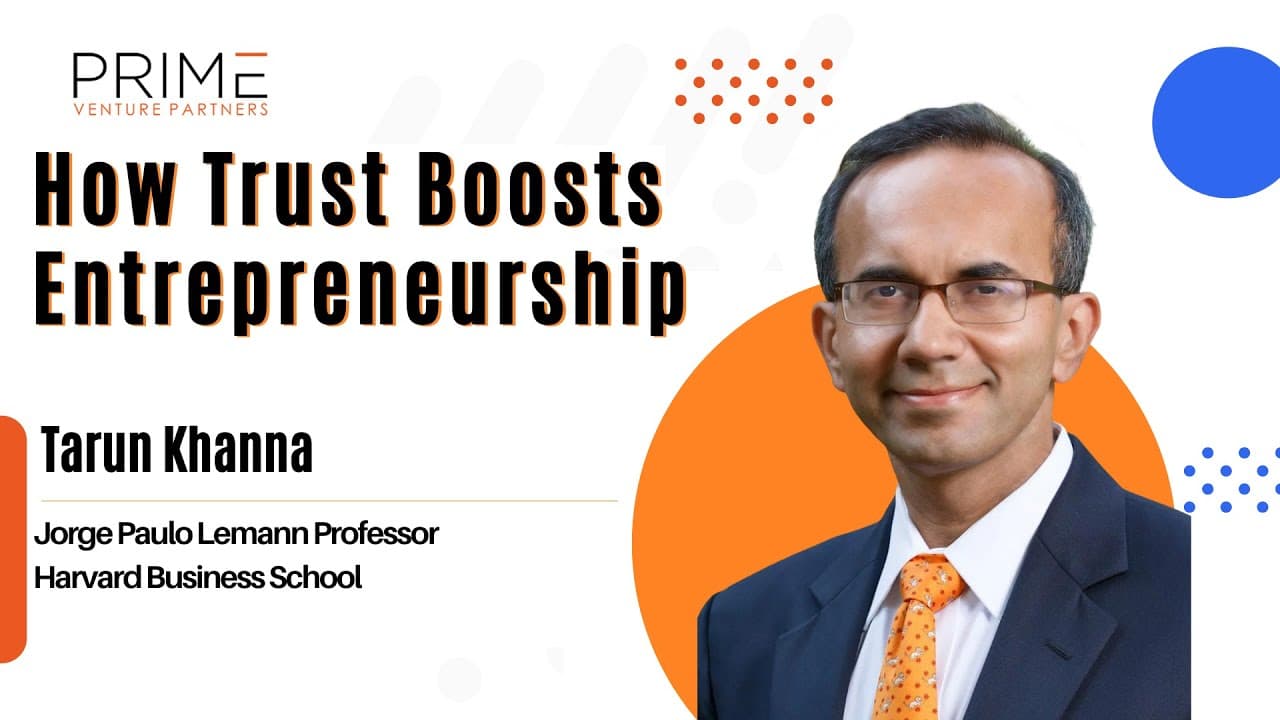
Ertenpreneurship in Emerging Economies with Tarun Khanna, Professor Harvard Business School
TL;DR
Entrepreneurship in developing economies is more challenging due to a lack of supporting systems, requiring entrepreneurs to not only solve their core problems but also create the conditions needed for success.
Transcript
welcome to the prime podcast this is sripavi it is my distinct privilege today to host karan khanna professor at the harvard business school who for over two decades has studied entrepreneurship as a means to social and economic development in emerging markets back in 2007 he was nominated to be a young global leader under 40 at the world economic ... Read More
Key Insights
- 😀 Entrepreneurship in developing economies faces challenges due to a lack of supporting systems and infrastructure.
- 💯 Entrepreneurs must not only focus on their core business tasks but also address societal problems and fill institutional voids.
- 🧑🏭 Trust is a critical factor in entrepreneurship, and entrepreneurs should strive to build trust with partners, suppliers, and customers.
- 💦 Initiatives like AIM in India are working to create a supportive ecosystem for entrepreneurs.
- 💪 Investment in science and research is essential to nurture innovation and create a strong scientific foundation.
- 😫 Diverse teams with varied skill sets, including storytelling abilities, are crucial for the success of entrepreneurial ventures.
- 💁 Access to reliable information and credible platforms is vital for entrepreneurs to overcome trust issues and collaborate effectively.
Install to Summarize YouTube Videos and Get Transcripts
Explore YouTube Video Summarizer or Get YouTube Transcript Extractor
Questions & Answers
Q: How is entrepreneurship different in developed and emerging economies?
In developed economies, entrepreneurs have access to abundant talent, risk capital, supportive institutions, and well-established property rights systems. This allows them to concentrate on their business goals. In contrast, entrepreneurs in emerging economies like India face numerous infrastructural challenges, requiring them to navigate issues such as limited talent pools, inadequate support systems, and unresolved societal problems.
Q: What is the role of trust in entrepreneurship?
Trust plays a crucial role in entrepreneurship, especially in low-trust societies like India. In such societies, people tend to work with those they are familiar with, limiting their potential partnerships and collaboration. To overcome this, entrepreneurs need to build trust with partners, suppliers, and customers. They can do so by providing credible information, addressing concerns, and creating platforms or ecosystems that foster trust.
Q: How does the lack of trust impact entrepreneurship in India?
The low level of trust in India creates challenges for entrepreneurs when it comes to finding trustworthy partners or collaborators outside their immediate network. It restricts their creative horizons and limits their ability to access a broader range of skills and expertise. Entrepreneurs must find ways to bridge this trust gap by creating trust platforms, providing reliable information, and building relationships based on trust.
Q: What can be done to foster entrepreneurship in developing countries like India?
To foster entrepreneurship in developing countries, it is important to address the institutional voids and build the necessary infrastructure. This can be achieved through initiatives such as the Atal Innovation Mission (AIM) in India, which aims to create a supportive ecosystem for entrepreneurs. Additionally, investment in science and research is crucial to create a strong scientific foundation and enable cutting-edge ventures.
Summary & Key Takeaways
-
Entrepreneurship in developed economies benefits from access to liquid talent pools, risk capital, property rights systems, and supportive institutions, making it easier to focus on business tasks.
-
In contrast, entrepreneurs in developing economies face significant infrastructural challenges, such as limited access to talent, inadequate support systems, and unresolved social and economic problems.
-
The task for entrepreneurs in developing countries is not only to create their desired ventures but also to address these institutional voids and build the necessary conditions for success.
Read in Other Languages (beta)
Share This Summary 📚
Summarize YouTube Videos and Get Video Transcripts with 1-Click
Try YouTube Summary with ChatGPT & Claude or YouTube Transcript Generator
Explore More Summaries from Prime Venture Partners 📚






Summarize YouTube Videos and Get Video Transcripts with 1-Click
Try YouTube Summary with ChatGPT & Claude or YouTube Transcript Generator