How to Create Engaging Scenario-Based eLearning
TL;DR
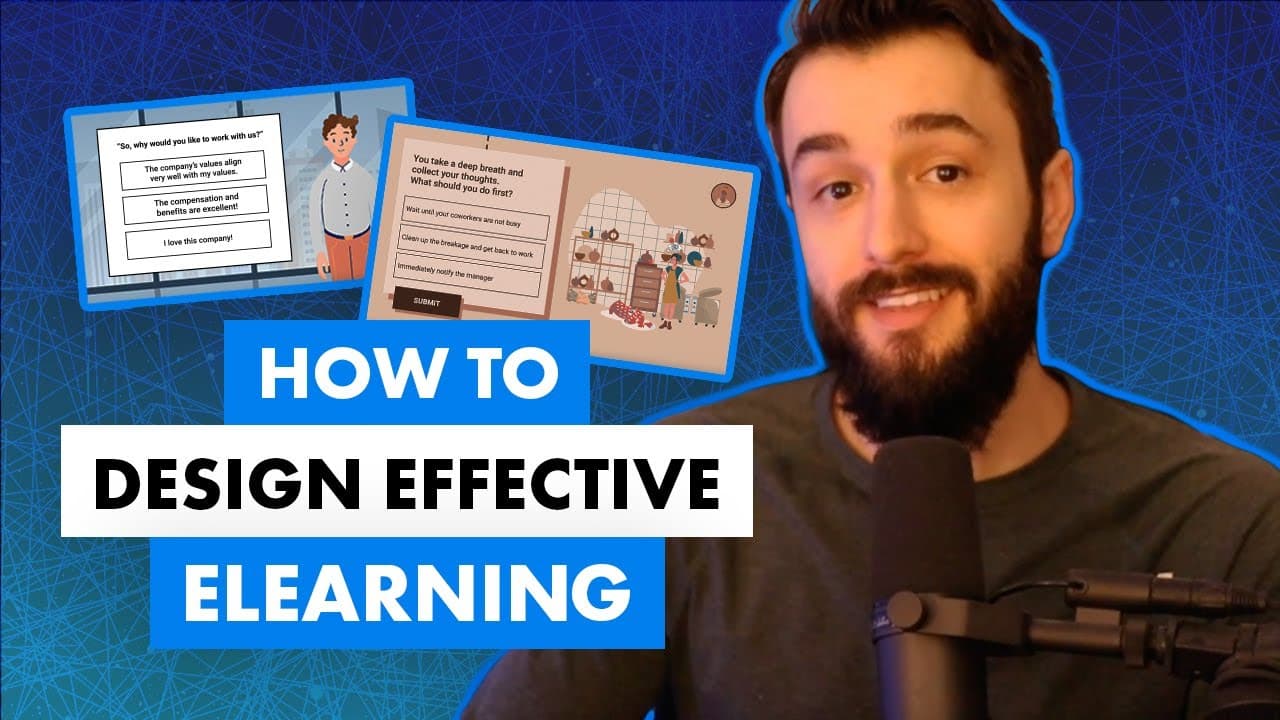
To create effective scenario-based eLearning, begin by identifying the learning needs and constructing a clear action map. Develop a storyboard that includes all content and programming notes, create visual mock-ups for the layout, and prototype the interactivity. This approach helps learners make meaningful decisions and experience real-world consequences, enhancing engagement and retention.
Transcript
Hello my friends, I'm Devlin Peck and in today's video, we're going to take a look at how to design engaging and effective scenario-based eLearning instead of boring information dump learning that puts people to sleep. So stay tuned and we'll dive right into it. Okay. So we are about to dive into this thing. I'm going to share with you with... Read More
Key Insights
- 🫨 Scenario-based eLearning involves creating immersive simulations where learners make choices and face consequences akin to real-life.
- 🌍 Aligning the training context with the performance context enhances transferability of knowledge and skills to real-world situations.
- 🎚️ Moments of delight, achieved through animations, interactions, and storytelling, can elevate engagement levels in eLearning.
- ©️ Efficiency in development can be improved by utilizing methods like copy-paste-and-replace for creating consistent content.
Install to Summarize YouTube Videos and Get Transcripts
Explore YouTube Video Summarizer or Get YouTube Transcript Extractor
Questions & Answers
Q: What is the guiding principle behind designing scenario-based eLearning?
The key concept is to engage learners by making them active participants in scenarios where they can make decisions and experience the consequences, mimicking real-life situations.
Q: What is the significance of aligning training context with performance context in eLearning design?
By mirroring the real-world context in training simulations, learners can better transfer their learning to actual job tasks, enhancing retention and application of knowledge.
Q: How can instructional designers ensure learner engagement in scenario-based eLearning?
Designers can enhance engagement through moments of delight, achieving this through animations, storytelling, and interactive features that create memorable experiences for learners.
Q: Why is the copy-paste-and-replace method recommended for eLearning development?
This method helps streamline the development process by building one functional slide or element and then duplicating and adapting it for related content, saving time and ensuring consistency.
Summary & Key Takeaways
-
Devlin Peck discusses the process of creating engaging scenario-based eLearning simulations impregnated with real-world consequences for effective learning.
-
The approach involves story-driven learning experiences where learners make choices and face outcomes akin to real-life situations.
-
By following a structured process from identifying needs to developing prototypes, instructional designers can create impactful eLearning content.
Read in Other Languages (beta)
Share This Summary 📚
Summarize YouTube Videos and Get Video Transcripts with 1-Click
Try YouTube Summary with ChatGPT & Claude or YouTube Transcript Generator
Explore More Summaries from Devlin Peck 📚






Summarize YouTube Videos and Get Video Transcripts with 1-Click
Try YouTube Summary with ChatGPT & Claude or YouTube Transcript Generator