18. Bayesian Statistics (cont.)
TL;DR
Bayesian inference uses priors to encode domain knowledge and incorporates it with data to estimate posterior probabilities.
Transcript
The following content is provided under a Creative Commons license. Your support will help MIT OpenCourseWare continue to offer high-quality educational resources for free. To make a donation or to view additional materials from hundreds of MIT courses, visit MIT OpenCourseWare at ocw.mit.edu. PHILIPPE RIGOLLET: So today, we're going to close this ... Read More
Key Insights
- 👻 Bayesian inference allows for the incorporation of prior knowledge into the estimation process.
- 🖤 Non-informative priors are used when domain knowledge is lacking, while informative priors encode specific beliefs about the parameter.
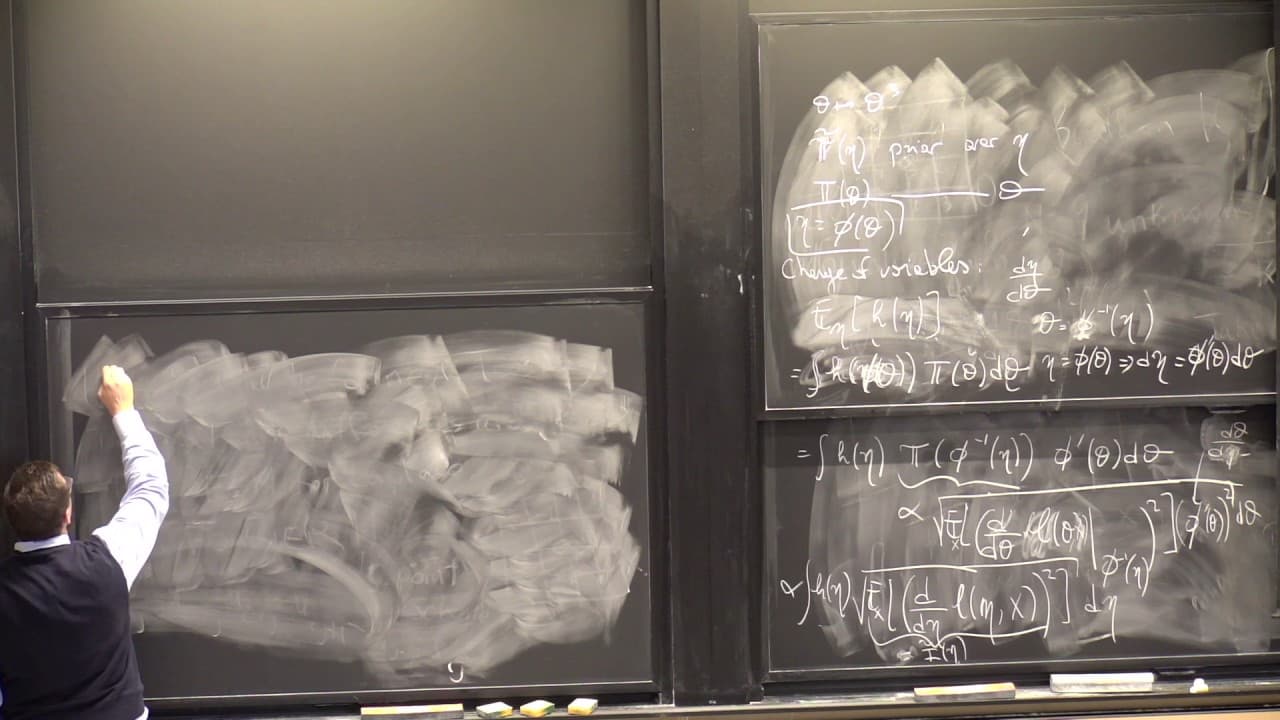
- 👋 Jeffreys prior is a commonly used prior that offers good properties for re-parameterization.
- ❓ Bayesian confidence intervals provide a more intuitive measure of uncertainty specific to the observed data.
Install to Summarize YouTube Videos and Get Transcripts
Explore YouTube Video Summarizer or Get YouTube Transcript Extractor
Questions & Answers
Q: What is the purpose of introducing a prior in Bayesian inference?
The prior in Bayesian inference serves to incorporate domain knowledge about the parameter, providing a way to encode information before observing data. It allows for a more nuanced analysis and can result in more accurate estimates, especially with limited data.
Q: Can non-informative priors be used when the parameter space is infinite?
Yes, non-informative priors can still be used for infinite parameter spaces. In such cases, a uniform prior or a prior proportional to one can be used. These priors do not favor any particular parameter value and allow the data to have a greater influence on the posterior distribution.
Q: What is Jeffreys prior and when is it used?
Jeffreys prior is a prior that uses the Fisher information matrix to determine the prior distribution. It is proportional to the square root of the determinant of the Fisher information matrix. It is particularly useful when assessing the posterior distribution in model re-parameterization, as it is invariant under certain transformations of the parameter.
Q: What is the difference between a Bayesian confidence interval and a frequentist confidence interval?
A Bayesian confidence interval is derived from the posterior distribution and reflects the uncertainty in the parameter estimate. A frequentist confidence interval, on the other hand, is derived from repeated sampling and measures the long-term frequency of capturing the true parameter value. Bayesian confidence intervals can provide a more intuitive interpretation of uncertainty in a specific data set.
Summary & Key Takeaways
-
Bayesian inference requires the introduction of a prior on the parameter, which encodes prior knowledge about its possible values.
-
Non-informative priors, such as uniform or improper priors, are used when domain knowledge is lacking.
-
Jeffreys prior is a prior that uses the Fisher information matrix to determine the prior distribution.
-
The posterior distribution obtained in Bayesian inference allows for inference and summarization of uncertainty.
Read in Other Languages (beta)
Share This Summary 📚
Summarize YouTube Videos and Get Video Transcripts with 1-Click
Try YouTube Summary with ChatGPT & Claude or YouTube Transcript Generator
Explore More Summaries from MIT OpenCourseWare 📚



Summarize YouTube Videos and Get Video Transcripts with 1-Click
Try YouTube Summary with ChatGPT & Claude or YouTube Transcript Generator