Primitive Technology: Purifying Clay By Sedimentation and Making Pots
TL;DR
A detailed guide on the process of making pottery from raw clay, including clay collection, refining, pot formation, burnishing, firing, and testing.
Transcript
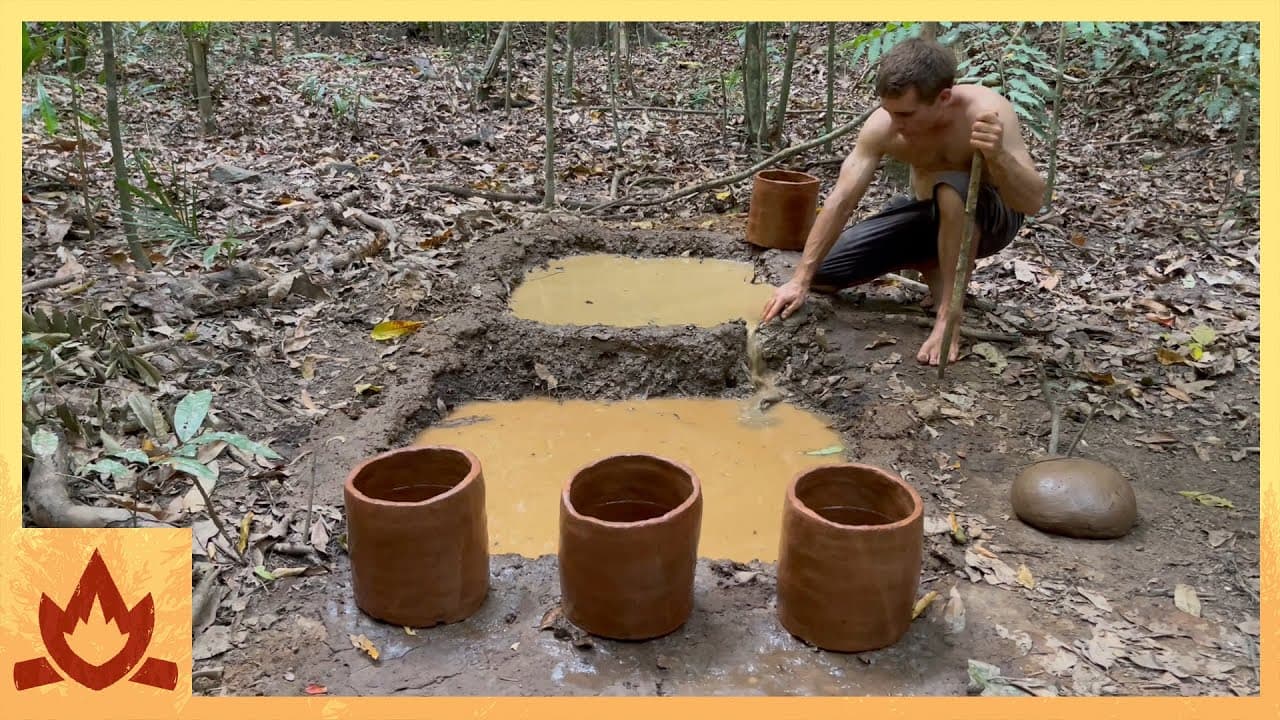
Raw clay The clay is full of rocks and other impurities that may burn away or explode in the kiln Digging a pond to collect the clay Compacting the soil so it doesn't contaminate the clay Digging raw clay, rocks and roots included Dumping clay in a pile above the pit Digging a well in the clay pile Adding water Mixing water so it becomes muddy (Cl... Read More
Key Insights
- 👻 Sedimentation method allows for easier clay processing and higher quality clay with less labor.
- 👨🎤 Clay collection involves digging a pond and separating rocks and impurities from the raw clay.
- 🦛 Coils and clay discs are used to build pots efficiently, and measurement is crucial to ensure proper kiln fit.
- 🇼🇫 Burnishing creates a smooth, waterproof surface on pottery walls.
- 🙃 Firing pots upside down with added bricks prevents sharp temperature changes and improves the baking process.
- 🏆 Testing techniques, such as the ringing sound test and water test, ensure the quality and functionality of the pottery.
- 😒 The use of grog in clay helps prevent cracking during firing.
Install to Summarize YouTube Videos and Get Transcripts
Explore YouTube Video Summarizer or Get YouTube Transcript Extractor
Questions & Answers
Q: What is the purpose of adding grog to the clay when making pottery?
Grog, which is finely crushed up pottery, is added to the clay to prevent cracking during firing. The small ceramic pieces in grog help prevent thermal shock as the temperature changes, ensuring the pottery remains intact.
Q: How is the pottery shaped without using a traditional pottery wheel?
Instead of using a pottery wheel, the potter creates round clay disks as a base for forming the pottery. The disc can be turned, making it easier to shape the pot by moving the disk rather than the potter.
Q: Why is burnishing important in pottery making?
Burnishing involves compressing, strengthening, and thinning the clay walls while giving them a glossy, semi-waterproof finish. It flattens the clay particles, creating a smooth surface both inside and outside the pot.
Q: What is the purpose of the water test for pottery?
The water test is performed to ensure the pots are watertight and won't leak. If the pot survives the water test, it can be used for carrying water or other liquid substances.
Key Insights:
- Sedimentation method allows for easier clay processing and higher quality clay with less labor.
- Clay collection involves digging a pond and separating rocks and impurities from the raw clay.
- Coils and clay discs are used to build pots efficiently, and measurement is crucial to ensure proper kiln fit.
- Burnishing creates a smooth, waterproof surface on pottery walls.
- Firing pots upside down with added bricks prevents sharp temperature changes and improves the baking process.
- Testing techniques, such as the ringing sound test and water test, ensure the quality and functionality of the pottery.
- The use of grog in clay helps prevent cracking during firing.
- The process of pottery-making involves various steps, from clay collection to firing, resulting in functional and aesthetically pleasing products.
Summary & Key Takeaways
-
The process begins with collecting raw clay, which is full of rocks and impurities. The clay is then compacted, drained, and settled to remove these impurities.
-
Grog, crushed pottery, is added to the clay to prevent cracking during firing. The clay is then shaped on clay discs, and coils are added to build the pottery.
-
The pots are smoothed, burnished, and dried until they are bone dry. They are fired upside down in a kiln with the addition of bricks to protect them.
-
After the firing process, the pots are tested for structural integrity, and a water test is performed to check for leaks. The processed clay can be used for various purposes.
Read in Other Languages (beta)
Share This Summary 📚
Summarize YouTube Videos and Get Video Transcripts with 1-Click
Try YouTube Summary with ChatGPT & Claude or YouTube Transcript Generator
Explore More Summaries from Primitive Technology 📚
Summarize YouTube Videos and Get Video Transcripts with 1-Click
Try YouTube Summary with ChatGPT & Claude or YouTube Transcript Generator