The Four Fundamental Forces of Nature
TL;DR
This lesson discusses the four fundamental forces in nature: gravity, electromagnetic force, strong nuclear force, and weak nuclear force.
Transcript
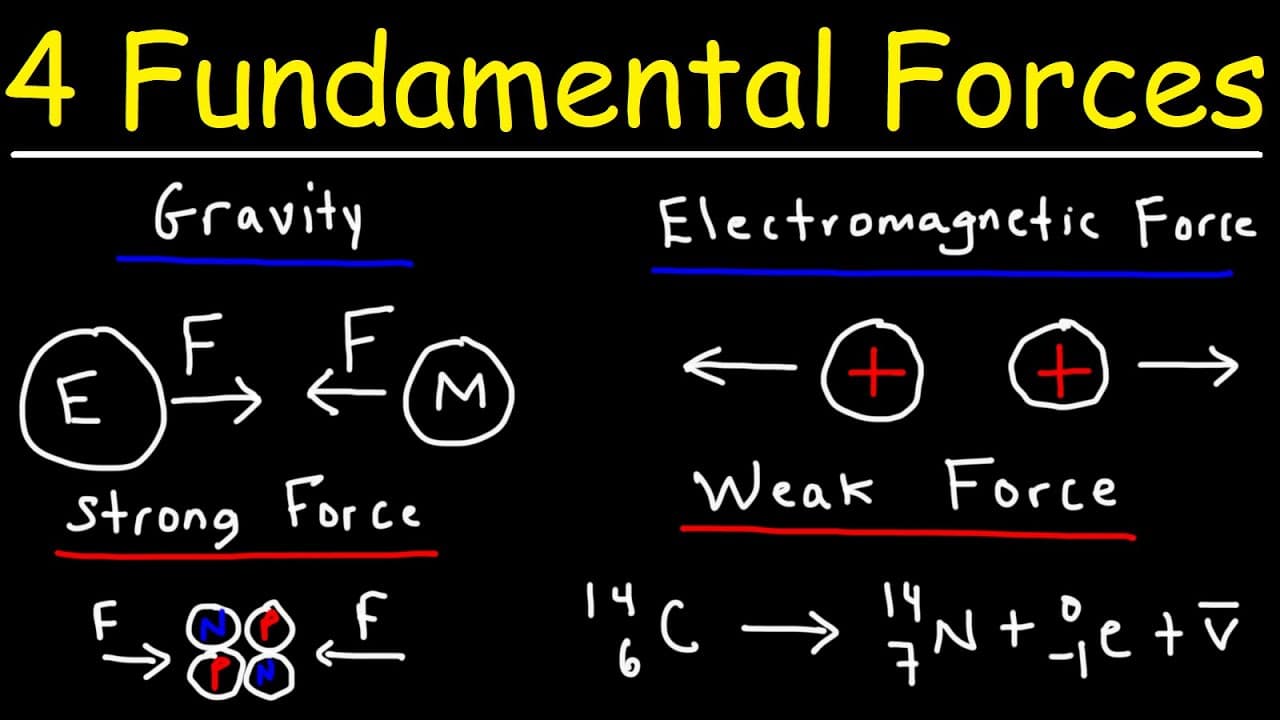
in this lesson we're going to talk about the four fundamental forces that are found in nature the first one that we're going to talk about is gravity or the gravitational force the gravitational force becomes important when you're dealing with very large objects think of planets like the Earth or think of the Sun or something as large as the Moon g... Read More
Key Insights
- 🧡 Gravity is a long-range force that attracts objects with mass.
- 🏑 The electromagnetic force involves both electric and magnetic forces, and moving charges can create their own fields.
- 💪 The strong nuclear force keeps the nucleus stable by overcoming the repulsion between protons.
- ☢️ The weak nuclear force is associated with radioactive decay and particle transformations.
Install to Summarize YouTube Videos and Get Transcripts
Explore YouTube Video Summarizer or Get YouTube Transcript Extractor
Questions & Answers
Q: What is the gravitational force?
The gravitational force is a force of attraction that acts between objects with mass, such as planets and stars. It can be calculated using the equation G * M1 * M2 / r squared, where G is the gravitational constant, M1 and M2 are the masses of the objects, and r is the distance between them.
Q: How does the electromagnetic force work?
The electromagnetic force includes electric and magnetic forces. Like charges repel each other, while opposite charges attract. Moving charges create magnetic fields, and moving magnets can create an electric force.
Q: What is the role of the strong nuclear force?
The strong nuclear force overcomes the electromagnetic force and keeps the positively charged protons in the nucleus of an atom together. It acts over short distances and prevents the nucleus from breaking apart.
Q: What is the weak nuclear force associated with?
The weak nuclear force is associated with radioactive decay. It is responsible for processes such as beta decay, where a nucleus emits a beta particle and transforms into a different element.
Summary & Key Takeaways
-
Gravity is a force that attracts objects together, especially noticeable on a large scale such as planets or the Sun.
-
The electromagnetic force can act over long distances and includes electric and magnetic forces.
-
The strong nuclear force keeps the nucleus of an atom stable by overcoming the repulsion between protons.
-
The weak nuclear force is associated with radioactive decay.
Read in Other Languages (beta)
Share This Summary 📚
Summarize YouTube Videos and Get Video Transcripts with 1-Click
Try YouTube Summary with ChatGPT & Claude or YouTube Transcript Generator
Explore More Summaries from The Organic Chemistry Tutor 📚




Summarize YouTube Videos and Get Video Transcripts with 1-Click
Try YouTube Summary with ChatGPT & Claude or YouTube Transcript Generator