War in Ukraine -- and What It Means for the World Order | Ian Bremmer | TED
TL;DR
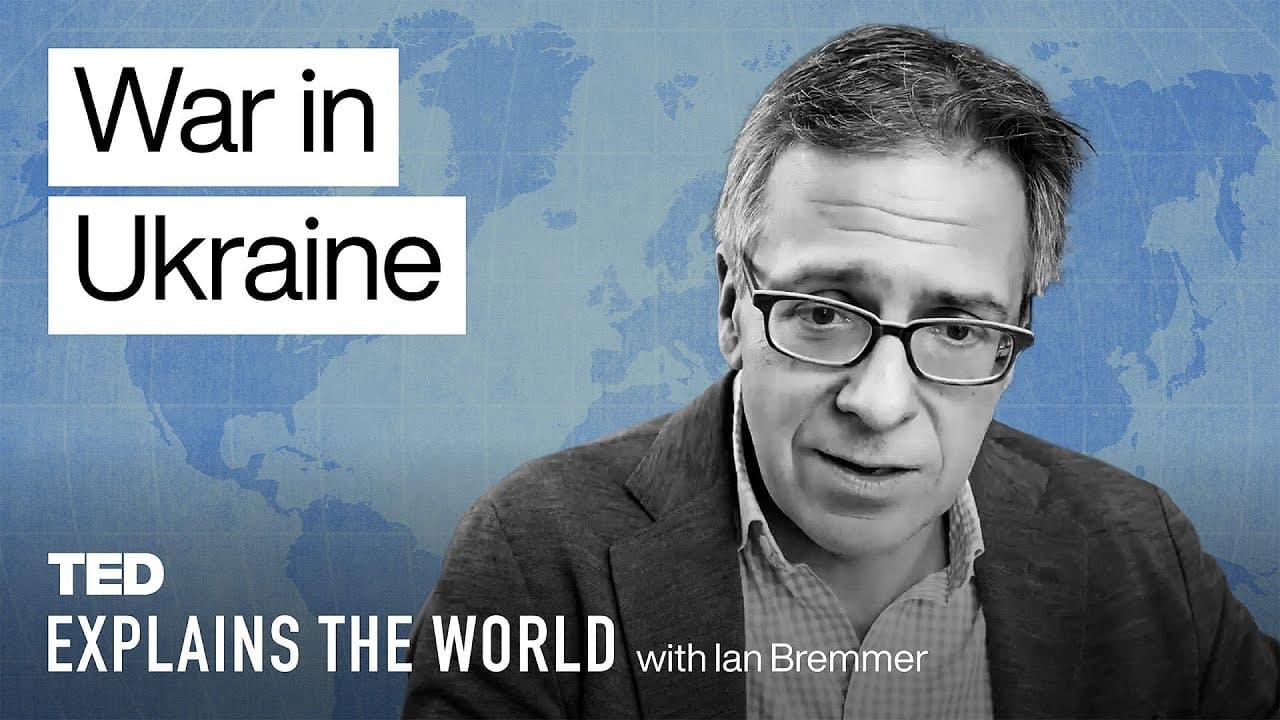
In this Membership conversation, geopolitical analyst Ian Bremmer discusses the Russian invasion of Ukraine, the impact on global geopolitics and economies, the potential for decoupling, and the risks of nuclear escalation.
Transcript
Bruno Giussani: It's difficult to think clearly of the Russian invasion of Ukraine, because wars, while they unfold, they're kind of shrouded in a sort of fog. Information is abundant: the millions of refugees, the shocking suffering and the destruction, the politics. But sense is lacking. And that's going to be the focus of this Membership convers... Read More
Key Insights
- 🌍 The war in Ukraine marks the end of the peace dividend that followed the fall of the Berlin Wall in 1989 and ushers in a new era of geopolitical shifts, with a focus on defense, security, and national interests.
- 🏛️ European countries, particularly Germany, are recognizing the need to prioritize defense spending and take a stronger stance on security issues. The war has led to a significant policy shift and a renewed purpose for NATO.
- 🌏 The decoupling between Europe and Russia, both politically and economically, is likely to be permanent. European countries are looking to diversify their energy sources, reduce dependence on Russia, and strengthen their national security capabilities.
- 🇷🇺 Russia's position in global security and European security is likely to be weakened as a result of the war. Putin will emerge from the conflict in a considerably weaker position both domestically and internationally.
- 🌐 The war in Ukraine has led to a realignment of the global geopolitical situation. China's strategic alignment with Russia has implications for long-term global dynamics. Other developing economies may also distance themselves from Russia.
- ⚖️ While there are significant challenges and potential negative consequences resulting from the war, there are also some silver linings. NATO and the European Union are gaining renewed purpose and cohesion. The United States is showing bipartisan unity in viewing Russia as a significant threat.
- 🚫 The war in Ukraine has the potential to escalate further and could lead to a nuclear confrontation. The risk of nuclear war is on the horizon and must be actively managed.
- 🌍 The war in Ukraine has ripple effects on food markets and food security. Rising food prices and supply chain challenges can lead to increased global inequality and pose a threat to the poorest countries.
- 🌿 The war in Ukraine may impact the transition to clean energy. While there may be an acceleration of clean energy adoption due to the need to reduce dependence on Russian fossil fuels, there is also a risk of derailing the transition due to a focus on energy security.
- 🤝 The global response to the crisis in Ukraine has varied. Some countries, such as India, have been cautious in taking a clear position, considering their existing relationships with Russia. Other regions, such as Africa and Latin America, may be indirectly affected by the war due to rising commodity prices and supply chain disruptions.
- 💼 The conflict may lead to a second-order decoupling, with increased fragmentation in the financial system and economic relationships. This could result in the formation of separate systems and barriers to cross-border transactions and trade.
- 🔒 The duration of sanctions and when they may be rolled back depends on the resolution of the conflict in Ukraine. Permanent sanctions are likely as long as Ukraine remains occupied, but the possibility of unwinding some sanctions may arise if a negotiated settlement is reached.
- 👑 President Zelenskyy of Ukraine has displayed great courage and leadership during the conflict. However, his actions leading up to the war have been criticized for exacerbating tensions and failing to effectively prepare Ukraine for a potential conflict.
Install to Summarize YouTube Videos and Get Transcripts
Explore YouTube Video Summarizer or Get YouTube Transcript Extractor
Questions & Answers
Q: What geopolitical shifts have already been brought by the war in Ukraine?
According to Ian Bremmer, the war in Ukraine signifies the end of the peace dividend and the prioritization of globalization. It has led to a shift in European focus towards defense policy and coordination, as well as a reduction in Europe's energy dependence on Russia.
Q: Is there still potential for a negotiated relationship between Russia and Ukraine?
Bremmer believes that the recent meeting between the foreign ministers of Russia and Ukraine is nowhere close to a negotiated settlement. He suggests that there is currently no plausible scenario for a peaceful resolution in the foreseeable future.
Q: How can Western countries support Ukraine militarily, economically, and in terms of intelligence?
Bremmer states that Western countries are already providing support to Ukraine in terms of weapons, intelligence, and real-time information. However, he warns that such support may be seen as an act of war by Russia, leading to potential retaliation.
Q: Will the war in Ukraine accelerate or derail the transition to clean energy?
Bremmer highlights differing perspectives on the impact of the war on clean energy transition. While Europe is expected to accelerate decoupling from fossil fuels, the United States may prioritize energy security and fossil fuels. China, on the other hand, is likely to continue its net-zero target without strong short-term plans.
Q: How is China responding to the Ukrainian war, and what are the implications for global geopolitics?
Bremmer explains that China sees the war as an opportunity to strengthen its strategic alignment with Russia. Despite portraying neutrality publicly, the Chinese government openly supports Russia in the conflict. This aligns with China's long-term goal of economic and technological integration with Russia, influencing global geopolitics.
Q: What are the potential risks of a nuclear confrontation in the conflict?
Bremmer acknowledges the nuclear sabers being rattled by Putin, but believes that nuclear war is unlikely. However, the risk of nuclear confrontation has reemerged, and the conflict must be actively managed to prevent potential escalation.
Q: Will the conflict lead to fragmentation of the financial system, with separate systems for the West and East?
Bremmer suggests that while a complete fragmentation of the financial system is unlikely, there may be second-order decoupling as Russia becomes financially integrated with China. This could lead to longer-term strategic decoupling between the West, including the United States, Europe, and Japan, and China.
Q: How likely is it that Putin will face a challenge from inside Russia?
Bremmer states that while there is pressure on Putin domestically, it is very unlikely that he will face a significant challenge from within Russia for the time being. The Russian government has control over information and has arrested anti-war protesters. However, economic challenges and future developments could lead to increased pressure on Putin.
Q: Is there a potential off-ramp for Putin in the conflict?
Bremmer suggests that an off-ramp for Putin could be a negotiated settlement after Kyiv is taken and President Zelenskyy is removed. This could lead to a frozen conflict or ceasefire, which Putin could present as a win to his domestic audience. However, this would not indicate a resolution or end to the fighting in Ukraine.
Q: How long will the sanctions against Russia remain in place?
Bremmer believes that as long as Ukraine remains occupied by Russia, the sanctions are unlikely to be lifted. While some sanctions may be unwound in the event of a negotiated settlement, many are likely to remain, reflecting a new way of doing business and a shift in the global order.
Q: How do Africa and Latin America factor into the conversation around the Ukrainian war?
Bremmer explains that countries with significant commodities may benefit from the conflict due to higher prices. However, these regions are not likely to be forced to choose sides in the conflict and their involvement is expected to be limited.
Q: How can we determine when to roll back sanctions?
Bremmer suggests that as long as Ukraine remains occupied and Putin remains in power, it is unlikely that sanctions will be rolled back. The duration of the sanctions will depend on the progress of the conflict and any potential negotiated settlements.
Q: What are your thoughts on President Zelenskyy of Ukraine?
Bremmer has conflicting views on President Zelenskyy. While he praises Zelenskyy's courage and leadership during the conflict, he also criticizes his actions leading up to the war, which may have escalated the situation. Bremmer highlights Zelenskyy's resistance to advice from Western countries and his unwillingness to prepare Ukraine for potential conflict.
Summary & Key Takeaways
-
Wars are difficult to understand in real-time due to the abundance of information and lack of clarity. The focus should be on the broader context and geopolitical shifts brought by the war in Ukraine.
-
The war marks the end of the peace dividend that followed the fall of the Berlin Wall, signaling a shift away from globalization towards prioritizing defense and national security. Europe will prioritize spending on defense and reduce its energy dependence on Russia.
-
The war in Ukraine has global implications, including potential fragmentation of the financial system, a reevaluation of clean energy transitions, and risks of nuclear confrontation and humanitarian crises. The responses from India, Africa, and Latin America are complex and varied.
Read in Other Languages (beta)
Share This Summary 📚
Summarize YouTube Videos and Get Video Transcripts with 1-Click
Try YouTube Summary with ChatGPT & Claude or YouTube Transcript Generator
Explore More Summaries from TED 📚



Summarize YouTube Videos and Get Video Transcripts with 1-Click
Try YouTube Summary with ChatGPT & Claude or YouTube Transcript Generator