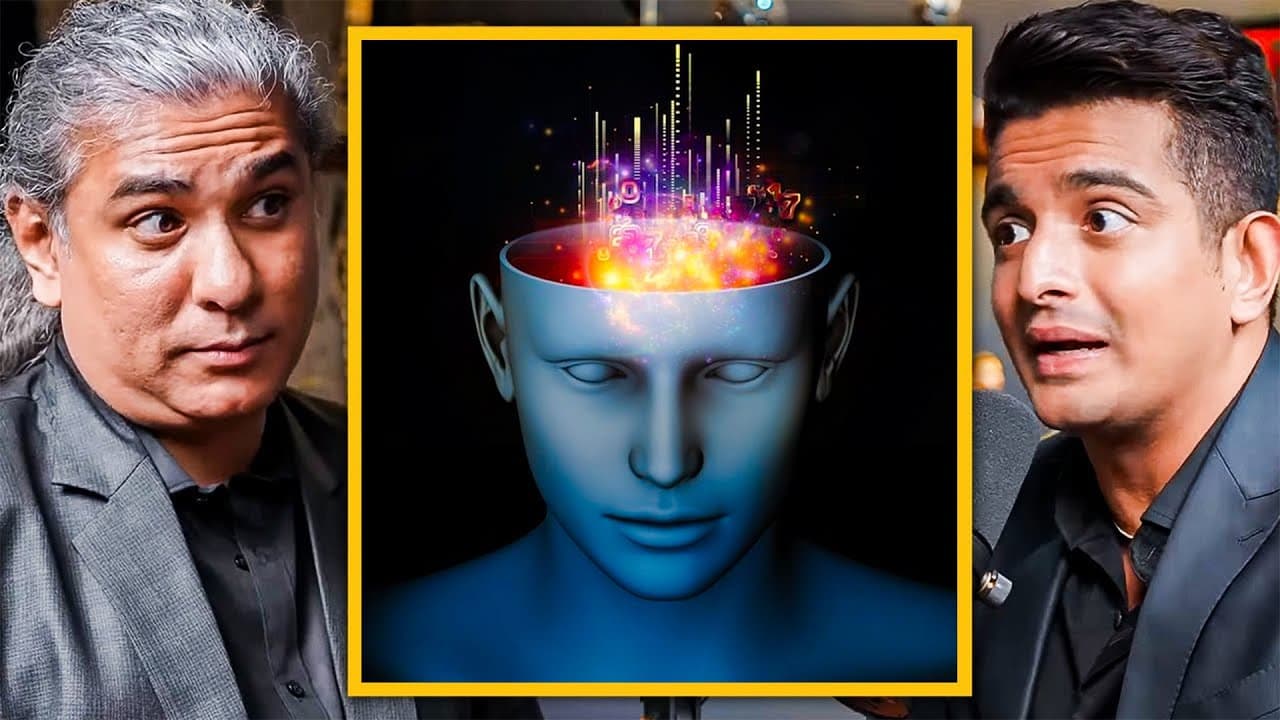
Greatest Mystery For Scientists - "Consciousness" Explained By Abhijit Chavda
TL;DR
The relationship between consciousness, quantum mechanics, and emerging properties remains deeply mysterious and unverified.
Transcript
welcome to TRS Clips where you'll find happiness through your own curiosity if thoughts and memories are analyzed from a biological perspective they're basically neural patterns in your brain and the brains of people who have been witnessed to those thoughts and memories quite possibly I mean uh Consciousness thoughts all that seem to be an emergen... Read More
Key Insights
- 🚨 Consciousness may emerge from vast networks of interconnected neurons, yet its exact nature remains undefined and challenging to study scientifically.
- 🦾 The exploration of consciousness intersects with quantum mechanics, where the behavior of particles could be influenced by conscious observation, posing philosophical questions about reality.
- 🤩 Current research in consciousness spans both biology and physics but lacks an empirical consensus or clear definition, highlighting a key area of ongoing inquiry.
- 🎁 Theories like panpsychism and cosmopsychism expand the discussion by suggesting that consciousness may not only exist within humans but is a universal trait present in varying degrees throughout all entities.
- ⌛ The complexities of consciousness and time are intertwined, representing two of the most significant enigmas in scientific exploration today.
- 🦾 Quantum mechanics reveals non-intuitive behaviors at microscopic levels, suggesting that our macroscopic experiences, including consciousness, arise from these foundational phenomena.
- 🦾 Advances in quantum technology showcase the practical applications of quantum mechanics, yet its implications for understanding consciousness remain largely philosophical at this stage.
Install to Summarize YouTube Videos and Get Transcripts
Explore YouTube Video Summarizer or Get YouTube Transcript Extractor
Questions & Answers
Q: What are neural patterns, and how do they relate to thoughts and memories?
Neural patterns are the specific connections and interactions among neurons in the brain that represent thoughts and memories. These patterns emerge from the complex architecture of the brain's trillions of neurons, which communicate through electrical and chemical signals. As these networks activate in different ways, they give rise to our conscious experiences, emotions, and behaviors. Each thought and memory can be seen as a distinct pattern formed by neural activity, showcasing the brain's remarkable ability to process and store information.
Q: Why is consciousness considered a big mystery in science?
Consciousness is often deemed a profound mystery because, despite advances in neuroscience and psychology, there is still no consensus on a clear definition of what it entails. Researchers can measure brain activity and identify regions associated with conscious experiences, yet the fundamental nature of consciousness—how subjective experiences arise from physical processes in the brain—remains elusive. Additionally, its connections to complex concepts like time further deepen the intrigue, as both consciousness and time represent significant gaps in our understanding of the universe.
Q: How does quantum mechanics potentially inform our understanding of consciousness?
Quantum mechanics deals with the behavior of particles at an atomic and subatomic level, where classical laws of physics do not apply. Some interpretations suggest that consciousness could influence the behavior of particles, particularly during wave function collapse, where an observation forces a particle into one state from multiple possibilities. This leads to intriguing questions about the role of consciousness in shaping reality, proposing that perhaps consciousness itself is a quantum phenomenon that interacts with the physical world in profound, yet unquantified ways.
Q: What are some philosophical theories regarding consciousness mentioned in the content?
The content discusses several philosophical perspectives, including panpsychism, which posits that all matter possesses some degree of consciousness, and cosmopsychism, which suggests that the entire universe may be a conscious entity. These theories challenge the traditional reductionist approach by proposing that consciousness is not limited to human experience but is a fundamental aspect of all existence. However, these ideas remain largely speculative due to the lack of empirical evidence, raising questions about our understanding of consciousness in relation to the universe at large.
Summary & Key Takeaways
-
The content discusses how consciousness might arise from the complex interactions of trillions of interconnected neurons, presenting thoughts and memories as neural patterns.
-
It highlights the ongoing debates in both biology and physics regarding the definition of consciousness and how quantum mechanics may relate to it, particularly through interpretations like wave function collapse.
-
The discussion introduces philosophical theories such as panpsychism and cosmopsychism, suggesting different levels of consciousness across the universe, yet acknowledges the lack of scientific proof for these ideas.
Read in Other Languages (beta)
Share This Summary 📚
Summarize YouTube Videos and Get Video Transcripts with 1-Click
Try YouTube Summary with ChatGPT & Claude or YouTube Transcript Generator
Explore More Summaries from TRS Clips 📚





Summarize YouTube Videos and Get Video Transcripts with 1-Click
Try YouTube Summary with ChatGPT & Claude or YouTube Transcript Generator