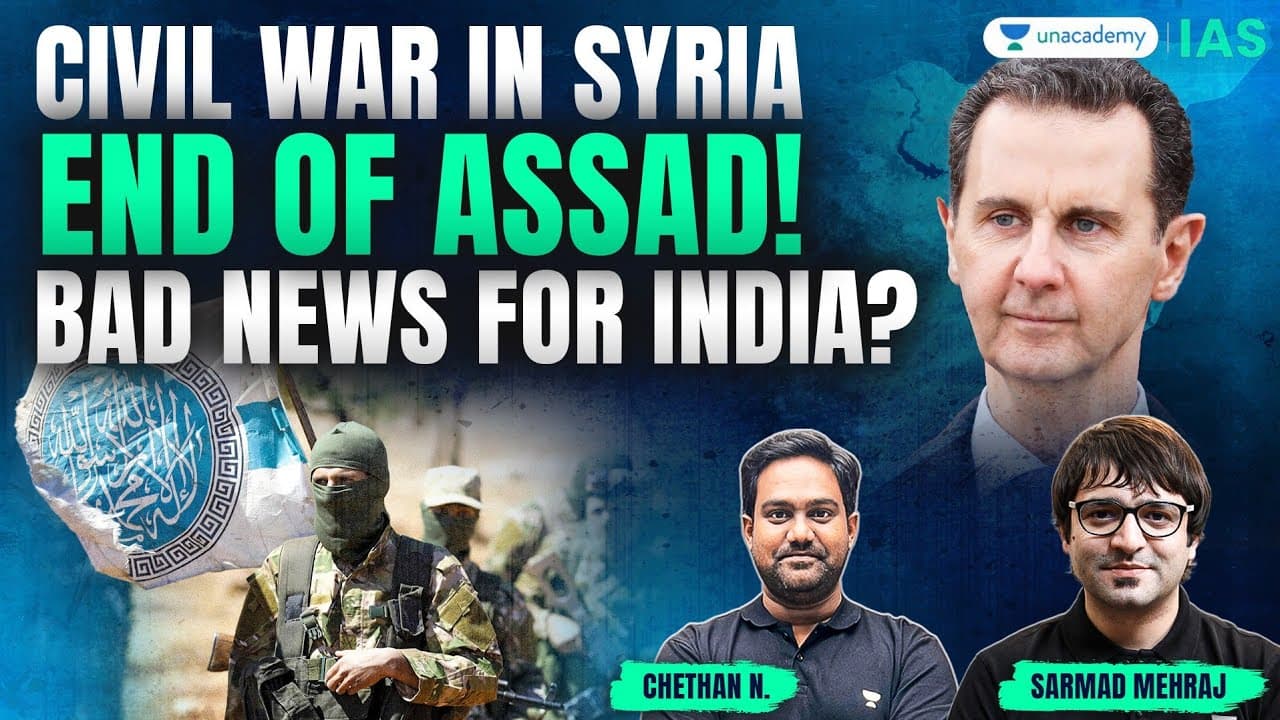
Who’s Destroying SYRIA? Will Bashar al-Assad Survive? | By Sarmad Mehraj & Chethan N | UPSC
TL;DR
The Syrian conflict involves regional and global powers, affecting Assad's control.
Transcript
hello and welcome to an academy a One-Stop destination for the English medium civil services aspirants there is a crisis in Syria president Bashar al-assad may lose control over his territory what is happening in Syria what are the origins of this conflict what is the role of the regional players such as Iran turkey what is the role of Russia and t... Read More
Key Insights
- The Syrian conflict is deeply rooted in the Arab Spring of 2010, which sparked movements against autocratic regimes across the Middle East and North Africa.
- Bashar al-Assad's regime in Syria, despite being authoritarian, maintained stability until external forces began to exploit the Arab Spring for regime change.
- Regional powers like Iran, Turkey, and Saudi Arabia, along with global powers such as the US and Russia, have significant stakes in the Syrian conflict.
- Russia's military intervention in 2015 was crucial in sustaining Assad's regime, countering the influence of Western-backed rebel groups.
- The rise of extremist groups like ISIS and HTS in Syria has further complicated the conflict, with these groups seizing territories and threatening regional stability.
- The conflict has led to a massive humanitarian crisis, with millions of refugees and internally displaced people, impacting neighboring countries like Turkey and Jordan.
- The geopolitical dynamics in Syria are influenced by the broader Shia-Sunni rivalry, with Iran and Saudi Arabia backing opposing sides.
- India's interests in the region are linked to energy security and the safety of its diaspora, making the stability of the Middle East crucial for its foreign policy.
Install to Summarize YouTube Videos and Get Transcripts
Explore YouTube Video Summarizer or Get YouTube Transcript Extractor
Questions & Answers
Q: What are the origins of the Syrian conflict?
The Syrian conflict traces back to the Arab Spring in 2010, which triggered pro-democracy movements across the Middle East and North Africa. Initially, it was an organic movement against autocratic regimes, but soon regional and global powers began to exploit these uprisings for their strategic interests, leading to a prolonged conflict in Syria.
Q: How has Russia influenced the Syrian conflict?
Russia's influence in the Syrian conflict has been pivotal, particularly since its military intervention in 2015. This intervention helped sustain Assad's regime by providing crucial military support against Western-backed rebels and extremist groups. Russia's strategic interests in Syria include maintaining its military and naval bases, which are vital for its presence in the Mediterranean.
Q: What role do extremist groups play in the Syrian conflict?
Extremist groups like ISIS and HTS have significantly impacted the Syrian conflict by seizing territories and challenging Assad's regime. These groups have exploited the chaos to expand their influence, posing a threat to regional stability. Their presence has further complicated the conflict, attracting international attention and intervention.
Q: How does the Syrian conflict affect regional power dynamics?
The Syrian conflict affects regional power dynamics by intensifying the Shia-Sunni rivalry, with Iran and Saudi Arabia supporting opposing sides. Turkey's involvement further complicates the situation as it seeks to assert its regional influence. The conflict also impacts neighboring countries like Jordan and Lebanon, which face refugee influxes and security challenges.
Q: What are the humanitarian impacts of the Syrian conflict?
The Syrian conflict has led to a severe humanitarian crisis, with millions of refugees and internally displaced people. Neighboring countries, particularly Turkey, bear the brunt of this crisis, hosting large refugee populations. The conflict has devastated infrastructure, leading to shortages of basic necessities and exacerbating the suffering of civilians.
Q: Why is the stability of the Middle East crucial for India?
The stability of the Middle East is crucial for India due to its energy security, as the region is a significant source of oil imports. Additionally, India has a large diaspora in the Middle East, whose safety and well-being are paramount. Any destabilization could disrupt energy supplies and pose challenges for Indian foreign policy.
Q: What strategic interests does the US have in the Syrian conflict?
The US has strategic interests in the Syrian conflict, primarily aimed at countering Russian and Iranian influence in the region. The US has supported rebel factions to challenge Assad's regime and maintain its geopolitical influence. Additionally, the US is concerned about the rise of extremist groups, which pose a global security threat.
Q: How might the Syrian conflict evolve in the future?
The future of the Syrian conflict remains uncertain, with potential for further escalation or a shift towards diplomacy. The involvement of global powers like the US and Russia, along with regional players, will continue to shape the conflict's trajectory. The humanitarian situation remains dire, and any resolution will require addressing the needs of millions of displaced people.
Summary & Key Takeaways
-
The Syrian conflict, originating from the Arab Spring, has evolved into a complex geopolitical struggle involving regional and global powers. Assad's regime, backed by Russia and Iran, faces threats from Western-backed rebels and extremist groups like HTS.
-
Russia's intervention in 2015 was pivotal in Assad's survival, countering Western efforts for regime change. The conflict has resulted in a humanitarian crisis, with millions displaced, affecting regional stability.
-
The involvement of the US, Russia, Iran, and Turkey highlights the global stakes in Syria, with implications for regional power dynamics and India's interests in energy security and diaspora safety.
Read in Other Languages (beta)
Share This Summary 📚
Summarize YouTube Videos and Get Video Transcripts with 1-Click
Try YouTube Summary with ChatGPT & Claude or YouTube Transcript Generator
Explore More Summaries from Unacademy IAS: English 📚




Summarize YouTube Videos and Get Video Transcripts with 1-Click
Try YouTube Summary with ChatGPT & Claude or YouTube Transcript Generator