Kathryn McKinley
TL;DR
Uncertainty in sensor readings and estimates from programs can be improved using a programming model called uncertainty, which combines domain knowledge and statistical semantics for more accurate results.
Transcript
who's this how fast is he go so fastest man on earth 24 miles per hour Jenova disses James born ho our intern he's faster how do I know my cell phone tells me that why does that happen because when we write a app that uses sensors right now we read two sensors wait five seconds compute the speed and we get trash alright and the reason we get trash ... Read More
Key Insights
- 🧑🏭 Inaccurate sensor readings and estimates are common due to factors like GPS errors and sensor quality.
- 🪜 Adding domain knowledge and context can improve the accuracy of estimates in programming.
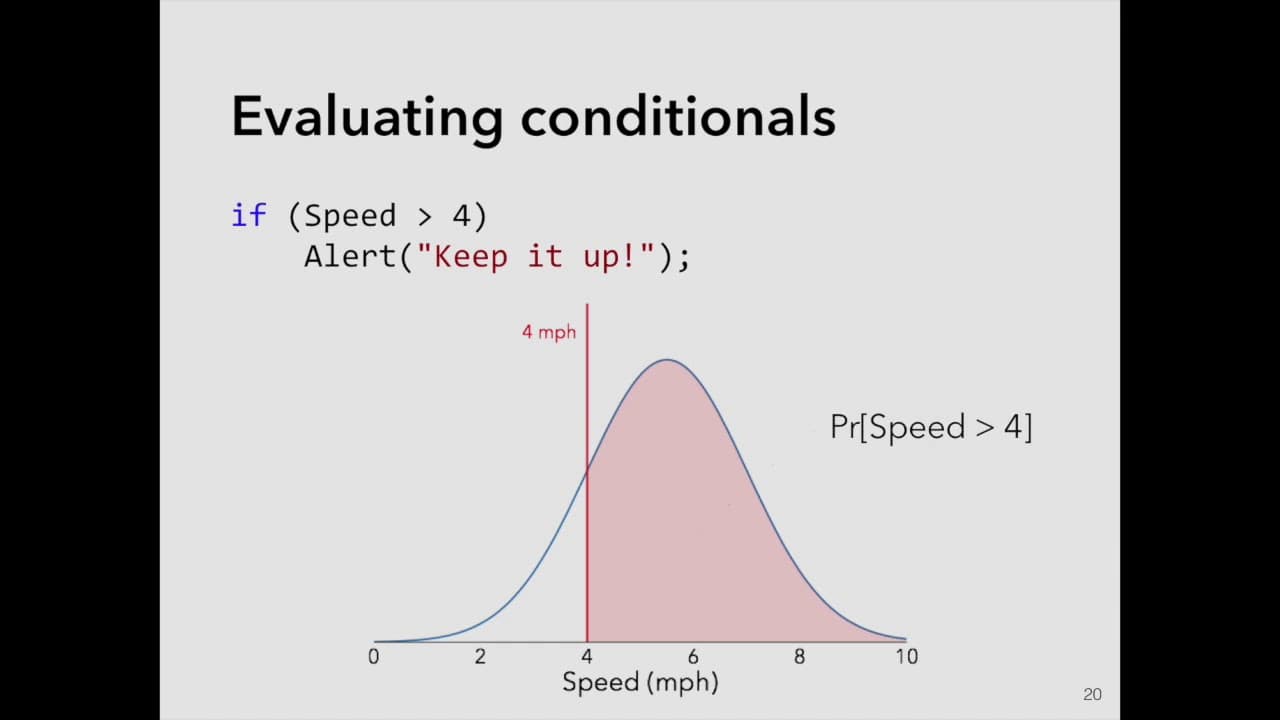
- 😑 The uncertainty programming model uses statistical semantics and hypothesis testing to evaluate expressions and reduce garbage data.
- 👻 The programming model allows control over false positives and negatives based on confidence levels.
- 🆘 Incorporating Bayesian reasoning and probability distributions helps enhance the accuracy of estimates.
- 💁 Contextual information and combining sensor data can improve accuracy and add value to estimates.
- 😒 Traditional assertions are insufficient for probabilistic programs, necessitating the use of probabilistic assertions.
Install to Summarize YouTube Videos and Get Transcripts
Explore YouTube Video Summarizer or Get YouTube Transcript Extractor
Questions & Answers
Q: How do inaccuracies in sensor readings impact programming with estimates?
Sensor readings can vary in accuracy due to factors like GPS errors and sensor quality, leading to unreliable estimates in programs.
Q: How does the uncertainty programming model improve accuracy?
The uncertainty model incorporates statistical semantics and hypothesis testing to evaluate expressions and reduce garbage data, resulting in more accurate estimates.
Q: What is the role of domain knowledge in programming with estimates?
Domain knowledge helps in developing error models for sensor data, improving the accuracy of estimates and reducing the impact of varying data quality.
Q: How can the uncertainty programming model be used to control false positives and negatives?
The model allows specifying confidence levels for conditional expressions, enabling control over false positives and negatives based on the desired level of confidence.
Summary & Key Takeaways
-
Sensor readings and estimates often vary in accuracy due to factors like sensor quality, GPS errors, and data communication issues.
-
Programming with estimates requires adding context and domain knowledge to improve accuracy.
-
Uncertainty programming model combines statistical semantics and hypothesis testing to evaluate expressions and deliver more accurate results.
Read in Other Languages (beta)
Share This Summary 📚
Summarize YouTube Videos and Get Video Transcripts with 1-Click
Try YouTube Summary with ChatGPT & Claude or YouTube Transcript Generator
Explore More Summaries from a16z 📚






Summarize YouTube Videos and Get Video Transcripts with 1-Click
Try YouTube Summary with ChatGPT & Claude or YouTube Transcript Generator