Using Mock Exams as an Opportunity to Model Thought Processes
TL;DR
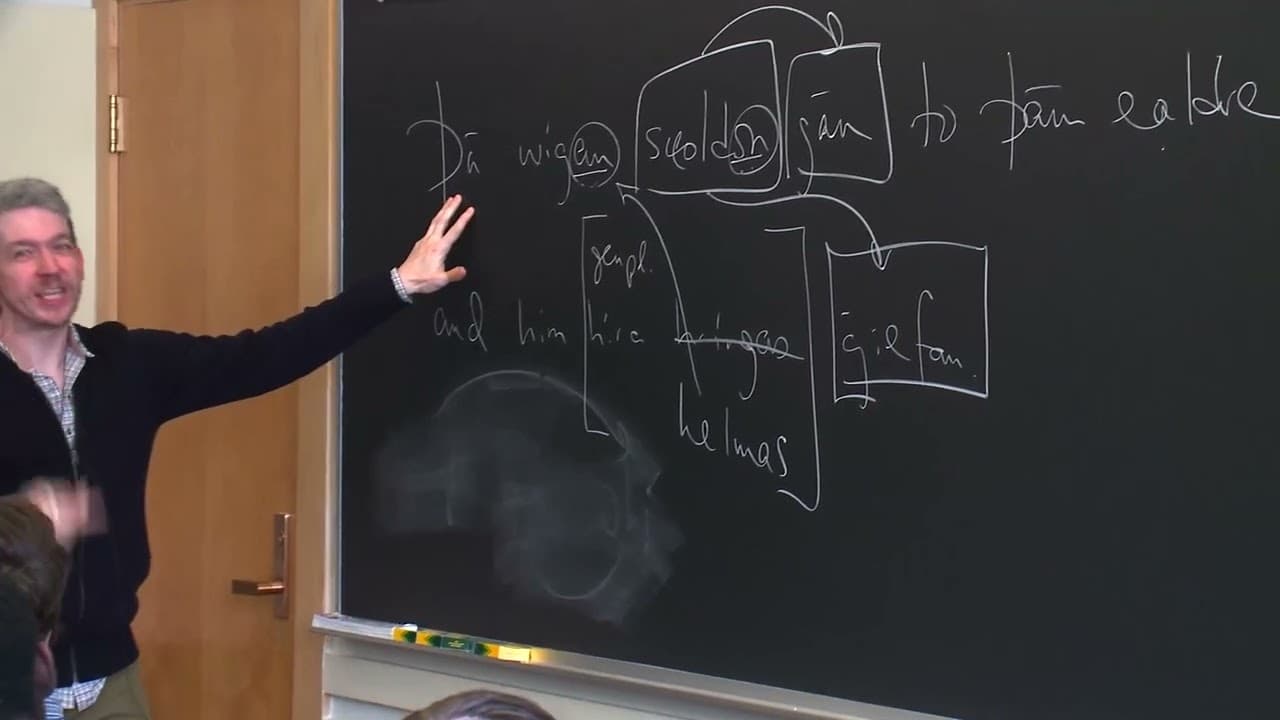
Students discuss the meaning of Old English verbs and analyze a sentence with multiple infinitives.
Transcript
ARTHUR BAHR: Who wants to take us through this one? Lambert? AUDIENCE: OK. So we can have the þā which I figured after doing all the readings, but probably "then." ARTHUR BAHR: OK, yeah. AUDIENCE: When I first tried this without looking up anything, I vaguely remembered wigan being weak, a weak masculine noun, I think. And I saw the -on at the end ... Read More
Key Insights
- 🍝 Understanding the past tense of preterite present verbs is essential in analyzing Old English sentences.
- ❤️🩹 The plural ending -on helps disambiguate verbs with an -an ending.
- 🔂 Infinitives can be governed by a single conjugated verb.
- 🥶 Metaphorical interpretations add depth to the analysis of Old English sentences.
- 😋 The relationship between warriors and lords often involved the exchange of rings and protection.
- 🫠 Reading actively for sentence meaning and metaphorical possibilities is valuable in studying Old English.
- 😑 Old English sentence structures can be compared to modern English idiomatic expressions.
Install to Summarize YouTube Videos and Get Transcripts
Explore YouTube Video Summarizer or Get YouTube Transcript Extractor
Questions & Answers
Q: What is the significance of the plural ending -on in Old English verbs?
The plural ending -on helps disambiguate the often ambiguous -an ending and indicates the past tense of the preterite present verbs.
Q: How do multiple infinitives relate to a conjugated verb?
In Old English, a single conjugated verb can govern multiple infinitives, similar to modern English constructions. In the discussed sentence, "had to" governs the infinitives "go" and "give."
Q: Is it common for warriors to give their helmets (or protection) to the lord after a battle?
While it is more likely for lords to give rings to warriors as a gesture of reward, a metaphorical interpretation of the sentence suggests that warriors could give their protection to the lord as a pledge of fealty.
Q: Can the word "helmas" be interpreted metaphorically as protection?
Yes, a metaphorical interpretation of "helmas" as protection is valid, suggesting that warriors pledge their protection to the lord.
Summary & Key Takeaways
-
Students analyze an Old English sentence and identify the meaning and grammatical structure of the verbs.
-
The discussion focuses on the past tense of the preterite present verbs and their plural endings.
-
The possibility of a metaphorical interpretation of the sentence is raised, where warriors give their protection to the lord.
Read in Other Languages (beta)
Share This Summary 📚
Summarize YouTube Videos and Get Video Transcripts with 1-Click
Try YouTube Summary with ChatGPT & Claude or YouTube Transcript Generator
Explore More Summaries from MIT OpenCourseWare 📚



Summarize YouTube Videos and Get Video Transcripts with 1-Click
Try YouTube Summary with ChatGPT & Claude or YouTube Transcript Generator