1.3 Random Vectors - The Nature of Code
TL;DR
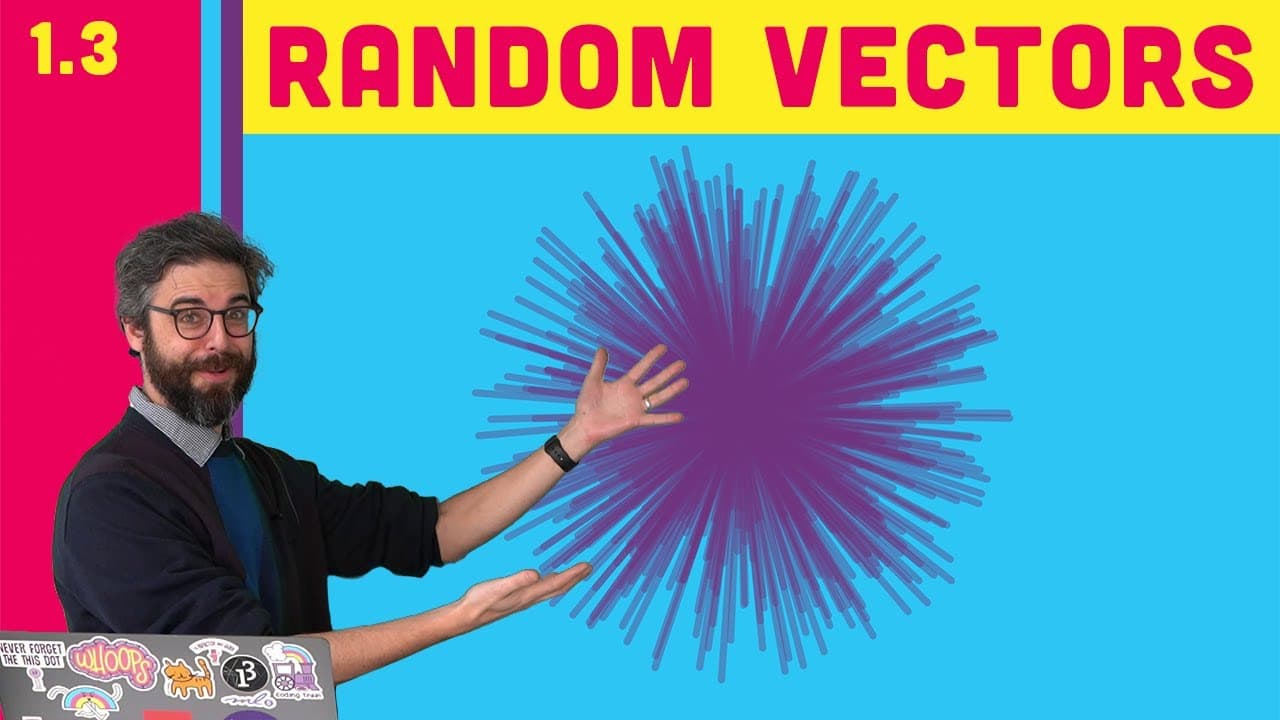
Learn about generating random vectors and unit vectors in p5.js for visual demonstrations and mathematical manipulations.
Transcript
Hello. So this is another video on working with vectors in p5.js. And in this video, I really just want to talk about what it means to make random vector, which seems like, why is there even a whole video about that? But I have a point to this, which I will get to. It also is, I think, useful, because it's kind of opening up this can of worms, this... Read More
Key Insights
- ❓ Random vectors can be visually generated in p5.js using functions like random 2D, providing flexibility for creating dynamic visualizations.
- 💨 Unit vectors, with a length of 1, are valuable for representing specific directions in vector mathematics, offering a simplified way to handle directional information.
- 👻 The multiply function in p5.js enables scaling vectors by scalar quantities, allowing for adjustments in vector magnitudes while maintaining their original directions.
- 🅰️ Understanding the concept of static functions in p5.js can provide insights into how functions operate on specific instances versus types of objects.
Install to Summarize YouTube Videos and Get Transcripts
Explore YouTube Video Summarizer or Get YouTube Transcript Extractor
Questions & Answers
Q: How can random vectors be generated in p5.js?
Random vectors in p5.js can be generated using functions like random 2D to produce vectors with random directions and unit lengths for visual demonstrations and mathematical operations.
Q: What is the significance of translating the coordinate space to the center of the canvas?
Translating the coordinate space to the center of the canvas in p5.js allows for visual demonstrations where 0, 0 represents the center, simplifying vector operations and visualizations.
Q: How can vectors be scaled in p5.js?
Vectors in p5.js can be scaled using the multiply function, which allows for multiplying vectors by scalar quantities to adjust their magnitudes while preserving their directions for various visualizations.
Q: What is the role of unit vectors in vector mathematics?
Unit vectors are vectors with a length of 1, representing only the direction without considering magnitude, making them useful for specific operations where direction is crucial, such as in trigonometry calculations.
Summary & Key Takeaways
-
The video delves into the concept of random vectors and unit vectors, showcasing how to generate vectors with random directions and fixed magnitudes in p5.js.
-
By using functions like random 2D and multiply in p5.js, the presenter demonstrates the flexibility of working with vectors for various visualizations and manipulations.
-
The video hints at upcoming topics like static functions, acceleration, magnitude, and normalization in relation to vector operations.
Read in Other Languages (beta)
Share This Summary 📚
Summarize YouTube Videos and Get Video Transcripts with 1-Click
Try YouTube Summary with ChatGPT & Claude or YouTube Transcript Generator
Explore More Summaries from The Coding Train 📚

Summarize YouTube Videos and Get Video Transcripts with 1-Click
Try YouTube Summary with ChatGPT & Claude or YouTube Transcript Generator