What Are Weak Interactions and Feynman Rules?
TL;DR
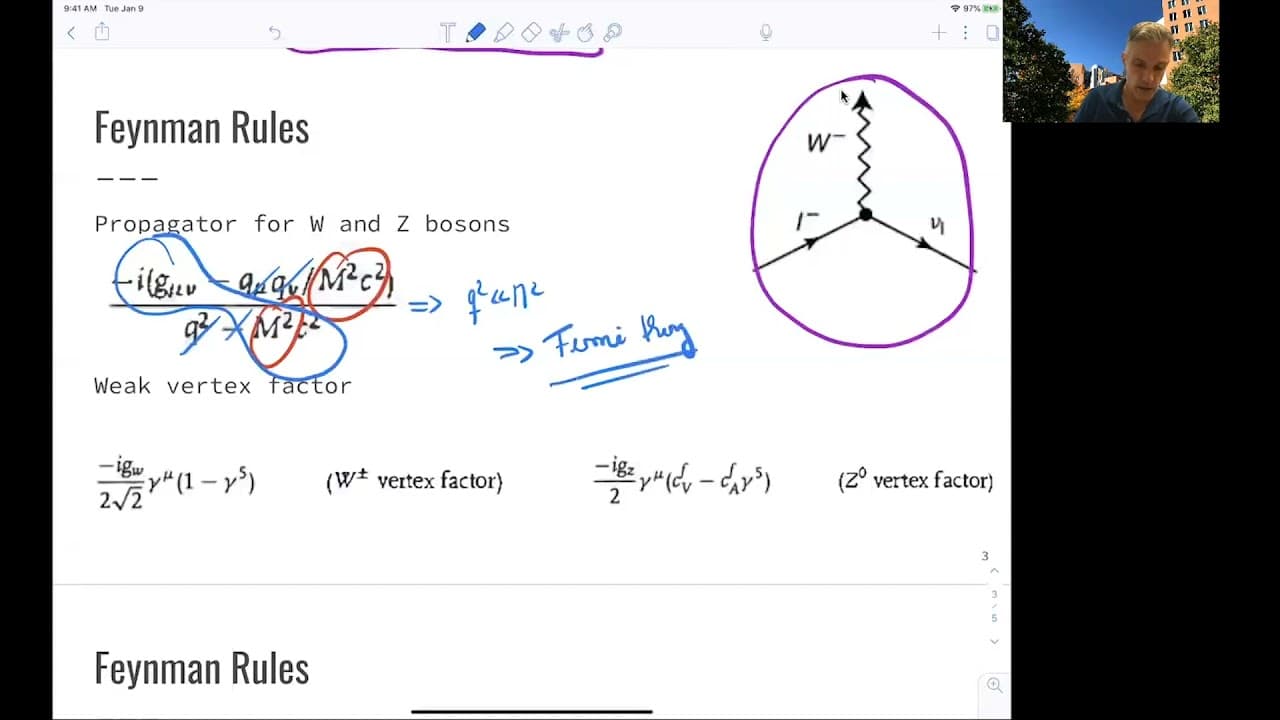
Weak interactions are a fundamental aspect of particle physics, represented by W and Z bosons that couple with all elementary particles. The Feynman Rules help calculate decay and scattering processes involving these particles, highlighting the complexities of their interactions, especially compared to quantum electrodynamics and quantum chromodynamics.
Transcript
[SQUEAKING] [RUSTLING] [CLICKING] MARKUS KLUTE: Welcome back to 8.701. So in this lecture, we open a new chapter of weak interaction. So we are one by one adding together the components we need in order to describe all elementary particles and their interactions. And I'll be adding the third form of interaction. After the QED and QCD, we enter into... Read More
Key Insights
- 💁 Weak interaction is the third form of interaction in particle physics, after QED and QCD.
- 🤪 The W and Z bosons couple to all elementary particles, and their vertex factors are more complicated than those in QED and QCD.
- 💨 Feynman Rules provide a systematic way of calculating processes in particle physics.
- 🥳 The weak interaction is a result of mixing between the weak and electrically charged parts of particles.
- 😐 Neutrinos have simpler vertex factors due to being electrically neutral.
Install to Summarize YouTube Videos and Get Transcripts
Explore YouTube Video Summarizer or Get YouTube Transcript Extractor
Questions & Answers
Q: What is weak interaction in particle physics?
Weak interaction is one of the four fundamental forces and is responsible for processes like beta decay and neutrino interactions. It is weaker compared to electromagnetic and strong interactions.
Q: How do the W and Z bosons couple to fermions?
The W and Z bosons couple to all elementary particles, including fermions. They have different vertex factors, which depend on the fermion's charge and specific constants associated with each fermion.
Q: What are Feynman Rules used for in particle physics?
Feynman Rules provide a recipe for calculating decays and scattering processes in particle physics. They involve analyzing vertices and propagators of particles involved in the process.
Q: What is the significance of the neutrino's factor of 1/2 in the vertex factor?
The neutrino, being electrically neutral, has a simpler vertex factor compared to electrically charged particles. This is because the weak interaction is a mixture of the weak part and the electrically charged part of the particle.
Summary & Key Takeaways
-
The video discusses the third form of interaction in particle physics, known as weak interaction, following QED and QCD.
-
It introduces the W and Z bosons, which couple to all elementary particles, and explores their coupling to each other.
-
The video explains the Feynman Rules, which are used to calculate decays and scattering processes in particle physics.
Read in Other Languages (beta)
Share This Summary 📚
Summarize YouTube Videos and Get Video Transcripts with 1-Click
Try YouTube Summary with ChatGPT & Claude or YouTube Transcript Generator
Explore More Summaries from MIT OpenCourseWare 📚


Summarize YouTube Videos and Get Video Transcripts with 1-Click
Try YouTube Summary with ChatGPT & Claude or YouTube Transcript Generator