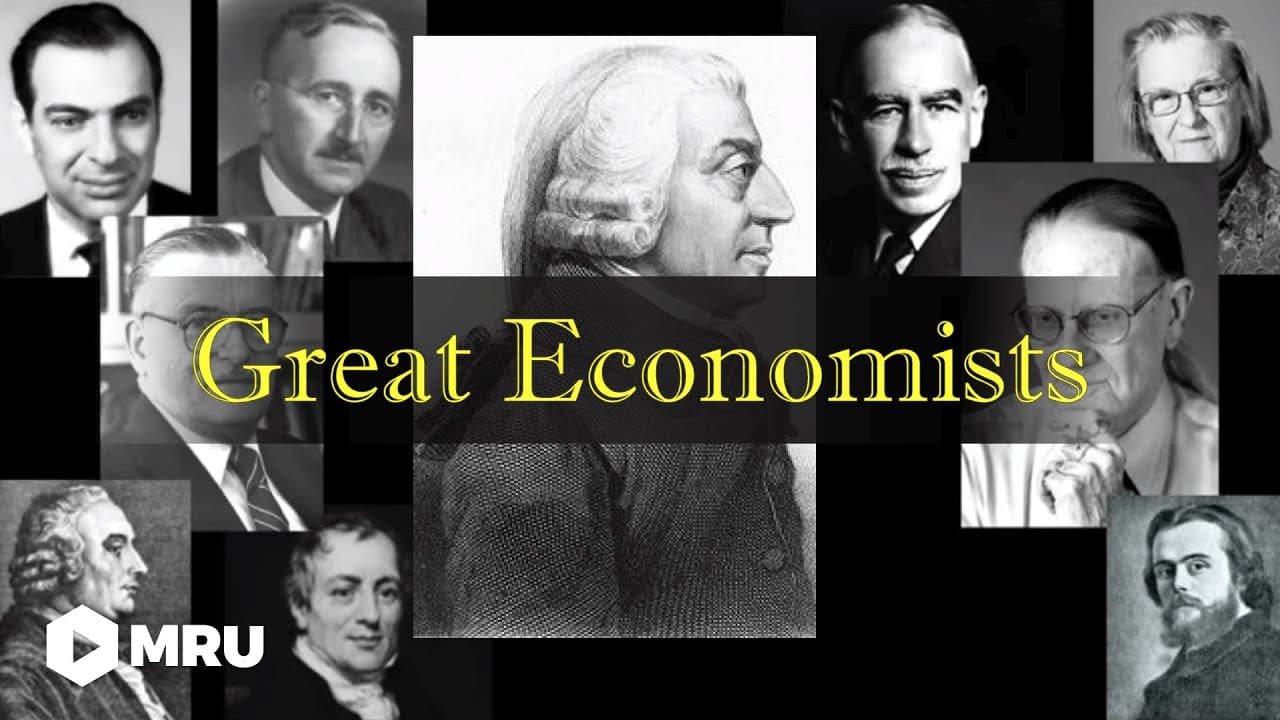
Adam Smith, Book 5, Ch. 1, pt. 3, Public Works
TL;DR
Smith supports infrastructure but warns against excessive tolls.
Transcript
we now turn to part 3 of book 5 chapter 1 which is on public works the nested titles here are a little complicated but we have chapter one called of the expenses of the sovereign or Commonwealth part three called of the expense of Public Works and public institutions and within that part 3 we are considering article one which is called of the Publi... Read More
Key Insights
- Adam Smith emphasizes the importance of public works like roads, bridges, canals, and harbors for facilitating commerce and trade.
- Smith advocates for financing public works through tolls, considering them equitable and consistent with local control, but warns against high tolls that could stifle commerce.
- He argues for local or provincial maintenance of public works, citing greater accountability despite potential local corruption.
- Smith supports temporary monopolies for joint stock trading companies, like the East India Company, to encourage innovation and open trade channels.
- He warns that permanent monopolies can lead to higher consumer prices and restrict business opportunities.
- Smith favors joint stock companies for ventures like canals, as they are too costly and risky for private individuals.
- The debate continues on Smith's stance on laissez-faire economics, with this section showing his preference for minimizing national government involvement.
- Smith's ideas are explored in further readings, including works by E.G. West and Jacob Viner, available on JSTOR.
Install to Summarize YouTube Videos and Get Transcripts
Explore YouTube Video Summarizer or Get YouTube Transcript Extractor
Questions & Answers
Q: What does Adam Smith consider important for facilitating commerce?
Adam Smith considers public works, such as roads, bridges, canals, and harbors, as crucial for facilitating commerce. He believes these infrastructures extend the realm of trade and commerce, allowing for more efficient movement of goods and services. Smith sees them as essential components for economic growth and development.
Q: How does Smith propose financing public works, and what caution does he offer?
Smith proposes financing public works through tolls, which he sees as an equitable method consistent with local control. However, he cautions against setting tolls too high, as this could choke off commerce, reduce the value of public works, and stunt economic growth. He advocates for modest tolls to avoid these negative outcomes.
Q: What is Smith's stance on the maintenance of public works?
Smith believes that public works should be maintained at the local or provincial level rather than the national level. He acknowledges the potential for local corruption but argues that local management offers greater accountability. Smith's preference for local control reflects his belief in more direct oversight and responsibility in maintaining infrastructure.
Q: Why does Smith support temporary monopolies for joint stock trading companies?
Smith supports temporary monopolies for joint stock trading companies to encourage innovation and open new trade channels. He likens these temporary monopolies to patents, offering initial rewards to innovators. Smith believes that such incentives benefit society by facilitating trade and economic development, but he stresses that these monopolies should remain temporary.
Q: What concerns does Smith have about permanent monopolies?
Smith is concerned that permanent monopolies can lead to higher prices for consumers by restricting free trade. He warns that they can stifle business opportunities and economic growth by preventing other traders from entering the market. Smith advocates for temporary monopolies to avoid these negative effects and promote competition.
Q: Why does Smith favor joint stock companies for ventures like canals?
Smith favors joint stock companies for ventures like canals because he views them as too costly and risky for private individuals to undertake alone. He believes that joint stock companies, supported by government grants, provide a suitable structure for managing these large-scale infrastructure projects, distributing risk among multiple investors.
Q: How does this section reflect Smith's views on laissez-faire economics?
This section reflects Smith's nuanced view on laissez-faire economics, as he advocates for minimizing national government involvement in public works. Instead, he emphasizes local control and private enterprise, suggesting a competitive and commercial approach to infrastructure. Smith's ideas show a balance between government oversight and market-driven solutions.
Q: What further readings are suggested to explore Smith's ideas on public works?
To explore Smith's ideas on public works further, readers are encouraged to consult E.G. West's article 'Adam Smith's Public Economics' and Jacob Viner's piece 'Adam Smith and Laissez-faire.' Both works are available on JSTOR. Additionally, researching the history of the British canal system and turnpikes can provide more context on the topic.
Summary & Key Takeaways
-
Adam Smith discusses the role of public works in facilitating commerce, such as roads, bridges, and canals. He supports financing these through tolls but cautions against high tolls that could impede economic growth. Smith prefers local management of public works for better accountability, despite the risk of local corruption.
-
Smith argues for temporary monopolies for joint stock trading companies to encourage innovation and trade. He warns against permanent monopolies, which could lead to higher prices and reduced business opportunities. He sees joint stock companies as suitable for costly ventures like canals.
-
Smith's views on public works show a nuanced approach to government involvement, favoring local control and private enterprise. His stance on laissez-faire economics is debated, but he appears to advocate for a competitive and commercial approach to infrastructure development.
Read in Other Languages (beta)
Share This Summary 📚
Summarize YouTube Videos and Get Video Transcripts with 1-Click
Try YouTube Summary with ChatGPT & Claude or YouTube Transcript Generator
Explore More Summaries from Marginal Revolution University 📚
Summarize YouTube Videos and Get Video Transcripts with 1-Click
Try YouTube Summary with ChatGPT & Claude or YouTube Transcript Generator