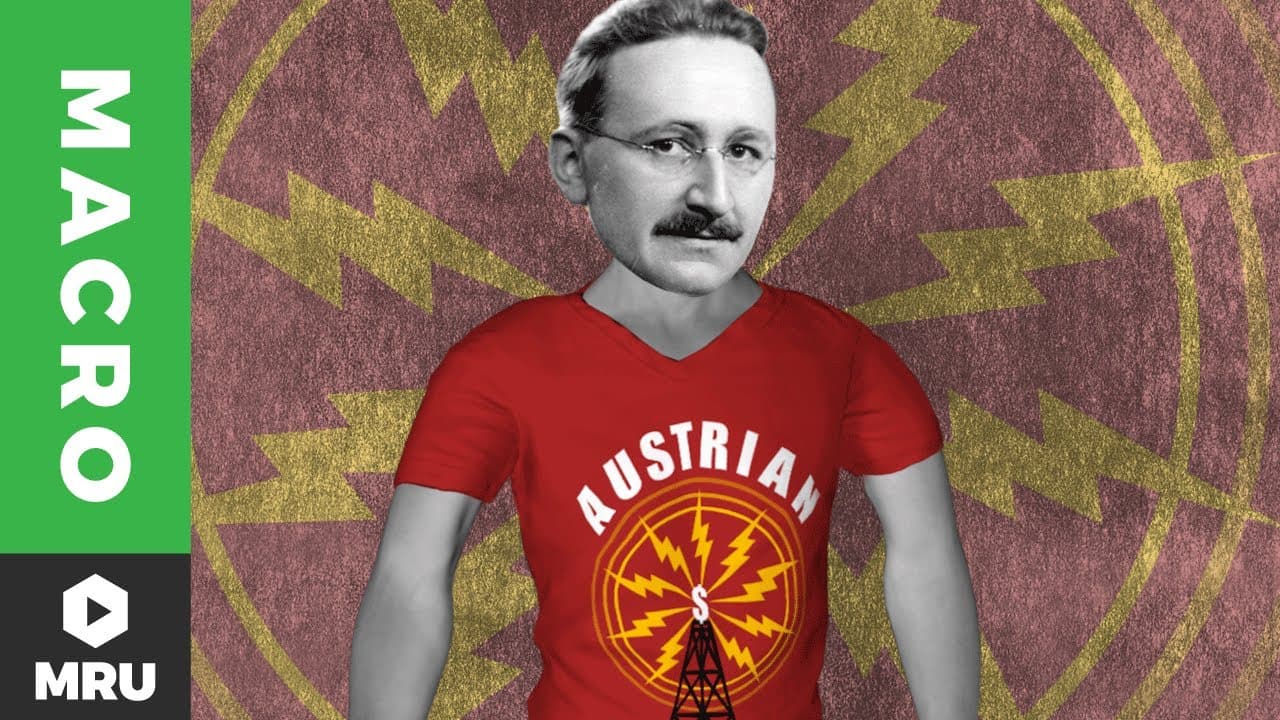
Game of Theories: The Austrians
TL;DR
Austrian theory links central bank actions to economic booms and busts.
Transcript
♪ [music] ♪ - [Tyler] The Austrian School of Economics has come up with its own approach to business cycles, and the most important proponents here are Ludwig Mises and Nobel Laureate Friedrich Hayek. Now, the Austrian School of Economics, more generally, it emphasizes market price signals and how those price signals communicate decentralized infor... Read More
Key Insights
- The Austrian School of Economics focuses on market price signals and their role in conveying decentralized information to entrepreneurs.
- Central banks, according to Austrians, can distort price signals leading to a cycle of economic boom and bust.
- Lowered interest rates by central banks can make unprofitable investments appear profitable, causing a misallocation of resources.
- The boom phase is characterized by increased investment in long-term projects that are not supported by actual consumer demand.
- Eventually, the market corrects itself, revealing the unsustainable nature of these investments, leading to a bust.
- Historical examples include the early 21st-century Federal Reserve policies and the eurozone's financial crisis, highlighting government intervention's role in distorting price signals.
- Austrian economists typically advocate for minimal government intervention and tighter monetary policies to prevent economic distortions.
- Critics of the Austrian theory point out its failure to explain why entrepreneurs are consistently misled by central banks and why economic downturns are so severe.
Install to Summarize YouTube Videos and Get Transcripts
Explore YouTube Video Summarizer or Get YouTube Transcript Extractor
Questions & Answers
Q: What is the main focus of the Austrian School of Economics?
The Austrian School of Economics primarily focuses on market price signals and their role in communicating decentralized information to entrepreneurs. Austrian economists emphasize how these signals can be distorted by central banks, leading to economic cycles of boom and bust. They argue that such distortions mislead entrepreneurs into making unprofitable investments.
Q: How do Austrian economists view central bank actions?
Austrian economists view central bank actions, such as lowering interest rates, as distortions of market signals. They argue that these actions make investments appear more profitable than they actually are, leading to a misallocation of resources. This results in an economic boom followed by a bust when the market corrects itself.
Q: What happens during the boom phase according to Austrian theory?
During the boom phase, central banks lower interest rates, making long-term investment projects appear profitable. This leads to increased investment in projects that are not supported by actual consumer demand. As a result, resources are misallocated, and the economy experiences a temporary expansion until the unsustainability of these investments becomes apparent.
Q: What examples do Austrian economists use to support their theory?
Austrian economists often cite the early 21st-century policies of the Federal Reserve and the eurozone's financial crisis as examples of government intervention distorting price signals. They argue that the Federal Reserve's easy credit policies led to a real estate bubble, while the eurozone crisis was exacerbated by investors' misplaced confidence in government guarantees.
Q: What is the Austrian solution to prevent economic distortions?
Austrian economists advocate for minimal government intervention and tighter monetary policies to prevent economic distortions. They believe that markets function efficiently without external interference, and that central banks should not attempt to stimulate the economy with more credit or lower interest rates, as these actions can lead to unsustainable booms.
Q: What are some criticisms of the Austrian theory?
Critics of the Austrian theory point out its failure to explain why entrepreneurs are consistently misled by central banks and why economic downturns are so severe. They argue that entrepreneurs should be aware of central bank manipulations and that Austrian theory may need to incorporate other economic ideas, such as sticky prices or falling aggregate demand, to fully explain downturns.
Q: How does actual economic data challenge Austrian predictions?
Actual economic data often shows co-movement of investment and consumption, which contradicts Austrian predictions. According to Austrian theory, investment and consumption should move in opposite directions during a boom. However, data indicates that both tend to increase together, challenging the accuracy of the Austrian model in explaining real-world economic cycles.
Q: Why do Austrian economists emphasize tight monetary policies?
Austrian economists emphasize tight monetary policies because they believe that loose monetary policies, such as lowering interest rates, distort market signals and lead to unsustainable economic booms. By maintaining tight monetary policies, they aim to prevent the misallocation of resources and avoid the subsequent economic bust that follows an artificial boom.
Summary & Key Takeaways
-
The Austrian School of Economics suggests that central banks can distort market signals, leading to economic booms and busts. By lowering interest rates, central banks make investments appear more profitable than they are, resulting in resource misallocation and eventual market correction.
-
Austrian economists argue for limited government intervention and tighter monetary policies, as they believe markets function efficiently without external interference. They cite historical examples like the Federal Reserve's early 21st-century policies and the eurozone crisis as evidence of government-induced economic distortions.
-
Critics of the Austrian theory highlight its inability to explain why entrepreneurs repeatedly fall for central bank manipulations and why economic downturns are so severe. Furthermore, actual data often shows co-movement of investment and consumption, contradicting Austrian predictions.
Read in Other Languages (beta)
Share This Summary 📚
Summarize YouTube Videos and Get Video Transcripts with 1-Click
Try YouTube Summary with ChatGPT & Claude or YouTube Transcript Generator
Explore More Summaries from Marginal Revolution University 📚

Summarize YouTube Videos and Get Video Transcripts with 1-Click
Try YouTube Summary with ChatGPT & Claude or YouTube Transcript Generator