Unit 8: Decision Analysis 3, Video 3: Constructing Trees
TL;DR
Decision analysis is effective for simple problems, but becomes messy for complicated problems. A simple example involving the decision of whether to take a raincoat is used to illustrate the calculation of expected value.
Transcript
[SQUEAKING] [RUSTLING] [CLICKING] RICHARD DE NEUFVILLE: Basically, something like 8, 10. 10 moves at the beginning with my pawns and my rooks, I would have 10 possible choices or 12 possible choices here. And then I could have what my opponent does, and a realistic problem can explode on you. So one of the issues here, again back to my emphasis at ... Read More
Key Insights
- ❓ Decision analysis is effective for simple problems but becomes messy for complicated problems.
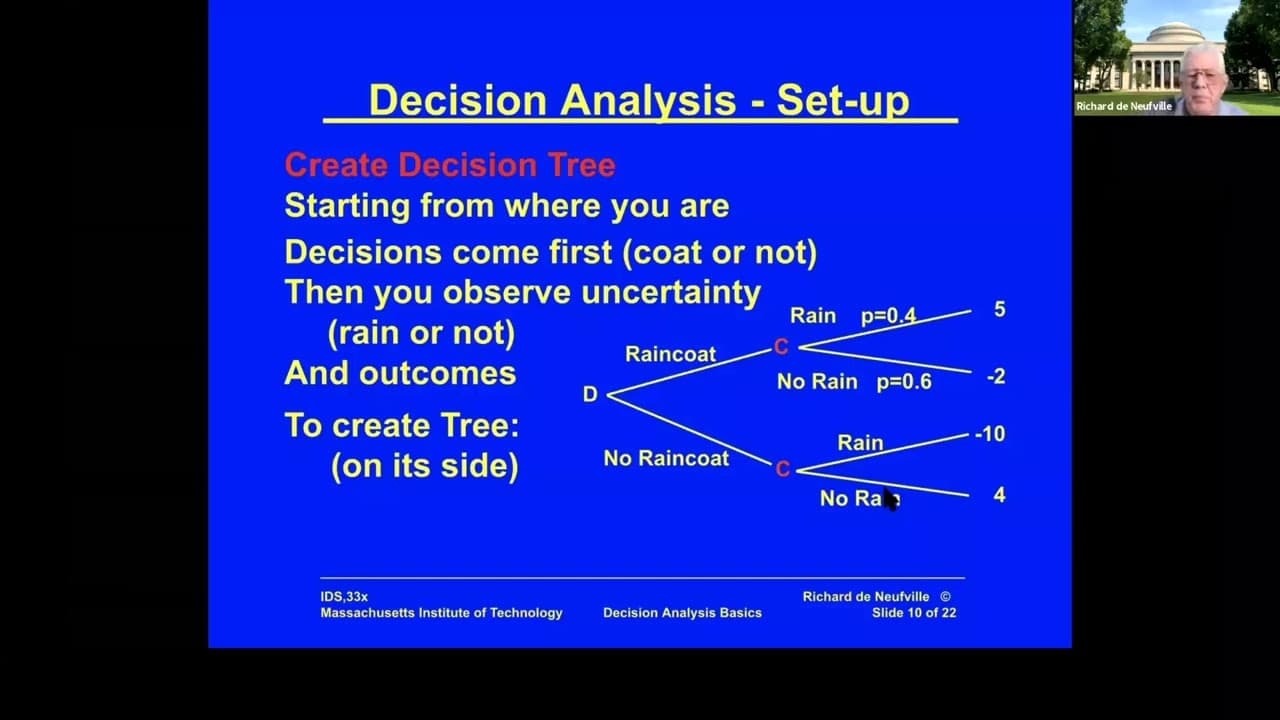
- 🌲 Decision trees are used to map out the choices and outcomes of a decision.
- 🍹 The expected value of a decision is calculated by multiplying the probabilities of each outcome by their respective values and summing them.
- 🆘 Expected value helps determine the optimal choice by comparing the average outcomes of different decisions.
- ❓ Decision analysis can be automated using programs or spreadsheets like Excel.
- 🌍 Real-world applications of decision analysis require more complex models that consider dependencies and uncertainties.
- 🆘 Simple examples like the raincoat decision help illustrate the concept of decision analysis.
Install to Summarize YouTube Videos and Get Transcripts
Explore YouTube Video Summarizer or Get YouTube Transcript Extractor
Questions & Answers
Q: What is the main difference between decision analysis for simple problems versus complicated problems?
Decision analysis is effective for simple problems, but it becomes messy for complicated problems. Simple problems can be easily represented by decision trees, while complicated problems involve multiple dependencies and uncertainties that are difficult to capture in a decision tree.
Q: How are decision trees used in decision analysis?
Decision trees are used to map out the possible choices and outcomes of a decision. Each branch represents a choice, and each node represents a possible outcome. The probabilities associated with each outcome are assigned to calculate the expected value of each decision.
Q: Why is expected value important in decision analysis?
Expected value is important in decision analysis as it represents the average outcome of a decision, taking into account the probabilities of each possible outcome. By comparing the expected values of different decisions, one can determine the optimal choice with the highest expected value.
Q: Can decision analysis be automated?
Yes, decision analysis can be automated using programs or spreadsheets like Excel. These tools allow for the calculation of expected values based on assigned probabilities and outcomes. The automation makes decision analysis more efficient, especially for complex problems with numerous possible choices and outcomes.
Summary & Key Takeaways
-
The video discusses the use of decision analysis for simple problems and highlights its limitations for complex problems.
-
An example is provided where the decision of whether to take a raincoat is analyzed.
-
A decision tree is created to map out the possible outcomes and probabilities associated with taking or not taking a raincoat.
-
The expected value of each decision is calculated, and it is determined that taking the raincoat has a higher expected value.
Read in Other Languages (beta)
Share This Summary 📚
Summarize YouTube Videos and Get Video Transcripts with 1-Click
Try YouTube Summary with ChatGPT & Claude or YouTube Transcript Generator
Explore More Summaries from MIT OpenCourseWare 📚



Summarize YouTube Videos and Get Video Transcripts with 1-Click
Try YouTube Summary with ChatGPT & Claude or YouTube Transcript Generator