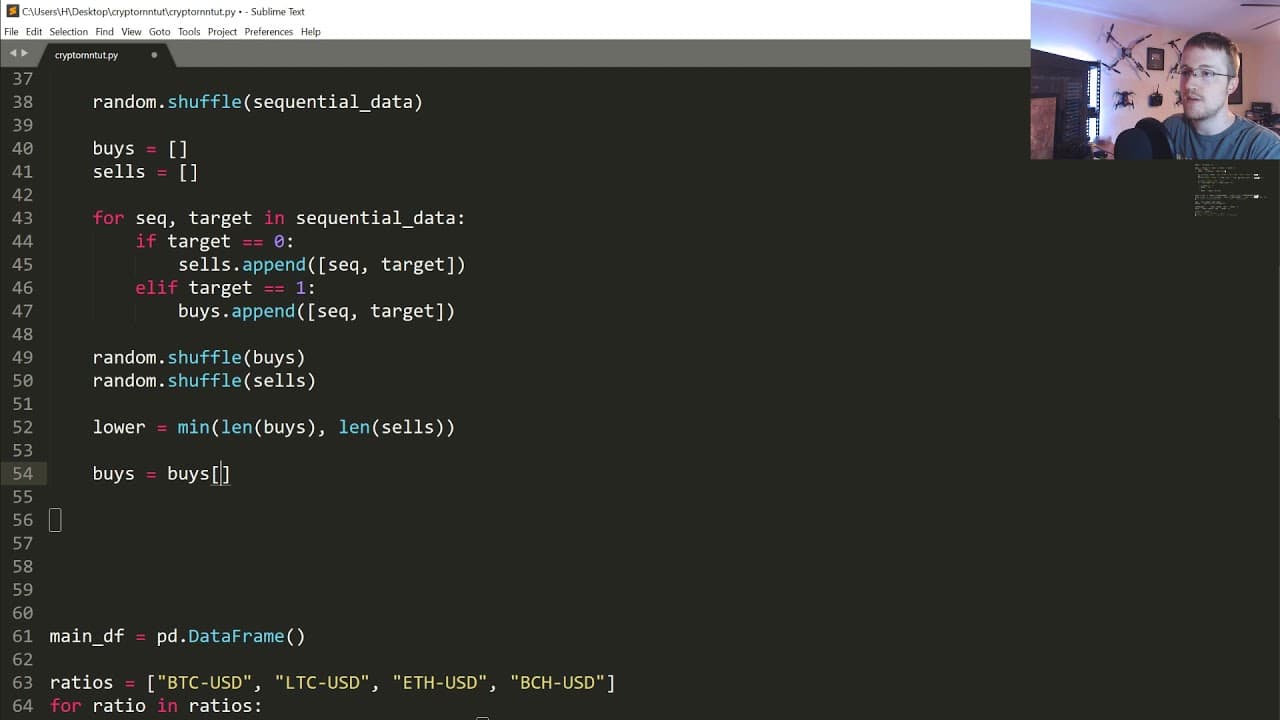
Balancing RNN sequence data - Deep Learning w/ Python, TensorFlow and Keras p.10
TL;DR
- Balancing data for a cryptocurrency price predictor neural network is crucial for accurate results.
Transcript
what is going on everybody and welcome to another deep learning with Python tensorflow and Cara's tutorial video in this video we're gonna continue building on our a future crypto currency price movement predictor recurrent neural network okay so where we left off we've got this pre-processing happening we've built the sequential data and we've sep... Read More
Key Insights
- ⚖️ Balancing data in neural networks prevents bias and improves learning.
- 🔀 Shuffling data enhances model generalization by preventing pattern learning.
- 🏷️ Splitting data into features and labels is essential for model training.
- 🏋️ Class weights may not fully address data imbalance in neural networks.
- 😑 Pre-processing steps involve sequential data building and validation data separation.
- 🏷️ Converting data into features and labels prepares it for model training.
- ⚖️ Statistics on training and validation data help monitor data balance.
Install to Summarize YouTube Videos and Get Transcripts
Explore YouTube Video Summarizer or Get YouTube Transcript Extractor
Questions & Answers
Q: Why is balancing the data in a neural network important?
Balancing data ensures that the model does not favor one class over another, leading to more accurate predictions. It prevents bias and helps the model learn effectively.
Q: How can class weights be used in balancing data?
Class weights adjust the importance of different classes in the loss function, but they may not fully address imbalanced data. It's crucial to balance data upfront for better model performance.
Q: What is the purpose of shuffling data before training a model?
Shuffling data prevents the model from learning patterns based on the order of data samples. It ensures that the model learns from a diverse range of examples, improving generalization.
Q: Why is it necessary to split data into features and labels for model training?
Separating data into input features (X) and target labels (Y) allows the model to learn the relationship between features and the desired output. It's a standard practice in training neural networks.
Summary & Key Takeaways
-
Pre-processing data involves sequential data building and validation data separation.
-
Balancing data is essential to prevent model bias and improve learning.
-
Converting data into features and labels is necessary for model training.
Read in Other Languages (beta)
Share This Summary 📚
Summarize YouTube Videos and Get Video Transcripts with 1-Click
Try YouTube Summary with ChatGPT & Claude or YouTube Transcript Generator
Explore More Summaries from sentdex 📚



Summarize YouTube Videos and Get Video Transcripts with 1-Click
Try YouTube Summary with ChatGPT & Claude or YouTube Transcript Generator