7 FREE AI Courses To Become an AI Developer in 2023 🔥| Ishan Sharma
TL;DR
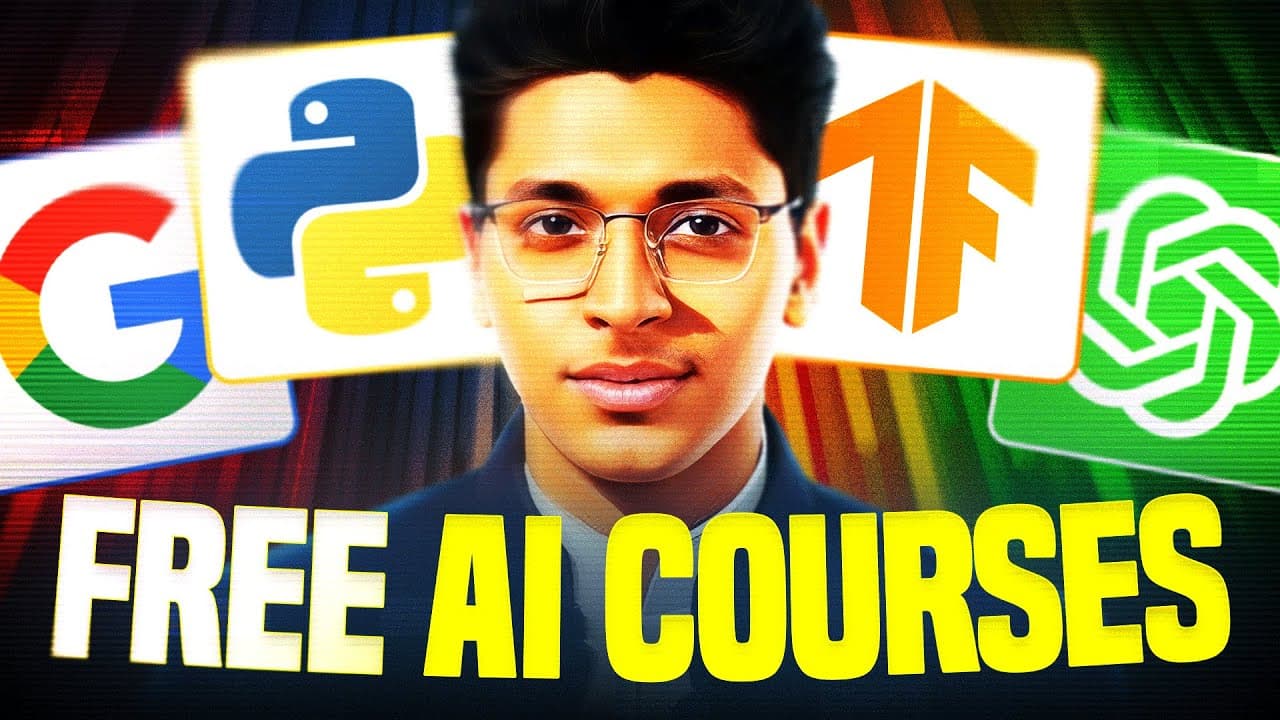
Learn the basics, programming with Python, libraries, machine learning, TensorFlow, natural language processing, chat GPT, and generative AI to become an AI developer.
Transcript
with an average salary of 21 lakhs per annum AR developer is one of the hottest jobs out there if you want to take advantage of this craze and become an AI developer these are the seven best free courses that you can do online and become an AI developer from the basics to the Advance if that sounds interesting hit the like button and let's get star... Read More
Key Insights
- 🎰 Understanding mathematics, especially linear algebra and statistics, is essential for success in AI and machine learning.
- 🎰 Python is the recommended programming language for beginners due to its simplicity and extensive libraries for AI and machine learning.
- 🔬 Key Python libraries like NumPy, Pandas, and Matplotlib are crucial for data manipulation, analysis, and visualization in data science.
- 🏛️ Machine learning concepts such as supervised learning, unsupervised learning, and reinforcement learning are fundamental for building AI models.
- 🎰 TensorFlow, a powerful machine learning framework, simplifies the development of deep neural networks and optimization of models.
- 🤗 Natural language processing (NLP) enables machines to interpret and generate human language, opening doors for chatbots and text prediction.
- 👻 ChatGPT, a language model, allows developers to create human-like text responses and can be learned through available courses.
Install to Summarize YouTube Videos and Get Transcripts
Explore YouTube Video Summarizer or Get YouTube Transcript Extractor
Questions & Answers
Q: Why is it important to have a strong foundation in mathematics before delving into AI and machine learning?
Understanding mathematics, such as linear algebra, matrices, and statistics, is crucial because it forms the basis of many AI and machine learning algorithms. It allows you to comprehend concepts like data representation, modeling, and optimization.
Q: Why is Python programming language recommended for beginners in AI and machine learning?
Python is widely used in the AI and machine learning community because of its simplicity, readability, and a vast ecosystem of libraries. It allows beginners to quickly grasp the core concepts and easily implement machine learning models and algorithms.
Q: What are some of the important Python libraries for data science, and how do they assist in analyzing and visualizing data?
The three key Python libraries for data science are NumPy, Pandas, and Matplotlib. NumPy helps in organizing data into arrays and matrices, Pandas facilitates querying and analyzing structured data, and Matplotlib enables data visualization.
Q: How can one start learning about machine learning, and what are the different topics covered in the process?
Tech with Tim's YouTube channel offers comprehensive videos on machine learning, including topics like supervised learning, unsupervised learning, linear regression, classification, clustering, and reinforcement learning. The videos also provide hands-on projects for practical learning.
Q: What is TensorFlow, and why is it recommended for creating machine learning models?
TensorFlow is a popular framework used for building machine learning and AI models. It simplifies the process by allowing developers to create and train deep neural networks using high-level APIs. TensorFlow's versatility and broad community support make it an ideal choice for AI development.
Q: How can one understand natural language processing (NLP) and its applications in machine learning?
The Stanford cs224n YouTube playlist offers a course on NLP, covering topics like text parsing, language models, Transformers, and large language models. This course provides insights into how machines can process and understand human language, enabling applications like chatbots and text prediction.
Q: What is ChatGPT, and how can one learn about it?
ChatGPT is a language model developed by OpenAI that can generate human-like text responses. The Deep Learning dot AI course by Andrew NG, "ChatGPT: Prompt Engineering for Developers," teaches how to use ChatGPT for prompt engineering, API usage, and developing applications based on generative AI.
Q: What is the recommended learning path to gain knowledge of generative AI?
Google offers a comprehensive 10-course learning path on generative AI, covering various aspects like large language models, world and Transformers, image generation, diffusion models, image captioning, and interacting with the Generative AI Studio. Completing this path will make one job-ready in the AI field.
Key Insights:
- Understanding mathematics, especially linear algebra and statistics, is essential for success in AI and machine learning.
- Python is the recommended programming language for beginners due to its simplicity and extensive libraries for AI and machine learning.
- Key Python libraries like NumPy, Pandas, and Matplotlib are crucial for data manipulation, analysis, and visualization in data science.
- Machine learning concepts such as supervised learning, unsupervised learning, and reinforcement learning are fundamental for building AI models.
- TensorFlow, a powerful machine learning framework, simplifies the development of deep neural networks and optimization of models.
- Natural language processing (NLP) enables machines to interpret and generate human language, opening doors for chatbots and text prediction.
- ChatGPT, a language model, allows developers to create human-like text responses and can be learned through available courses.
- A comprehensive generative AI learning path offered by Google covers various aspects like large language models, image generation, and image captioning, making learners job-ready in the AI field.
Summary & Key Takeaways
-
Understand the underlying mathematics of linear algebra, matrices, determinants, matrix multiplication, eigenvalues, eigenvectors, probabilities, and statistics before diving into AI and machine learning.
-
Learn Python programming from the basics of data types, conditionals, loops, functions, objects, and classes to solving real-world problems.
-
Master the essential Python libraries for data science - NumPy, Pandas, and Matplotlib - to organize, query, and visualize data.
-
Explore machine learning concepts such as supervised learning, unsupervised learning, reinforcement learning, linear regression, classification, clustering, and build projects.
-
Dive into the TensorFlow framework to create deep neural networks and understand model optimization, regression, classification, and more.
-
Learn about natural language processing (NLP) and models like Transformer and ChatGPT to parse and generate text predictions.
-
Enroll in Google's generative AI learning path to gain comprehensive knowledge of generative AI, large language models, image generation, image captioning, and more.
Read in Other Languages (beta)
Share This Summary 📚
Summarize YouTube Videos and Get Video Transcripts with 1-Click
Try YouTube Summary with ChatGPT & Claude or YouTube Transcript Generator
Explore More Summaries from Ishan Sharma 📚


Summarize YouTube Videos and Get Video Transcripts with 1-Click
Try YouTube Summary with ChatGPT & Claude or YouTube Transcript Generator