What Is an Anharmonic Oscillator and Its Perturbations?
TL;DR
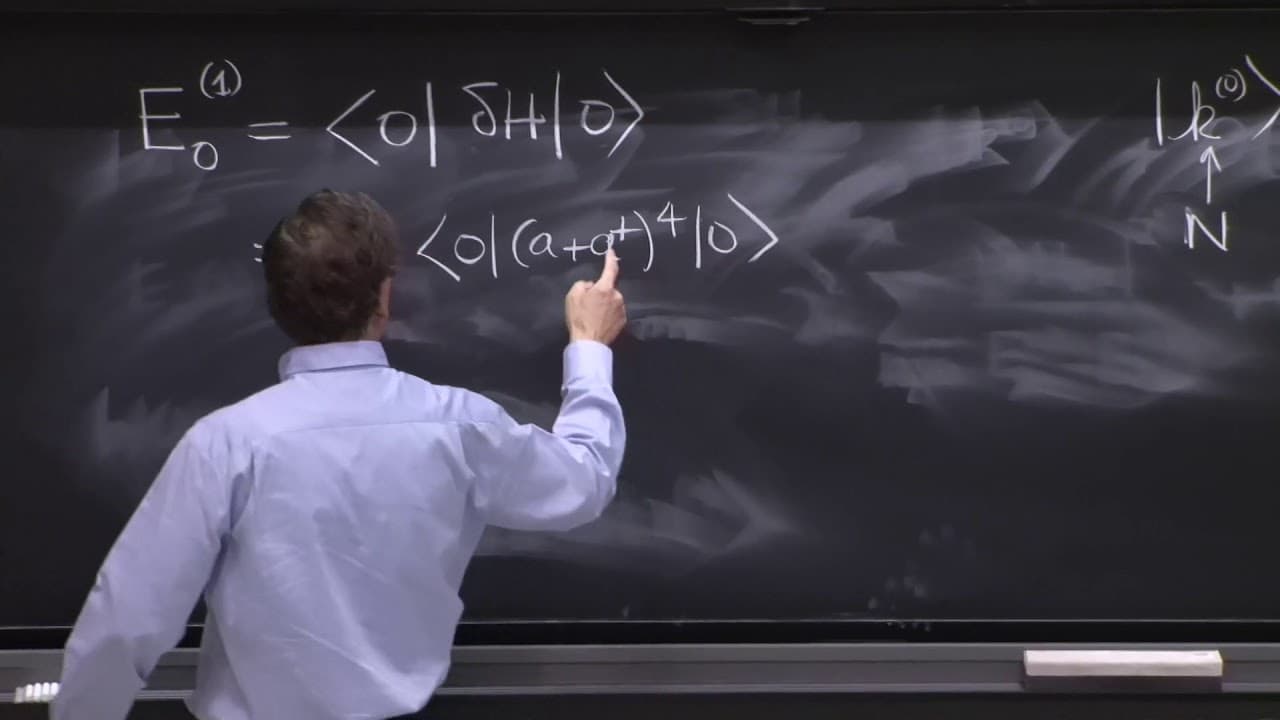
An anharmonic oscillator differs from a harmonic oscillator in that the energy differences between levels are not constant. By adding a perturbation of the form x^4, the potential energy increases more rapidly, affecting the ground state energy. The first-order and second-order corrections can be calculated, revealing significant insights into the system's behavior.
Transcript
PROFESSOR: Let us consider the anharmonic oscillator, which means that you're taking the unperturbed Hamiltonian to be the harmonic oscillator. And now, you want to add an extra term that will make this anharmonic. Anharmonic reflects the fact that the perturbations are oscillations of the system are not exactly harmonic. And in the harmonic oscill... Read More
Key Insights
- 🎚️ The anharmonic oscillator introduces variations in the energy differences between levels.
- 💨 Adding a perturbation in the form of x^4 can make the potential of the oscillator blow up faster.
- ⚖️ The length scale in the harmonic oscillator is derived from the units of momentum.
- 🍉 The perturbation term in the anharmonic oscillator has units of energy.
Install to Summarize YouTube Videos and Get Transcripts
Explore YouTube Video Summarizer or Get YouTube Transcript Extractor
Questions & Answers
Q: What is the main difference between the harmonic and anharmonic oscillators?
The main difference is that the energy differences between levels in the harmonic oscillator are constant, while in the anharmonic oscillator, these energy differences can vary.
Q: How is the perturbation in the form of x^4 added to the system?
The perturbation is added as a lambda times the operator x^4 divided by the length scale d^4. This perturbation has units of energy.
Q: What is the purpose of computing the corrections to the energy in the anharmonic oscillator?
Computing the energy corrections allows us to understand how the perturbation affects the system and how the energy levels change due to the anharmonicity.
Q: Does the series expansion for the anharmonic oscillator energy converge?
No, the series expansion for the anharmonic oscillator energy does not converge. It is an asymptotic expansion, which means that the terms become smaller and smaller, eventually repeating and increasing again. This can be used as an approximation for the energy.
Summary & Key Takeaways
-
The professor introduces the concept of the anharmonic oscillator, which involves deviations from the harmonic (or regular) oscillator.
-
In the anharmonic oscillator, the energy differences between levels are not constant, unlike in the harmonic oscillator.
-
The professor explains how to add a perturbation in the form of x^4 to the system and calculates the first-order and second-order corrections to the ground state energy.
Read in Other Languages (beta)
Share This Summary 📚
Summarize YouTube Videos and Get Video Transcripts with 1-Click
Try YouTube Summary with ChatGPT & Claude or YouTube Transcript Generator
Explore More Summaries from MIT OpenCourseWare 📚



Summarize YouTube Videos and Get Video Transcripts with 1-Click
Try YouTube Summary with ChatGPT & Claude or YouTube Transcript Generator