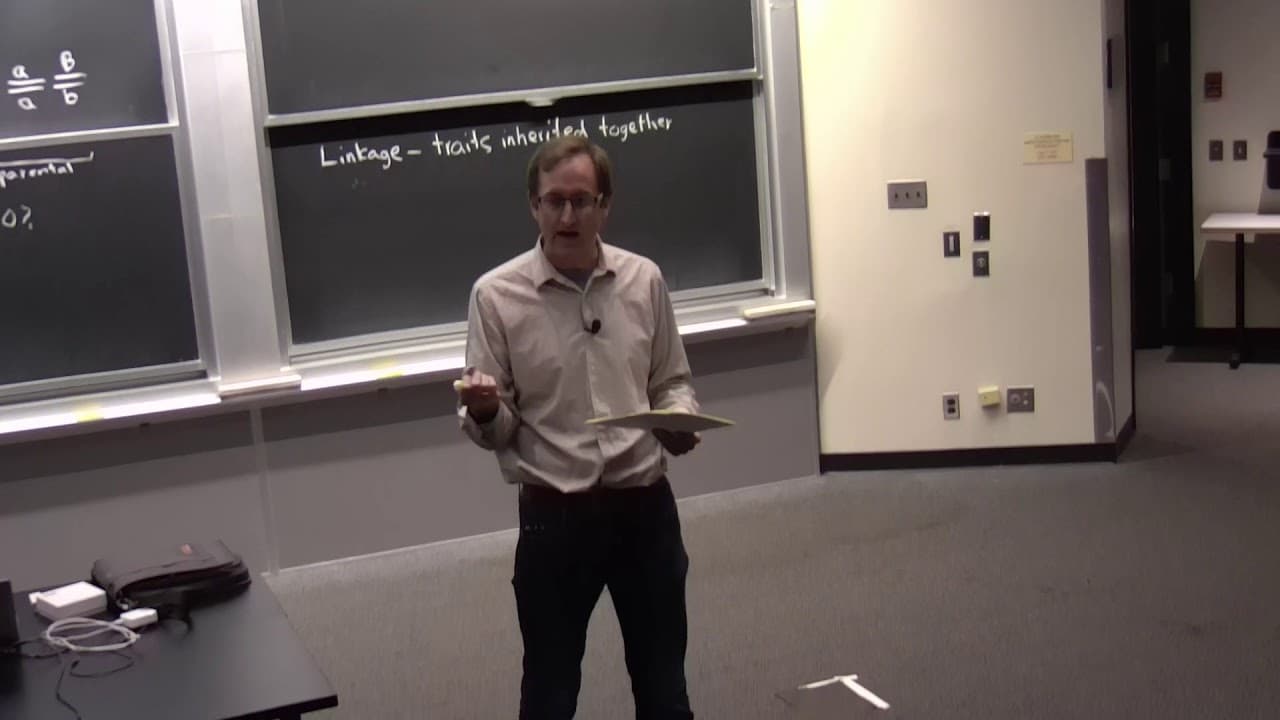
14. Genetics 3 – Linkage, Crossing Over
TL;DR
Fruit flies and yeast exhibit genetic linkage and recombination, allowing researchers to map genes and understand inheritance patterns.
Transcript
ADAM MARTIN: And so I wanted to start today's lecture by continuing what we were talking about in the last lecture. So I'm just going to hide this real quick. And so we're talking about the fruit fly and the white gene and the white mutant, which results in white-eyed flies. And we talked about how if you take females that have red eyes and cross t... Read More
Key Insights
- 🪽 Understanding the inheritance patterns and genetic linkage can be achieved through experiments with model organisms like fruit flies and yeast.
- 😵 Reciprocal crosses reveal how the sex-linked inheritance pattern affects the phenotype of offspring.
- 🍁 Genetic maps created through measuring recombination frequencies provide insights into the distance and linkage between genes.
Install to Summarize YouTube Videos and Get Transcripts
Explore YouTube Video Summarizer or Get YouTube Transcript Extractor
Questions & Answers
Q: How does the inheritance pattern differ between the reciprocal crosses of fruit flies with white-eyed females and red-eyed males?
In the reciprocal crosses, white-eyed females crossed with red-eyed males result in all white-eyed males and all red-eyed females. This is due to the sex-linked inheritance pattern.
Q: How are genetic maps created and what do they reveal?
Genetic maps are created by measuring recombination frequencies between genes. These maps reveal the distance and linkage between genes along a chromosome.
Q: What is the significance of the three-point cross experiment in yeast?
The three-point cross experiment in yeast demonstrates that genes can exhibit linkage to physical structures on chromosomes, such as the centromere. It allows researchers to observe patterns of genetic recombination.
Q: What are the possible outcomes in a meiotic event for two genes that are linked to the centromere?
In a meiotic event for two genes linked to the centromere, the possible outcomes are parental ditypes and non-parental ditypes. Tetratypes are unlikely to occur.
Summary & Key Takeaways
-
Fruit flies with white-eyed phenotype can be crossed to red-eyed flies to produce offspring with red eyes due to a sex-linked inheritance pattern.
-
Reciprocal crosses with white-eyed females and red-eyed males result in offspring with white eyes in males and red eyes in females.
-
Genetic maps can be created by measuring recombination frequencies between genes to understand their distance and linkage.
-
Yeast cells can undergo meiosis, producing spores that can be used to study genetic linkage and recombination.
Read in Other Languages (beta)
Share This Summary 📚
Summarize YouTube Videos and Get Video Transcripts with 1-Click
Try YouTube Summary with ChatGPT & Claude or YouTube Transcript Generator
Explore More Summaries from MIT OpenCourseWare 📚



Summarize YouTube Videos and Get Video Transcripts with 1-Click
Try YouTube Summary with ChatGPT & Claude or YouTube Transcript Generator