Polar plot | Example | draw | Example | CS | Control Systems | Lec-98
TL;DR
The discussion explains the polar plot for a transfer function with varying frequencies and directions.
Transcript
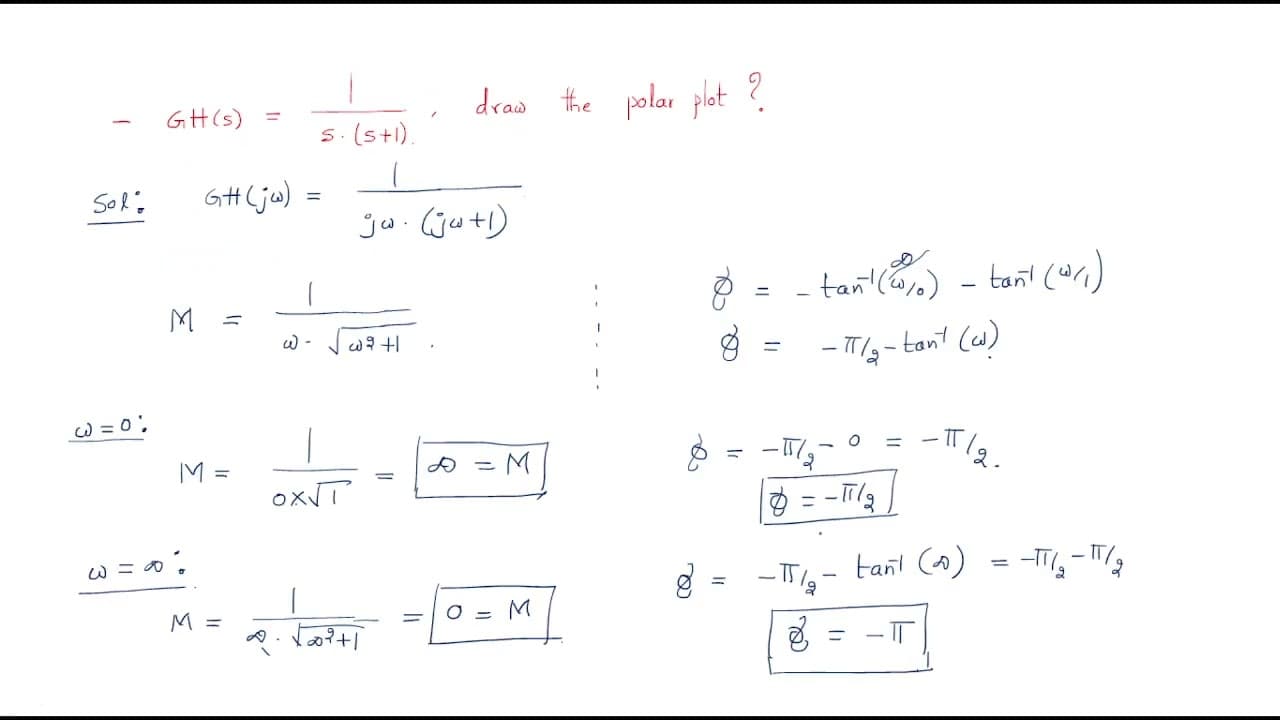
hello everyone in this session we will discuss some more different problem in the polar plot here the problem is g h of s equals one by s into s plus one rather polar plot up to now we discussed about the problems only poles in the poles added in the denominator for the transfer function here initially a pole at 0 will be added then how the polar p... Read More
Key Insights
- 😘 The analysis of g(h) = 1/(s(s+1)) illustrates critical points in frequency response, especially at low and high frequencies.
- 🎮 The phase response at zero and infinite frequencies entails significant implications for system stability and performance in control systems.
- 🐻❄️ A valid polar plot ensures that the magnitude and direction conform to theoretical expectations, providing confidence in system designs.
- ❓ Determining directionality is crucial as it directly influences the interpretation of system response across varying operational conditions.
- 🐻❄️ Understanding the implications of adding poles enables engineers to anticipate changes in system behavior reflected in the polar plot.
- 🐻❄️ The completion of the polar plot includes careful consideration of phase shifts related to the frequency, which is vital for frequency-domain analysis.
- 👷 The construction process reflects a balance between calculated parameters and physical behavior expectations in system dynamics.
Install to Summarize YouTube Videos and Get Transcripts
Explore YouTube Video Summarizer or Get YouTube Transcript Extractor
Questions & Answers
Q: What is the significance of analyzing the polar plot at zero frequency?
Analyzing the polar plot at zero frequency allows us to determine the initial behavior of the system's response. In this case, the magnitude approaches infinity while the phase reaches -5/2 radians. This provides insight into the system's stability and frequency response at low frequencies, critical for control systems design and analysis.
Q: How does the magnitude and phase change at infinite frequency?
At infinite frequency, the magnitude of the transfer function approaches zero, and the phase reaches -5 radians. This indicates that as frequency increases indefinitely, the system attenuates the input signal significantly, which is crucial for understanding how the system behaves under high-frequency conditions.
Q: Why is it important to check if the polar plot is valid?
Validating the polar plot ensures that the calculated magnitudes and phase angles at different frequencies conform to expected system behavior. It helps confirm that the physical system represented behaves as anticipated, which is essential when designing and analyzing systems in control theory.
Q: What role does the direction (clockwise or counterclockwise) play in interpreting the polar plot?
The direction of the polar plot indicates how the phase changes with respect to frequency. Clockwise direction usually signifies a decreasing phase shift with increasing frequency in this context. Understanding this helps engineers predict how the system will respond dynamically to input signals.
Q: How did you determine the starting and ending directions for the polar plot?
The ending direction is derived from the phase at different frequency limits: at omega equals zero it is -5/2 radians, while at infinite frequency it is -5 radians. The starting direction must conform to the behavior of the poles, and since the remaining pole influences the plot's behavior, we assume a clockwise direction to reflect stability.
Q: What happens to the polar plot if additional poles are added?
Adding extra poles typically influences the behavior of the polar plot by altering the magnitude and phase response. Each additional pole tends to increase the system’s stability or response time, and the plot's direction can also change, which should be analyzed carefully to maintain accurate system representation.
Q: Can you summarize the overall steps taken during the polar plot construction?
The construction involves calculating magnitude and phase at specific frequencies, validating these results to ensure the plot’s accuracy, determining the starting and ending directions based on pole positions, and finally sketching the plot to reflect this analysis. Each of these steps contributes to a comprehensive understanding of system dynamics.
Q: Why is it crucial to know the magnitude and direction of a polar plot before drawing it?
Knowing the magnitude and direction is essential to accurately represent the system's behavior in the polar plot. It determines how the system reacts over a range of frequencies, informs control strategies, and ensures that design considerations meet performance criteria effectively.
Summary & Key Takeaways
-
The session covers the construction of polar plots for the transfer function g(h) = 1/(s(s+1)), focusing on its behavior at different frequencies.
-
It discusses the process of determining magnitudes and phases at both zero and infinite frequencies to ensure a valid polar plot representation.
-
The analysis concludes with drawing the polar plot, emphasizing the direction of movement, especially in scenarios where poles are added at the origin.
Read in Other Languages (beta)
Share This Summary 📚
Summarize YouTube Videos and Get Video Transcripts with 1-Click
Try YouTube Summary with ChatGPT & Claude or YouTube Transcript Generator