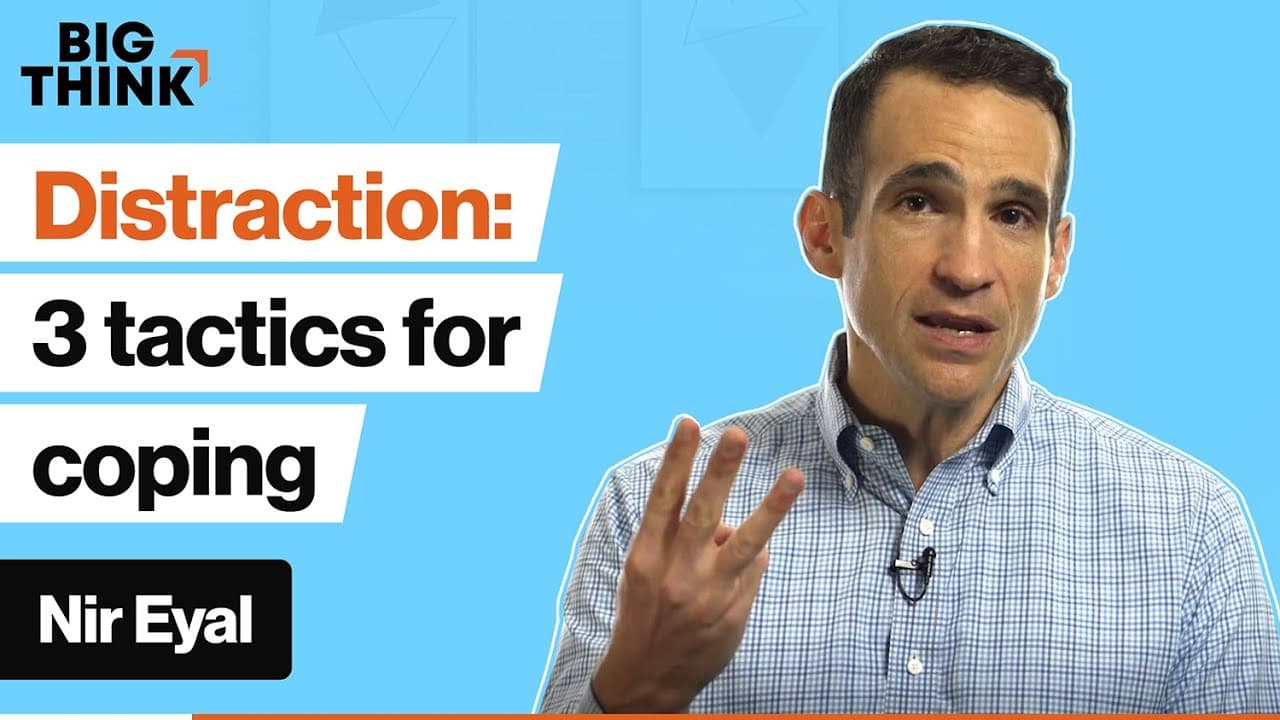
Don’t blame tech for your distracted brain. Take control. | Nir Eyal | Big Think
TL;DR
Overcoming distractions involves reimagining triggers, tasks, and temperament for better focus.
Transcript
I took the advice of every other expert in book out there about managing distraction of focus and I got rid of all my technology I did a digital detox I got myself a flip phone and I bought myself a word processor off eBay from the 1990s and I thought getting rid of all the technology would solve the problem but of course it didn't I sit down on my... Read More
Key Insights
- 🫚 Internal triggers, not technology, are the root cause of distractions.
- 🔬 Healthy coping strategies involve reimagining triggers with curiosity.
- 💱 Finding enjoyment in tasks through a change in perception enhances focus.
- 🥺 Belief in depletable willpower can lead to self-limiting behaviors.
- 🎮 Refuting the myth of technology addiction empowers individuals to take control of their attention.
- 👯 Learned helplessness occurs when people believe they cannot change their circumstances.
- 👻 Empowering oneself to master internal triggers allows for better focus and life choices.
Install to Summarize YouTube Videos and Get Transcripts
Explore YouTube Video Summarizer or Get YouTube Transcript Extractor
Questions & Answers
Q: What was the initial approach taken to address distractions?
The individual tried a digital detox, ditching technology for vintage devices, but found that internal triggers persisted, leading to distractions.
Q: What are the three main strategies for managing internal triggers?
The strategies involve reimagining the trigger itself, the task at hand, and one's temperament to address discomfort and enable focus.
Q: How does the belief in depletable willpower affect distractions?
Belief in depletable willpower can lead to learned helplessness, where individuals give in to distractions, reinforcing the idea of technology addiction.
Q: Why is it essential to refute the myth of technology addiction?
Portraying technology as an addiction reinforces learned helplessness, while understanding and managing internal triggers empowers individuals to take control of their focus.
Summary & Key Takeaways
-
Eliminating technology didn't solve distraction issue, internal triggers were the problem.
-
Three strategies for coping with internal triggers: reimagining trigger, task, and temperament.
-
Belief in addictive technology leads to learned helplessness, mastering internal triggers empowers focus.
Read in Other Languages (beta)
Share This Summary 📚
Summarize YouTube Videos and Get Video Transcripts with 1-Click
Try YouTube Summary with ChatGPT & Claude or YouTube Transcript Generator
Explore More Summaries from Big Think 📚




Summarize YouTube Videos and Get Video Transcripts with 1-Click
Try YouTube Summary with ChatGPT & Claude or YouTube Transcript Generator