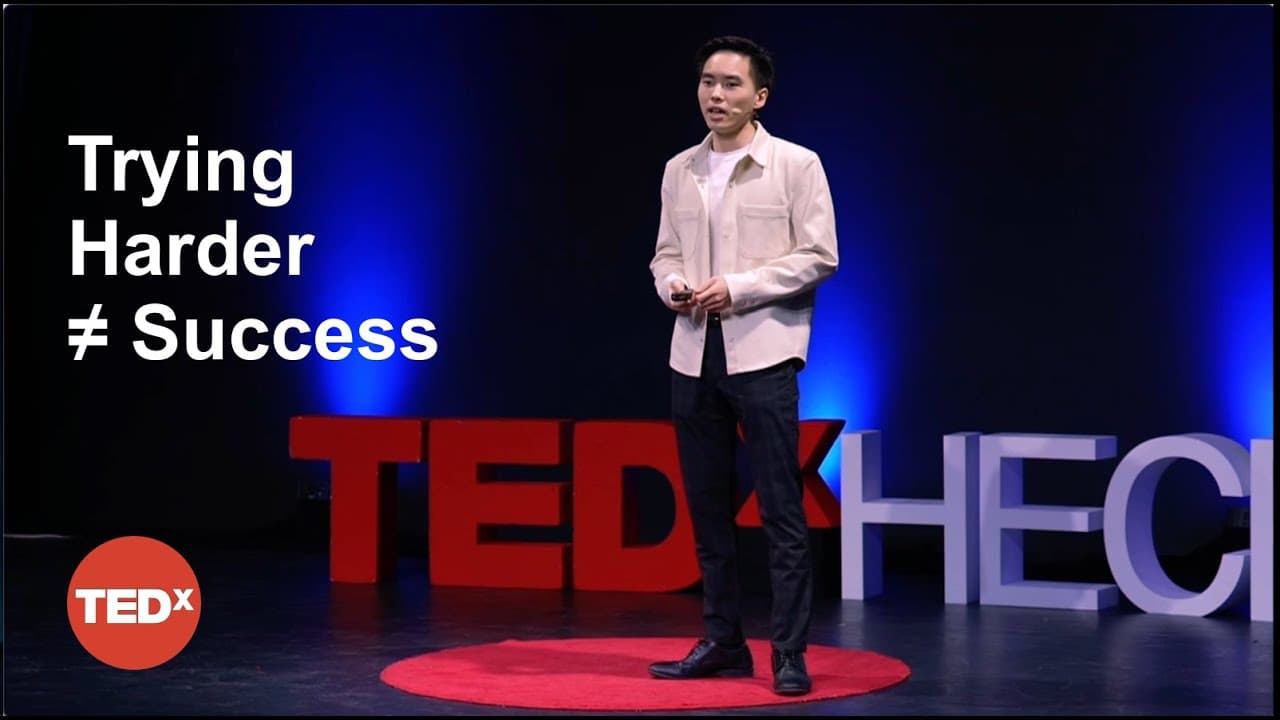
The Paradox of Effort | Terence La | TEDxHECParis
TL;DR
Success isn't linear; trying too hard can lead to less success. Embrace the "Duck Philosophy" for balance.
Transcript
[Applause] I thought success was like math linear and predictable 1 + 1 equal 2 2 + 2al 4 and 4 + 4al 8 a leads to B and B leads to C you put in effort you get results for instance you study more you get better grades with better you get better jobs and you work longer hours you get more money and that's how you get what you want I thought it was a... Read More
Key Insights
- 🥺 Success isn't always linear; trying too hard can lead to less success in the long run.
- 🍳 Embrace the "Duck Philosophy" for balance, focusing on being present, adaptable, and knowing when to take breaks.
- 💌 Let go of control and trust the process to avoid disappointment and burnout.
- 😀 Strive to strike a balance between working hard and going with the flow for a happier and more successful life.
- 🛟 Don't tie happiness to arbitrary goals; focus on the process and embrace life as an adventure.
- ⁉️ Life's equation is more complex than simple math; focus on the process (X) rather than the outcome (question mark).
- ⚖️ Avoid forcing outcomes and expectations; trust the process and maintain a balance between effort and outcome expectations.
Install to Summarize YouTube Videos and Get Transcripts
Explore YouTube Video Summarizer or Get YouTube Transcript Extractor
Questions & Answers
Q: What led the narrator to realize that trying too hard can lead to less success?
The narrator's initial belief in linear success through optimization and planning was shattered when ambitious plans fell apart after multiple setbacks, leading to the realization that trying too hard could result in less success.
Q: How did insights from children's movies and observing ducks shape the narrator's mindset?
Insights from Kung Fu Panda and observing ducks taught the narrator to let go of control, embrace the present moment, adapt to opportunities, and take breaks when necessary, forming the foundation of the "Duck Philosophy."
Q: What are the three key principles of the "Duck Philosophy"?
The "Duck Philosophy" emphasizes being calm like a duck's head, adaptable like a duck's wings, and smart about taking breaks like a duck's feet, encouraging a balance between action and letting go for a happier and more successful life.
Q: How did the narrator's life change after embracing the "Duck Philosophy"?
By letting go of control, micromanaging less, and focusing on the process rather than outcomes, the narrator experienced increased happiness, creativity, and success, leading to unexpected opportunities and decreased stress levels.
Summary & Key Takeaways
-
The narrator believed success was about optimization and planning, but after multiple setbacks, realized trying too hard led to less success.
-
Through insights from Kung Fu Panda and observing ducks, the narrator developed the "Duck Philosophy" focusing on balance and letting go of control.
-
The philosophy emphasizes being present like a duck, adapting to opportunities, and knowing when to take breaks, leading to a happier and more successful life.
Read in Other Languages (beta)
Share This Summary 📚
Summarize YouTube Videos and Get Video Transcripts with 1-Click
Try YouTube Summary with ChatGPT & Claude or YouTube Transcript Generator
Explore More Summaries from TEDx Talks 📚

Summarize YouTube Videos and Get Video Transcripts with 1-Click
Try YouTube Summary with ChatGPT & Claude or YouTube Transcript Generator