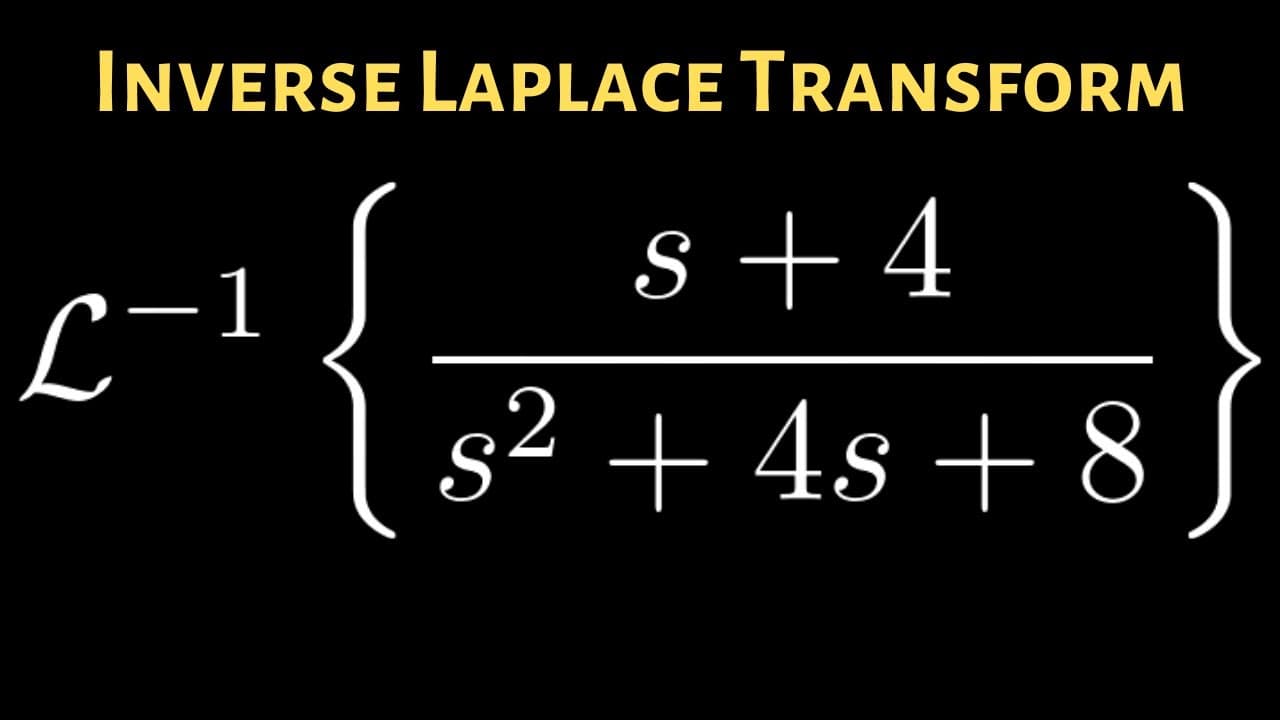
How to Find the Inverse Laplace Transform of (s + 4)/(s^2 + 4s + 8)
TL;DR
Factor and complete the square to find the inverse Laplace transform of a function, then apply shifting and use cosine and sine rules for solutions.
Transcript
in this problem we're going to try to find the inverse laplace transform of this function here so the first thing you should always try in these problems is try to factor the bottom here so we would need two numbers that multiply to eight but add to four and you know two times four is eight um you know one times eight is eight i don't think we're g... Read More
Key Insights
- 🧑🏭 Factor and complete the square to simplify the function before proceeding.
- 💁 Shifting is crucial to convert terms to the desired form for the inverse Laplace transform.
- 👨💼 Mastering the cosine and sine rules aids in finding solutions efficiently.
- ❓ Practice improves proficiency in solving inverse Laplace transform problems.
- 💯 Understanding perfect square trinomials is beneficial for simplification.
- 🖐️ The first translation theorem plays a significant role in applying shifting.
- 👨💼 Utilizing cosine and sine functions involves careful consideration of the transformed variables.
Install to Summarize YouTube Videos and Get Transcripts
Explore YouTube Video Summarizer or Get YouTube Transcript Extractor
Questions & Answers
Q: What is the initial step in finding the inverse Laplace transform of a function?
The initial step involves factoring the denominator and potentially completing the square to simplify the function and make further calculations more manageable.
Q: How does shifting play a role in finding the inverse Laplace transform?
Shifting is essential to convert terms to the desired form for the inverse Laplace transform, allowing for the application of cosine and sine rules for efficient solutions.
Q: Why is completing the square important in this process?
Completing the square helps in simplifying the function and enables identification of perfect square trinomials that facilitate the inverse Laplace transform calculations.
Q: How do cosine and sine rules contribute to finding solutions for the inverse Laplace transform?
Cosine and sine rules are used for specific forms of transformed functions to determine the final solutions, providing a structured method for obtaining the results accurately.
Summary & Key Takeaways
-
Factor the denominator and complete the square to simplify the function.
-
Use shifting to convert terms to desired form for inverse Laplace transform.
-
Apply cosine and sine rules for solutions based on the transformed functions.
Read in Other Languages (beta)
Share This Summary 📚
Summarize YouTube Videos and Get Video Transcripts with 1-Click
Try YouTube Summary with ChatGPT & Claude or YouTube Transcript Generator
Explore More Summaries from The Math Sorcerer 📚



Summarize YouTube Videos and Get Video Transcripts with 1-Click
Try YouTube Summary with ChatGPT & Claude or YouTube Transcript Generator