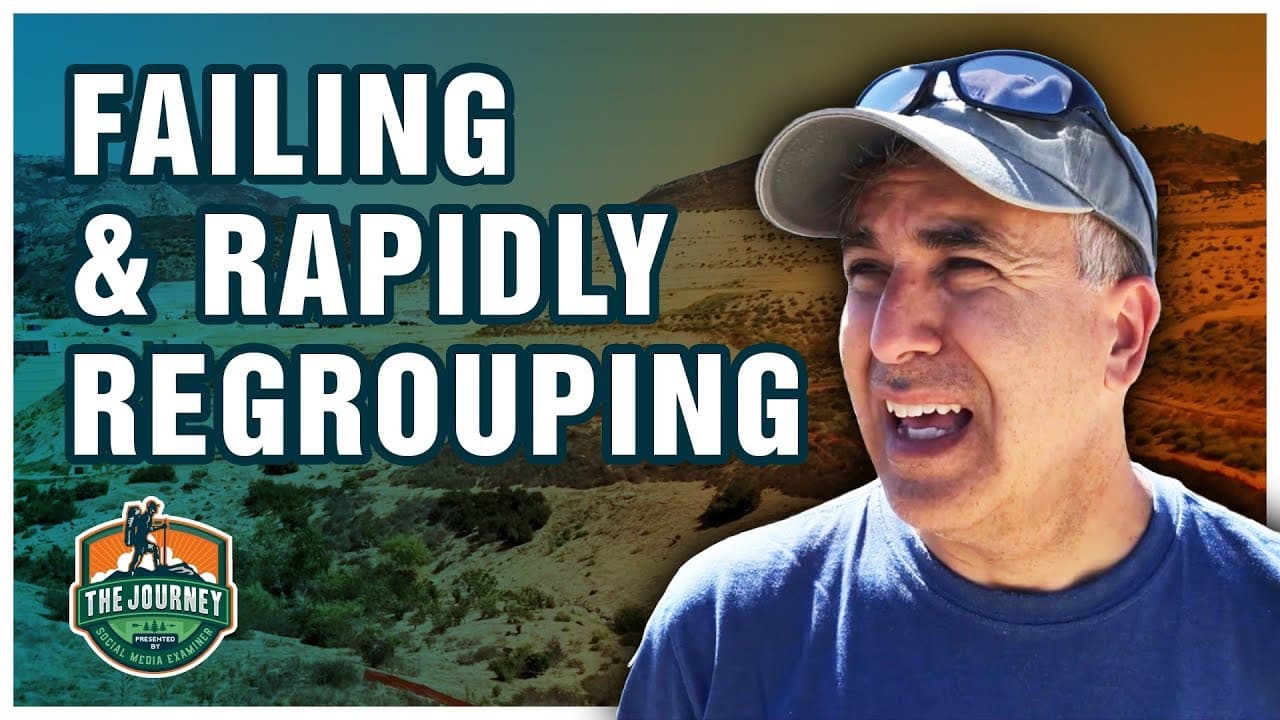
Failing and Rapidly Regrouping, The Journey, Episode 9, Season 2
TL;DR
Michael Stelzner's team navigates a failed documentary launch.
Transcript
MICHAEL STELZNER: I am very frustrated in myself because I've fallen into a trap. Join us on an impossible mission to grow our business 50%. Welcome to The Journey. We've decided to kind of pause the promotion of the conference to focus in on the promotion of The Journey. If we get enough people to watch The Journey we know that the outcome will be... Read More
Key Insights
- Michael Stelzner faces frustration as his strategic decision to launch on Facebook fails, leading to a reevaluation of their approach.
- The team identifies that the audience retention on Facebook is significantly lower than on YouTube, prompting a shift in focus to YouTube.
- They realize the importance of timing, considering moving the release day to Thursday for better audience engagement.
- The team acknowledges the mistake of letting emotions drive decisions instead of relying on data and rational analysis.
- The importance of having a clear mission is emphasized, with a goal set to sell 341 tickets within the month.
- Rapid execution and adaptability are highlighted as crucial, with the team encouraged to fail forward and learn quickly.
- Michael reflects on the pressures of managing content creation and considers whether continuing 'The Journey' is feasible.
- The episode underscores the significance of strategic planning and flexibility in achieving business objectives.
Install to Summarize YouTube Videos and Get Transcripts
Explore YouTube Video Summarizer or Get YouTube Transcript Extractor
Questions & Answers
Q: What was the main issue with the documentary launch?
The main issue with the documentary launch was the decision to focus on Facebook as the primary platform, which resulted in significantly lower audience retention compared to YouTube. This strategic misstep led to the realization that viewers preferred consuming long-form content on YouTube rather than Facebook.
Q: How did the team plan to address the failed launch?
The team planned to address the failed launch by shifting their focus to YouTube, where audience retention was higher. They also considered changing the release day to Thursday for better engagement. Additionally, they emphasized the need for rapid execution and adaptability to improve their strategy and meet sales targets.
Q: What role did data play in the team's decision-making process?
Data played a crucial role in the team's decision-making process. It provided insights into audience retention rates on different platforms, highlighting the inadequacy of Facebook for long-form content. This data-driven approach helped the team make informed decisions about shifting their focus to YouTube and adjusting their content strategy.
Q: What lesson did Michael learn from the failed launch?
Michael learned the importance of not letting emotions drive business decisions, as this led to a strategic error in focusing on Facebook. He realized the need for rational analysis and data-driven decision-making to avoid falling into the 'Bright Shiny Objects Syndrome' trap and to ensure successful outcomes.
Q: What was the team's mission, and how did they plan to achieve it?
The team's mission was to sell 341 tickets within the month. To achieve this, they planned to execute a clear and focused strategy, including sending additional promotional emails, creating short video ads, and organizing their ideas into a cohesive plan. Rapid execution and flexibility were emphasized as key to achieving their sales goals.
Q: How did the team view the importance of timing in their strategy?
The team viewed timing as a critical factor in their strategy. They considered changing the release day from Monday to Thursday, based on audience engagement patterns, to optimize viewership and retention. This adjustment was part of their effort to refine their content strategy and improve overall performance.
Q: What internal challenges did Michael face during this process?
Internally, Michael faced the challenge of managing the pressures of content creation and questioning the scalability of 'The Journey.' He spent considerable time editing episodes and felt the weight of ensuring the project's success. This led him to consider whether continuing 'The Journey' was a sustainable endeavor.
Q: What broader business principles were highlighted in the episode?
The episode highlighted broader business principles such as the importance of strategic planning, adaptability, and rapid execution. It emphasized learning from failures, making data-driven decisions, and maintaining a clear mission to navigate challenges effectively and achieve business objectives.
Summary & Key Takeaways
-
Michael Stelzner and his team face challenges after their documentary launch on Facebook fails to gain traction. They analyze audience retention data, realizing a shift to YouTube may be necessary. The team discusses timing and content strategy adjustments to improve engagement and sales.
-
The episode highlights Michael's frustration with letting emotions guide decisions, leading to strategic missteps. The team learns from these mistakes and emphasizes the importance of having a clear mission and executing plans rapidly to meet sales targets.
-
Reflecting on the pressures of content creation, Michael questions the sustainability of 'The Journey.' Despite setbacks, the team remains committed to adapting and learning quickly, focusing on strategic planning and flexibility to achieve business goals.
Read in Other Languages (beta)
Share This Summary 📚
Summarize YouTube Videos and Get Video Transcripts with 1-Click
Try YouTube Summary with ChatGPT & Claude or YouTube Transcript Generator
Explore More Summaries from Social Media Examiner 📚



Summarize YouTube Videos and Get Video Transcripts with 1-Click
Try YouTube Summary with ChatGPT & Claude or YouTube Transcript Generator