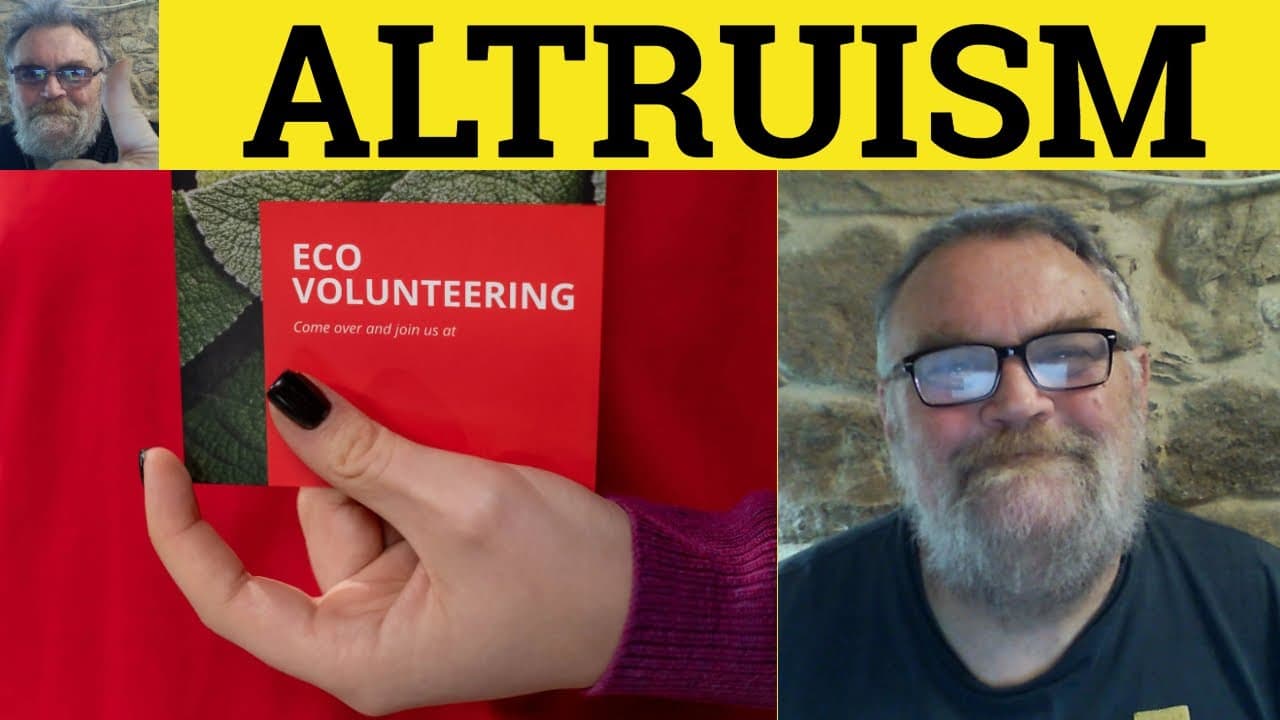
🔵 Altruism Meaning - Altruist Definition Altruistic Examples Philosophy Altruism Altruistic Altruist
TL;DR
Altruism is the act of selflessly helping others, even at a personal cost, and is characterized by actions done for the benefit of others rather than oneself.
Transcript
hi there students altruism okay altruism is a noun it's normally uncountable you could have an altruist a person who practices altruism a person who is altruistic the adjective okay let's see altruism is acting to help other people or to help other interests um by doing something that um has a cost to you so it's um putting the um interest the bene... Read More
Key Insights
- 🧑🏭 Altruism involves acting selflessly to benefit others, even if it comes at a personal cost.
- 🤑 It can be seen in various forms, such as donating time, money, or resources to charities.
- 🥅 Altruistic behavior can be observed in both humans and animals, with the goal of promoting survival and genetic spread.
- 🖐️ Empathy plays a significant role in the development of altruism.
- 🙈 Altruism is seen as a virtuous act that displays concern for the welfare of others.
- 🪙 The concept of altruism was coined by Auguste Comte in 1830, who aimed to remedy social disorder caused by the French Revolution.
- 👔 Altruism can be used in formal, semi-formal, and informal contexts.
Install to Summarize YouTube Videos and Get Transcripts
Explore YouTube Video Summarizer or Get YouTube Transcript Extractor
Questions & Answers
Q: What is altruism and how can it be defined?
Altruism is the selfless act of helping others or putting their interests before one's own. It involves actions that come at a personal cost but benefit others.
Q: How is altruism different from egoism?
Egoism is the pursuit of one's own self-interest and personal gain, while altruism is concerned with benefiting others without expecting anything in return.
Q: Can altruism be observed in the animal kingdom?
Yes, altruistic behavior can be observed in animals as well. For example, certain species engage in behaviors that may be harmful to themselves but benefit their relatives, helping to ensure the survival of their genes.
Q: What is the relationship between altruism and empathy?
Empathy can lead to altruism, as it involves understanding and sharing the feelings of others. A strong sense of empathy enhances one's willingness to help others selflessly.
Key Insights:
- Altruism involves acting selflessly to benefit others, even if it comes at a personal cost.
- It can be seen in various forms, such as donating time, money, or resources to charities.
- Altruistic behavior can be observed in both humans and animals, with the goal of promoting survival and genetic spread.
- Empathy plays a significant role in the development of altruism.
- Altruism is seen as a virtuous act that displays concern for the welfare of others.
- The concept of altruism was coined by Auguste Comte in 1830, who aimed to remedy social disorder caused by the French Revolution.
- Altruism can be used in formal, semi-formal, and informal contexts.
- The origin of the word "altruism" is rooted in the idea of doing for others and putting their interests first.
Summary & Key Takeaways
-
Altruism involves acting to help others or their interests, even if it is disadvantageous to oneself.
-
It is the opposite of egoism and misanthropy.
-
Altruistic behavior can be observed in both humans and animals, with the ultimate goal of promoting the survival or spread of genes.
Read in Other Languages (beta)
Share This Summary 📚
Summarize YouTube Videos and Get Video Transcripts with 1-Click
Try YouTube Summary with ChatGPT & Claude or YouTube Transcript Generator
Explore More Summaries from iswearenglish 📚





Summarize YouTube Videos and Get Video Transcripts with 1-Click
Try YouTube Summary with ChatGPT & Claude or YouTube Transcript Generator