Chemistry Separation of Substances Part 6 (Sieving) Class 6 VI
TL;DR
Sieving is a process that uses a sieve with tiny pores to separate particles of different sizes from a mixture, commonly used to remove impurities from flour and ensure quality in the pharmaceutical industry.
Transcript
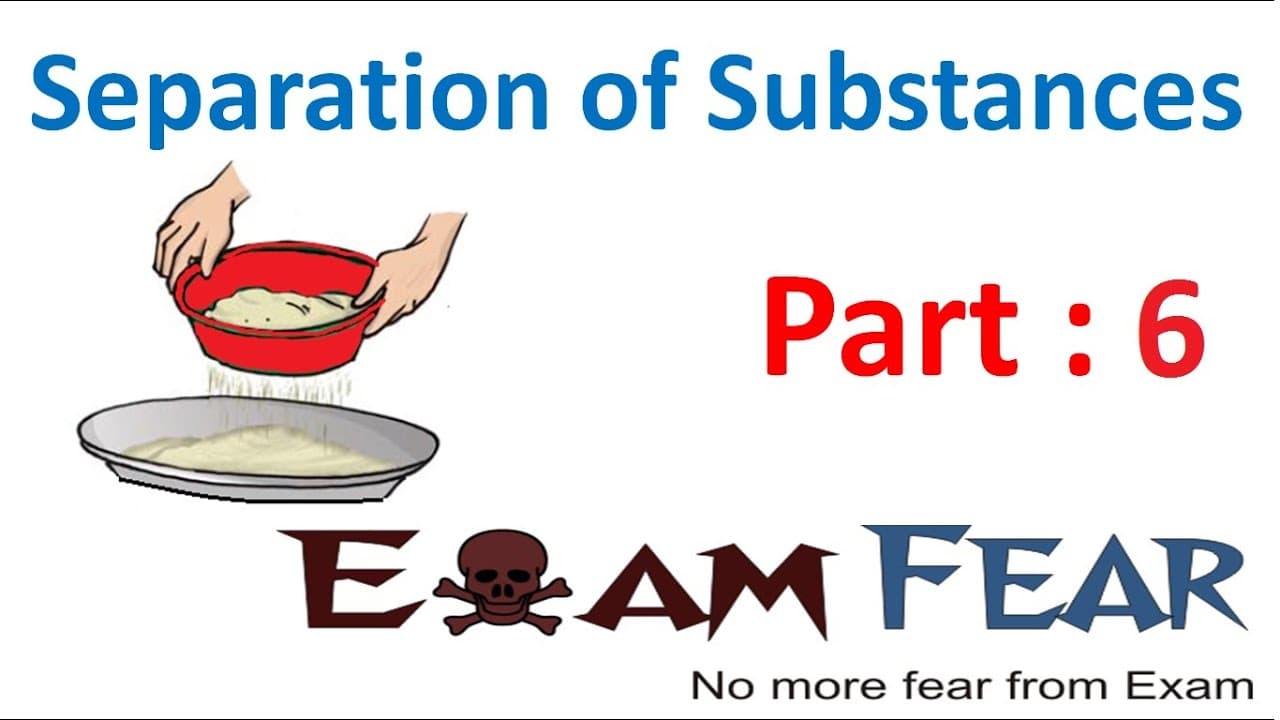
hello friends this video on separation of substances part 6 is brought to you by exam feel calm no more fear from exam now let's talk about the fourth process which is seething so what is feeling now when we talk about feeling it is like separating particles of different sizes from a mixture so here it doesn't matter whether a particle is heavy or ... Read More
Key Insights
- 😒 Sieving is a process that uses a sieve with tiny pores to separate particles based on their size.
- 😋 It is commonly used in various industries, including food processing and pharmaceuticals.
- ❓ Sieving is effective in removing impurities from mixtures, such as flour, and ensuring the quality of products.
- ❓ However, sieving is not suitable for separating particles of similar size or particles with similar densities.
- 🇨🇷 It is a cost-effective method but may require additional techniques for more precise separations.
- 🇸🇬 Sieves can be made of different materials, such as steel or plastic, and have varying pore sizes.
- 🖐️ The process of sieving plays a crucial role in maintaining the safety and effectiveness of pharmaceutical products.
Install to Summarize YouTube Videos and Get Transcripts
Explore YouTube Video Summarizer or Get YouTube Transcript Extractor
Questions & Answers
Q: What is sieving and how does it work?
Sieving is a process that uses a sieve with tiny pores to separate particles of different sizes. The sieve allows smaller particles to pass through while blocking larger particles.
Q: What are some common applications of sieving?
Sieving is commonly used to remove impurities from flour and ensure the quality of medicines in the pharmaceutical industry. It is also used in various industries for particle size analysis and separation.
Q: What are the advantages of sieving?
Sieving is effective in separating tiny particles and is useful for removing impurities from mixtures. It is a relatively simple and cost-effective method.
Q: Are there any limitations to sieving?
One limitation of sieving is that it is not effective for particles of similar size. If two particles are of similar size, the sieve may not be able to distinguish between them.
Summary & Key Takeaways
-
Sieving is the process of using a sieve with tiny pores to separate particles of different sizes from a mixture.
-
It is commonly used to remove impurities from flour and ensure the quality of medicines in the pharmaceutical industry.
-
Sieving is effective in separating tiny particles but not suitable for particles of similar size.
Read in Other Languages (beta)
Share This Summary 📚
Summarize YouTube Videos and Get Video Transcripts with 1-Click
Try YouTube Summary with ChatGPT & Claude or YouTube Transcript Generator
Explore More Summaries from LearnoHub - Class 11, 12 📚

Summarize YouTube Videos and Get Video Transcripts with 1-Click
Try YouTube Summary with ChatGPT & Claude or YouTube Transcript Generator