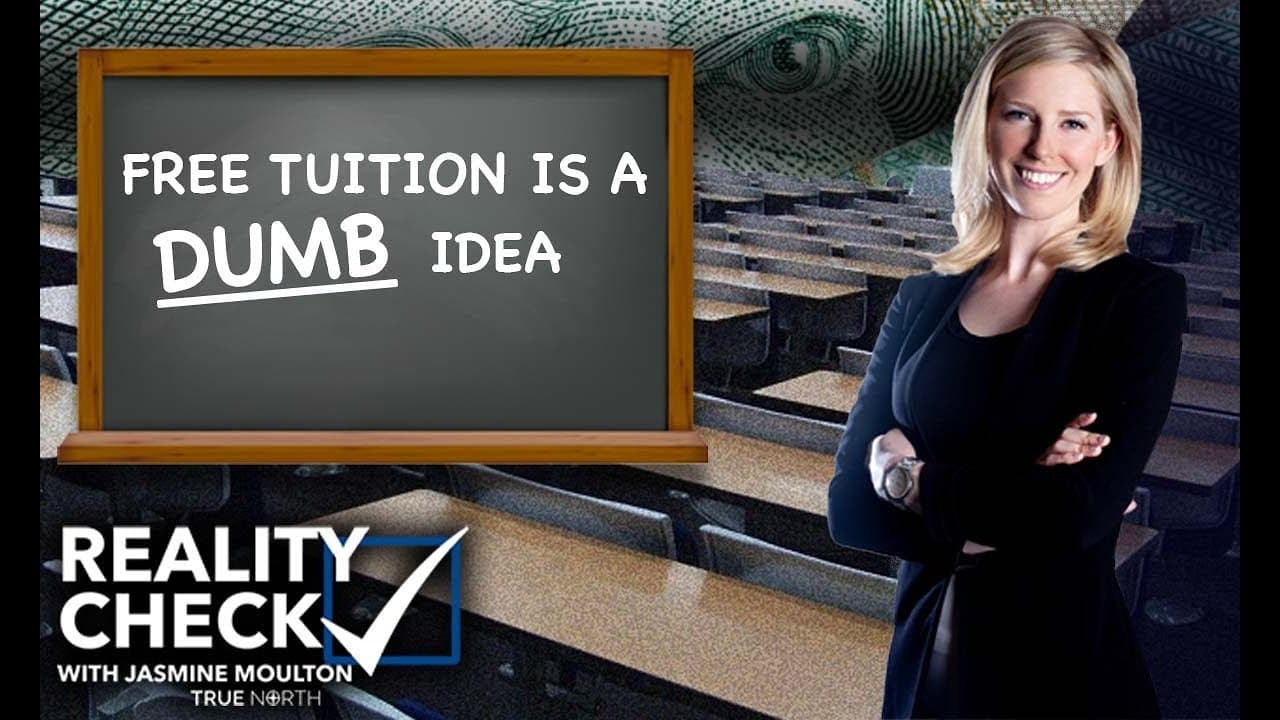
Reality Check: Free tuition is a DUMB idea
TL;DR
The show argues against free tuition in Canada, highlighting misconceptions and potential economic drawbacks.
Transcript
i'm jasmine molten and this is reality check reality check is a new show here at true north where we use facts to debunk the favorite arguments of the left if you're new to the show some past episodes include us debunking leftists ideas such as the rich don't pay their fair share or canada has the best health care system in the world reality check ... Read More
Key Insights
- ❣️ Tuition makes up less than a third of Canadian universities' revenue, indicating heavy government subsidies.
- 🥶 Canada has a higher post-secondary completion rate than nations with free tuition, challenging the financial barrier argument.
- 🥶 The host questions the efficacy of free tuition, arguing it may lead to high costs without a significant return on investment.
- 🥶 Proponents of free tuition often overlook the substantial government debt incurred by all citizens, regardless of personal education.
- 🥶 The debate over free tuition reflects broader ideological divides in Canadian politics.
- 🤨 A significant portion of university graduates works in unrelated fields, raising concerns over the effectiveness of degree programs.
- 🧑🏭 Cultural background and childhood investment are essential factors in post-secondary education decisions, more so than tuition costs.
Install to Summarize YouTube Videos and Get Transcripts
Explore YouTube Video Summarizer or Get YouTube Transcript Extractor
Questions & Answers
Q: What are the main arguments put forth by proponents of free tuition in Canada?
Proponents argue that free tuition removes financial barriers preventing access to education, promotes economic growth by increasing graduate numbers, and fosters equity by reducing disparities in educational access among different income groups.
Q: How does the show "Reality Check" debunk the idea that tuition costs prevent students from attending post-secondary education?
The show cites data from the OECD indicating that Canada ranks among the highest in tertiary education completion rates, surpassing countries with free tuition, suggesting that factors beyond tuition costs significantly influence students' decisions to pursue higher education.
Q: What insights does the host provide regarding government debt in relation to student debt?
The host highlights that while average student loan debt upon graduation is about $28,000, Ontarians individually owe approximately $64,000 in overall government debt, questioning why leftist politicians prioritize student debt over broader fiscal responsibility.
Q: How does the "Reality Check" host view the economic implications of free tuition policies?
The host argues that free tuition does not guarantee better economic outcomes. They mention that many graduates work in fields unrelated to their degrees, suggesting that taxpayer funding for degrees in unconventional subjects may not yield a worthwhile return on investment.
Q: In what ways does the show argue that free tuition policies are regressive rather than equitable?
The argument states that free tuition disproportionately favors wealthier individuals who are already more likely to attend post-secondary education, while lower-income groups receive limited benefits, thereby failing to address the underlying issues of educational access.
Q: What perspective does the show offer on the cultural factors influencing educational attendance?
The host points out that cultural influences and early educational investments play a larger role in determining who attends post-secondary education than tuition costs. These factors often go unaddressed by proposals for universal free tuition.
Summary & Key Takeaways
-
The show "Reality Check" critiques leftist claims advocating free tuition in Canada by emphasizing that tuition is not the primary barrier to post-secondary education.
-
It presents statistical evidence showing that Canada maintains high post-secondary education completion rates compared to countries with free tuition, debunking the idea that cost is the main deterrent.
-
The host argues that free tuition disproportionately benefits wealthier students and that addressing cultural and early educational factors could be more effective than subsidizing tuition universally.
Read in Other Languages (beta)
Share This Summary 📚
Summarize YouTube Videos and Get Video Transcripts with 1-Click
Try YouTube Summary with ChatGPT & Claude or YouTube Transcript Generator
Explore More Summaries from True North 📚

Summarize YouTube Videos and Get Video Transcripts with 1-Click
Try YouTube Summary with ChatGPT & Claude or YouTube Transcript Generator