Coupling mechanisms | Types | Microwave Engineering | Lec-51
TL;DR
This video details various coupling mechanisms for transferring energy between waveguides.
Transcript
foreign in this video I am going to explain about various coupling mechanisms available in the waveguids so what do you mean by coupling mechanism and what is the necessity to couple a power from one waveglide to another waveguide so coupling mechanism is nothing but it is used to couple the power or transfer the power from one wave guide to anothe... Read More
Key Insights
- ❓ Waveguide coupling is essential in telecommunications, radar, and electronic systems for transferring energy efficiently.
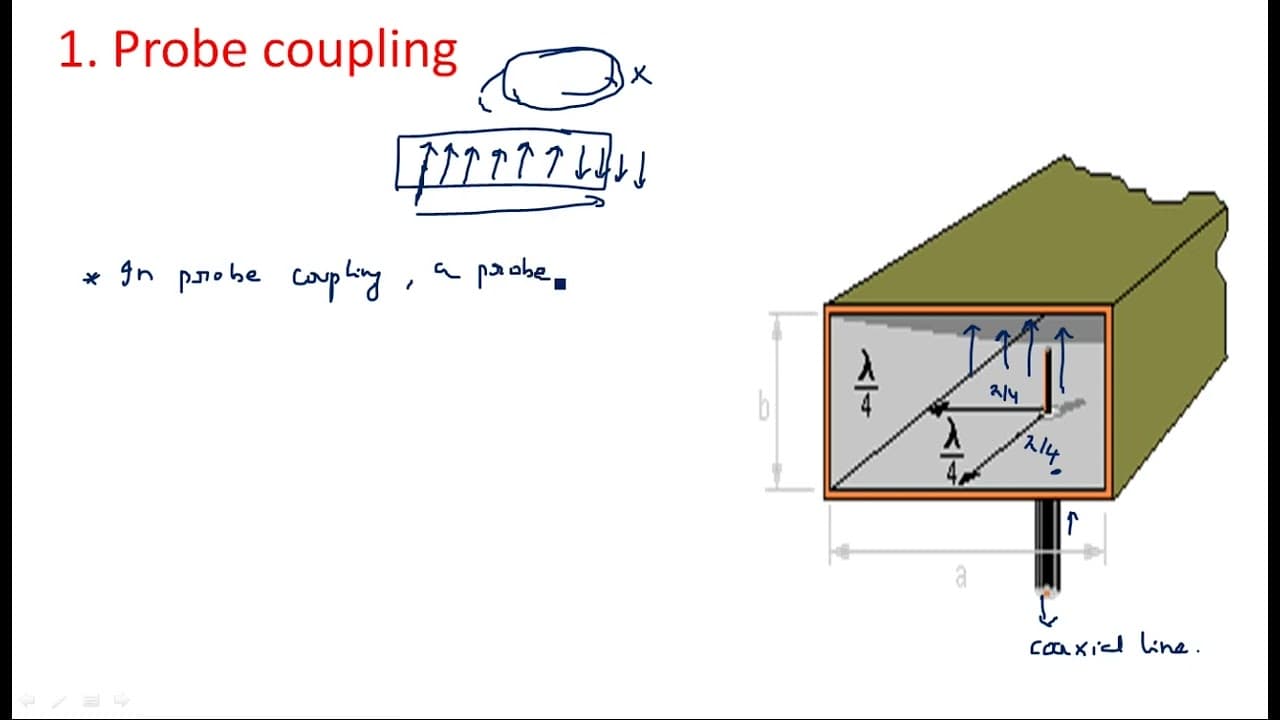
- 💦 Probe coupling works solely for electric fields using a coaxial probe to distribute energy into waveguides.
- 🔁 Loop coupling is crucial for applications that rely on magnetic field management, facilitating energy release through a looped conductor.
- 👻 Aperture coupling can transfer both electric and magnetic fields, allowing an efficient connection between different waveguide dimensions.
- ⚾ Each coupling mechanism is tailored for specific energy transfer needs based on configuration and operational requirements.
- 🎨 Understanding these coupling mechanisms is beneficial for optimizing designs in RF circuits and advanced communication systems.
- 🌸 Effective coupling ensures minimal signal loss, maintaining the integrity of energy transmission in waveguide systems.
Install to Summarize YouTube Videos and Get Transcripts
Explore YouTube Video Summarizer or Get YouTube Transcript Extractor
Questions & Answers
Q: What is waveguide coupling, and why is it necessary?
Waveguide coupling refers to the process of transferring electromagnetic energy between two or more waveguides. This transfer is necessary for effective power management in systems that rely on waveguides, such as communications and radar systems. Efficient coupling ensures that signals can move between various devices and maintain their integrity, enabling complex functionalities in electronic systems.
Q: Can you explain the three types of coupling mechanisms in waveguides?
The three types of coupling mechanisms include probe coupling, loop coupling, and aperture coupling. Probe coupling transfers electric fields using a coaxial probe inserted into the waveguide. Loop coupling relies on magnetic fields released from a looped conductor, with energy transferred as magnetic flux. Aperture coupling allows both electric and magnetic fields to transfer energy between waveguides without the need for coaxial cables, relying instead on the opening dimensions of the waveguides.
Q: How does probe coupling specifically work in waveguides?
In probe coupling, a probe is inserted into a waveguide at a quarter-wavelength distance, allowing it to interact with the electromagnetic fields. As current flows through the probe, it generates an electric field that is then coupled into the waveguide. This method effectively allows for the transfer of electric energy by detaching the electric field from the probe into the waveguide, making it a selective coupling method primarily for electric fields.
Q: What role does loop coupling play in waveguide energy transfer?
Loop coupling facilitates the transfer of magnetic energy by employing a looped conductor placed inside the waveguide. As electric energy flows through the loop, it produces magnetic flux, which is released into the waveguide. This magnetic coupling is essential for applications that require the management of magnetic fields, allowing for efficient energy dissipation and utilization within various waveguide configurations.
Q: What distinguishes aperture coupling from the other types?
Aperture coupling is unique because it allows for the transfer of both electric and magnetic fields without requiring a physical probe or loop directly inserted into the waveguide. Instead, aperture coupling utilizes the varying dimensions of the waveguides where they meet, enabling a more comprehensive coupling of electromagnetic energy. This method is especially advantageous for larger configurations where maintaining a physical connection would be challenging.
Summary & Key Takeaways
-
The video introduces waveguide coupling, a process for transferring electromagnetic energy, either electrical or magnetic, from one waveguide to another.
-
Three primary coupling mechanisms are discussed: probe coupling, loop coupling, and aperture coupling, each effective for specific types of energy transfer.
-
Detailed explanations of each coupling type include their configurations, how they function, and the specifics of energy propagation, along with diagrams for clarity.
Read in Other Languages (beta)
Share This Summary 📚
Summarize YouTube Videos and Get Video Transcripts with 1-Click
Try YouTube Summary with ChatGPT & Claude or YouTube Transcript Generator