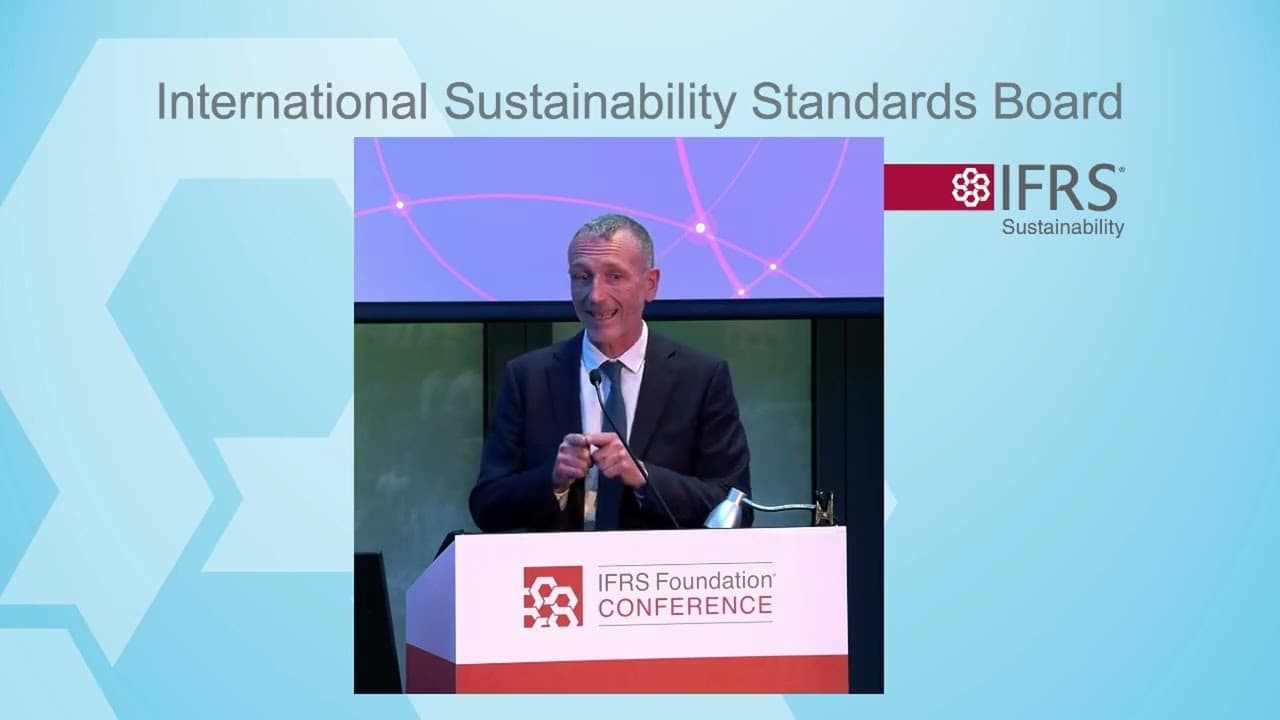
Emmanuel Faber launches the ISSB Standards in his keynote address at the IFRS Conference 2023
TL;DR
The IFRS Foundation has launched sustainability accounting standards, S1 and S2, to address the limitations of traditional economics and incorporate sustainability into financial reporting.
Transcript
well good afternoon everyone it's great to be back here in London for the IFRS conference my first conference was last year and we did some work so Andreas asked you a question about movies or I'll ask well only a few of you I think were able to raise your and so maybe I will be more successful with an easier one Kuma view in this audience have see... Read More
Key Insights
- 🌐 The IFRS Foundation's international financial reporting standards have played a crucial role in expanding global capital markets and facilitating investment in emerging economies.
- ✳️ Traditional economics fail to account for the true value of natural resources and overlook the risks and opportunities associated with sustainability.
- 💋 The launch of S1 and S2 by the IFRS Foundation marks a significant step in incorporating sustainability into financial reporting and addressing the limitations of traditional economics.
- 🖕 The new sustainability accounting standards aim to provide a comprehensive language of accounting that considers the broader scope of a company's value chain and the short, mid, and long-term impacts of sustainability risks and opportunities.
- 🔠 Incorporating sustainability into financial reporting is essential for the future of accounting and the stability of capital markets.
- 😒 Capacity building and collaboration with stakeholders will be crucial in ensuring the effective use of the new sustainability accounting standards.
Install to Summarize YouTube Videos and Get Transcripts
Explore YouTube Video Summarizer or Get YouTube Transcript Extractor
Questions & Answers
Q: What is the role of the IFRS Foundation in relation to accounting standards?
The IFRS Foundation is responsible for developing and maintaining international financial reporting standards, which are used in over 140 jurisdictions. They ensure that financial statements accurately represent the financial position and performance of companies.
Q: How does the IFRS Foundation address the limitations of traditional economics?
The IFRS Foundation recognizes the need to account for the value of natural resources and the impact of sustainability risks and opportunities on financial statements. Their new standards, S1 and S2, aim to provide a comprehensive language of accounting that incorporates these factors.
Q: What are some examples of the limitations of traditional economics when it comes to valuing resources?
Traditional economics fail to consider the true value of resources such as oil and water. Companies account for the cost of exploring, producing, and selling oil, but not the value generated by nature to create it. Similarly, the value of water is often undervalued, leading to risks in supply chains and disruptions in industries reliant on water resources.
Q: How do the new sustainability accounting standards connect with value creation and financial statements?
The new standards require companies to report on the short, mid, and long-term impacts of sustainability risks and opportunities on their financial statements. They aim to encourage companies to consider relationships and dependencies with natural capital, social capital, and human capital, and how these impact value creation.
Key Insights:
- The IFRS Foundation's international financial reporting standards have played a crucial role in expanding global capital markets and facilitating investment in emerging economies.
- Traditional economics fail to account for the true value of natural resources and overlook the risks and opportunities associated with sustainability.
- The launch of S1 and S2 by the IFRS Foundation marks a significant step in incorporating sustainability into financial reporting and addressing the limitations of traditional economics.
- The new sustainability accounting standards aim to provide a comprehensive language of accounting that considers the broader scope of a company's value chain and the short, mid, and long-term impacts of sustainability risks and opportunities.
- Incorporating sustainability into financial reporting is essential for the future of accounting and the stability of capital markets.
- Capacity building and collaboration with stakeholders will be crucial in ensuring the effective use of the new sustainability accounting standards.
- The launch of S1 and S2 marks a departure from traditional economics and represents a shift towards a more sustainable and comprehensive approach to financial reporting.
Summary & Key Takeaways
-
The speaker reflects on the evolution of economics over the past century and the role of market economies in lifting people out of poverty.
-
The IFRS Foundation's creation of international financial reporting standards has allowed capital markets to expand globally.
-
The growth of sustainability metrics and the recognition of the value of nature and resources highlight the need for a new language of accounting.
Read in Other Languages (beta)
Share This Summary 📚
Summarize YouTube Videos and Get Video Transcripts with 1-Click
Try YouTube Summary with ChatGPT & Claude or YouTube Transcript Generator