L05.6 Binomial Random Variables
TL;DR
Binomial random variables are used to model situations involving a fixed number of independent trials with a probability of success for each trial.
Transcript
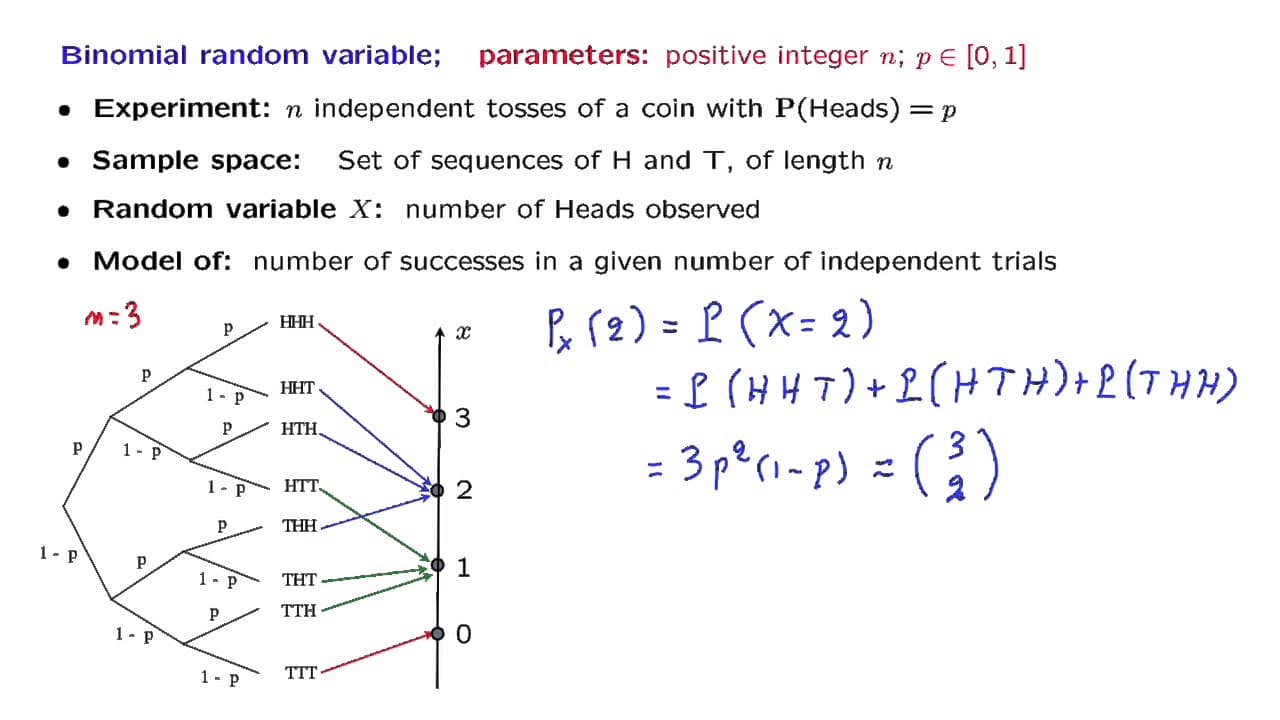
The next random variable that we will discuss is the binomial random variable. It is one that is already familiar to us in most respects. It is associated with the experiment of taking a coin and tossing it n times independently. And at each toss, there is a probability, p, of obtaining heads. So the experiment is completely specified in terms of t... Read More
Key Insights
- #️⃣ The binomial random variable is commonly used to model situations with a fixed number of independent trials and a probability of success for each trial.
- 🆘 The PMF helps calculate the probabilities of different outcomes for a binomial random variable.
- 😀 The distribution of the binomial random variable can vary based on the parameters n and p.
- 🪙 Fair coin tosses tend to have symmetrical distributions, while biased coin tosses may have skewed distributions.
- 🪙 The most likely outcome for a fair coin toss tends to be in the middle range, while for biased coin tosses, it is towards one extreme.
Install to Summarize YouTube Videos and Get Transcripts
Explore YouTube Video Summarizer or Get YouTube Transcript Extractor
Questions & Answers
Q: What is a binomial random variable?
A binomial random variable is associated with an experiment of a fixed number of independent trials, each with a probability of success, and represents the number of successes in those trials.
Q: How can we calculate the probability mass function (PMF) for a binomial random variable?
The PMF for a binomial random variable can be calculated using the binomial formula, which gives the probability of obtaining k successes in a sequence of n independent trials.
Q: What does the PMF tell us about the distribution of a binomial random variable?
The PMF shows us the probabilities of obtaining different numbers of successes in the trials. It reveals the likelihood of each outcome occurring.
Q: How does the probability distribution of a binomial random variable change with different parameters?
The probability distribution depends on the number of trials (n) and the probability of success (p). Changing these parameters can affect the shape and likelihoods of different outcomes.
Summary & Key Takeaways
-
The binomial random variable is associated with the experiment of tossing a coin independently n times, with a probability p of obtaining heads.
-
The random variable, denoted as X, represents the number of heads observed in the experiment.
-
The binomial probability mass function (PMF) can be used to calculate the probability of obtaining a certain number of successes in the trials.
Read in Other Languages (beta)
Share This Summary 📚
Summarize YouTube Videos and Get Video Transcripts with 1-Click
Try YouTube Summary with ChatGPT & Claude or YouTube Transcript Generator
Explore More Summaries from MIT OpenCourseWare 📚


Summarize YouTube Videos and Get Video Transcripts with 1-Click
Try YouTube Summary with ChatGPT & Claude or YouTube Transcript Generator