Current time base generator | Example problem | PDC | Lec-91
TL;DR
This content explains designing and analyzing a current time-based generator circuit.
Transcript
hi everyone let us see an example problem on this current time based generators in the previous video I have given you the explanation how to design a current time based generator and what are the output waveforms of this current time base generator for this current time by generator see in the voltage time based generators we have used the capacit... Read More
Key Insights
- ⚾ Current time-based generators operate using inductors to manage energy storage and output current effectively, contrasting with voltage-based systems.
- ⌛ The inductor's roles in calculating current and time constants are vital for system stability and response, especially during transient operations.
- 🤩 Detailed mathematical models provide clarity in understanding how circuit parameters interact and influence overall performance, key to designing efficient devices.
- 😮 An understanding of rise and fall time constants helps engineers optimize circuit responsiveness to changes, ensuring reliable functionality.
- 👻 Analyzing slope errors allows designers to assess deviations from ideal behavior, which is crucial in maintaining circuit accuracy.
- ❓ Output waveforms provide graphical insights into circuit behavior during different operational states, facilitating troubleshooting and enhancement.
- 🖐️ Awareness of collector-emitter dynamics plays a crucial role in evaluating circuit performance, especially in regards to transistors' switching characteristics.
Install to Summarize YouTube Videos and Get Transcripts
Explore YouTube Video Summarizer or Get YouTube Transcript Extractor
Questions & Answers
Q: What is the primary purpose of the current time-based generator discussed in the content?
The primary purpose of the current time-based generator is to produce specific output waveforms through a controlled flow of current. Unlike voltage-based systems, this design utilizes inductors to store energy in magnetic fields, addressing issues such as transient response and waveform stability in electronic circuits.
Q: How are inductors utilized differently than capacitors in this circuit?
In this circuit, inductors are employed to store energy in the form of magnetic fields, which is essential for generating a controlled current output. Capacitors, on the other hand, store energy as electrical charge in voltage time-based circuits, making inductors preferable in applications requiring nonlinear current management and higher inductive reactance.
Q: What formula is used to calculate the inductor current IL, and what parameters does it depend on?
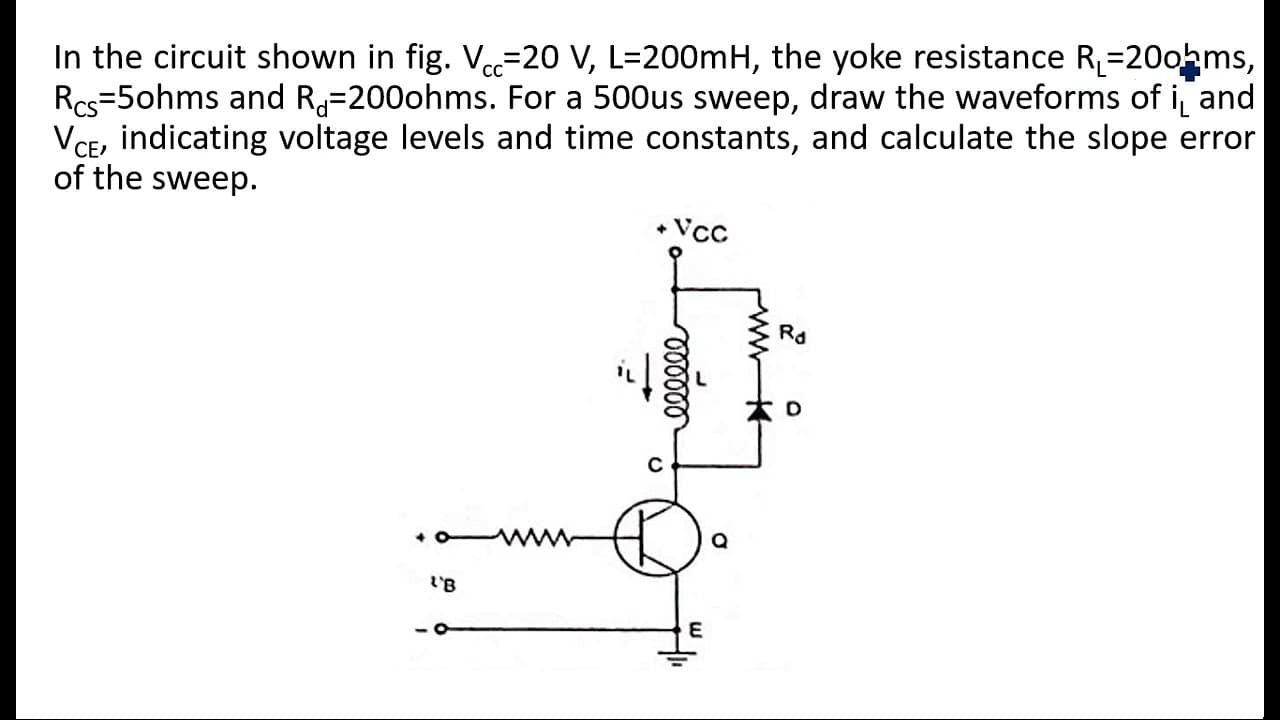
The inductor current IL is calculated using the formula IL = VCC * T / L * (1 - 1/2(RL + RCS)*T / L). This formula depends on the supply voltage (VCC), time duration (T), inductance value (L), and the resistances of the load (RL) and transistor saturation (RCS), thereby influencing the current flow through the inductor throughout the operation.
Q: Can you explain the significance of the rise time constant and how it is calculated?
The rise time constant represents the time it takes for the inductor current to rise from 10% to 90% of its maximum value. It is calculated using the formula T_rise = L / (RL + RCS), where L is the inductance and RL and RCS are the resistances. This constant is crucial for assessing how quickly the circuit can respond to changes in input signals and can affect overall circuit performance.
Q: What happens to the inductor's current when the transistor is switched off, and how is it modeled mathematically?
When the transistor is off, the inductor's current begins to decrease and follows an exponential decay pattern represented by the equation IL(t) = IL_initial * e^(-T-Ts)/(L/(RL+RD)). This models the discharge process through the resistance as the magnetic field collapses, resulting in a measurable current drop that can affect circuit operation.
Q: How do you interpret the output waveforms of the voltage VCE and inductor current IL during circuit operation?
The output waveforms illustrate the relationship between the collector-emitter voltage (VCE) and inductor current (IL) during intermittent transistor operation. They show how VCE peaks at supply voltage during the off state and drops when the transistor is active, corresponding to the fluctuations in IL. Understanding these waveforms is essential for analyzing transient behavior in electronic designs.
Q: What is slope error, and why is it significant in this analysis?
The slope error quantifies the deviation of the output current from its expected linear trajectory and is given by the formula es = IL / VCC. It is significant because it indicates the accuracy of the circuit's performance in producing desired current levels relative to the supply voltage, which affects the fidelity of signal transmission in electronic applications.
Q: What were the final results for the peak collector voltage and slope error based on the circuit analysis?
The peak collector voltage was calculated to be approximately 29.7 volts, which is obtained by adding the voltage supply (20 volts) to the voltage drop across the resistor caused by the current flowing through it. The slope error of the sweep was determined to be 6.05 percent, indicating the efficiency of the current time-based generator in maintaining expected performance levels.
Summary & Key Takeaways
-
The video provides an example problem for designing a current time-based generator using inductors, emphasizing their role in energy storage through magnetic fields, unlike voltage time-based generators that use capacitors.
-
Key calculations are demonstrated, including determining inductor current, rise and fall time constants, as well as calculating voltage levels and slope errors from output waveforms associated with the device's operation.
-
The output waveforms reveal the behavior of the circuit during different operational states of the transistor, outlining the relationship between input values, current flow, and output characteristics.
Read in Other Languages (beta)
Share This Summary 📚
Summarize YouTube Videos and Get Video Transcripts with 1-Click
Try YouTube Summary with ChatGPT & Claude or YouTube Transcript Generator