RH criteria | Closed loop Stability | CS | Control Systems | Lec-43
TL;DR
This content explains the Rh criteria for analyzing system stability using characteristic equations and tables.
Transcript
hello everyone in this session we will discuss about the rh criteria so last session we will discuss some points regarding the rh criteria so what is rhq area rh criteria means root harvard criteria ruth or which criteria or which criteria that is the scientist name actually so in this we will get close loop stability close loop stability we will a... Read More
Key Insights
- 🧑🔬 The Rh criteria, named after the scientist, facilitate the stability analysis of dynamic systems through mathematical evaluations.
- 💁 Characteristic equations form the backbone of stability analysis, serving as a tool to derive essential coefficients for systematic investigation.
- 😥 The Rh table is pivotal in visualizing coefficient relationships and identifying critical points that indicate system stability.
- 🤘 System stability can be analyzed through sign changes in the first column of the Rh table, with specific patterns reflecting stability or instability.
- 👻 A combination of traditional and shortcut methods allows engineers to efficiently evaluate system stability without sacrificing accuracy.
- 💁 The content emphasizes the foundational principles behind the Rh criteria while also offering practical tips for quick assessments in engineering tasks.
- 🎮 Understanding both theoretical and practical aspects of stability analysis equips engineers to design safer and more effective control systems.
Install to Summarize YouTube Videos and Get Transcripts
Explore YouTube Video Summarizer or Get YouTube Transcript Extractor
Questions & Answers
Q: What is the purpose of the Rh criteria?
The Rh criteria are used to determine the stability of a control system by analyzing its closed loop transfer function and characteristic equation. It helps engineers assess whether the system will respond predictably and remain stable over time, thus avoiding potential failures or undesirable behavior.
Q: How is the closed loop transfer function represented?
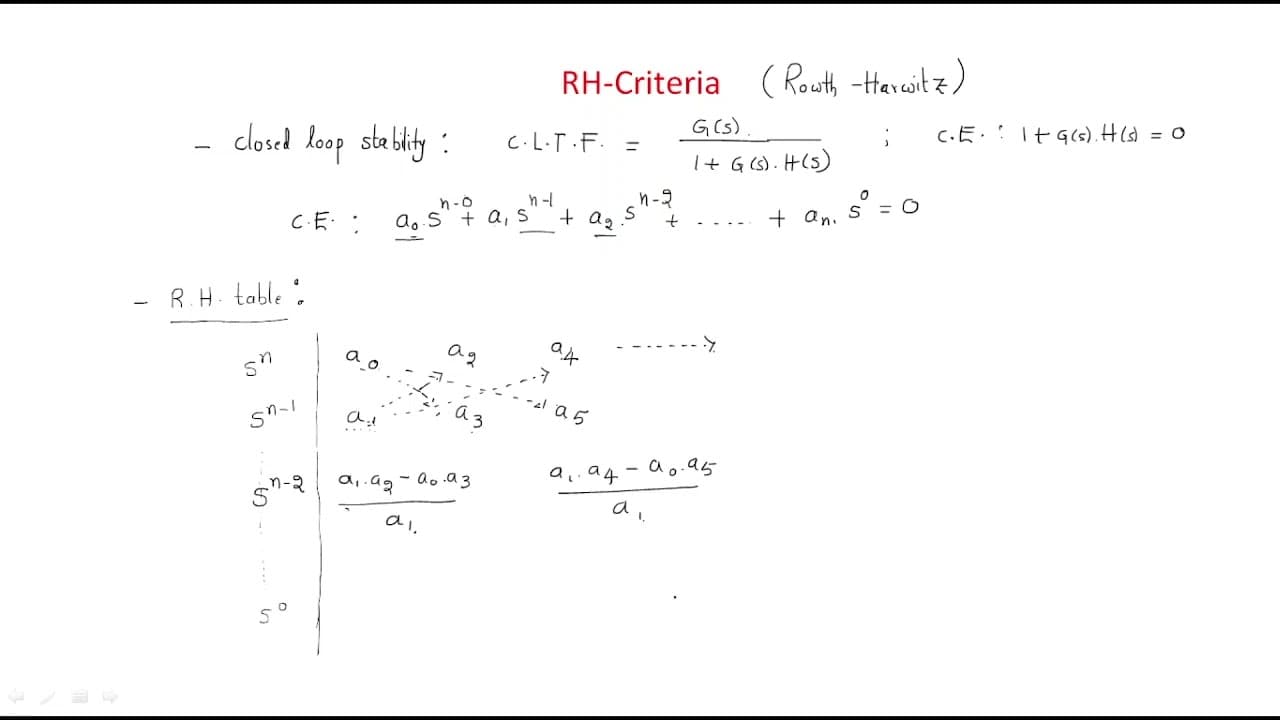
The closed loop transfer function is generally represented as G(s) / (1 + G(s)H(s)), where G(s) is the forward path transfer function and H(s) is the feedback path transfer function. This representation is crucial for deriving the characteristic equation needed to analyze the stability of control systems.
Q: What does a sign change in the first column of the Rh table indicate?
A sign change in the first column of the Rh table indicates potential instability within the control system. Each sign change corresponds to a pole in the right half of the s-plane, which signifies that the system may have unstable behavior, demanding further investigation and design adjustments.
Q: Can you explain how to construct the Rh table?
To construct the Rh table, start by listing the coefficients of the characteristic equation from highest to lowest order. The first column reflects these coefficients, and subsequent columns are calculated using specific formulae involving products of these coefficients. Analysis of sign changes in this table helps in determining system stability.
Q: What is the characteristic equation referenced in the stability analysis?
The characteristic equation is derived from the closed loop transfer function and takes the form 1 + G(s)H(s) = 0. By establishing this equation, one can evaluate the roots, which are essential for determining the stability of the control system based on the location of these roots in the s-plane.
Q: What method can be used as a shortcut for stability analysis?
A shortcut method involves comparing the products of inside and outside coefficients derived from the characteristic equation. If the inside coefficient products exceed the outside coefficients, the system is deemed stable. This approach simplifies the stability assessment process without extensive calculations from the Rh table.
Q: Why is it important to analyze system stability?
Analyzing system stability is crucial to ensure the reliability and expected performance of control systems. Stable systems behave predictably under various conditions, while unstable systems can yield erratic responses, threatening performance and safety in applications such as automated processes and feedback systems.
Q: What example is given to illustrate the stability analysis?
The session discusses a characteristic equation s³ + 6s² + 3s + 10 = 0, illustrating how to determine its stability. By applying the Rh criteria and constructing the Rh table, participants learn to assess whether the system is stable based on the coefficients and their sign changes in the analysis.
Summary & Key Takeaways
-
The Rh criteria involves the analysis of a system's stability through the closed loop transfer function, which is represented by a characteristic equation formed from system coefficients.
-
The stability analysis is conducted using the Rh table, where the coefficients from the characteristic equation are organized, and sign changes in the first column indicate system stability or instability.
-
Additional methods, such as product comparisons of coefficients, provide a quicker way to assess stability, confirming or contrasting conclusions drawn from the Rh table.
Read in Other Languages (beta)
Share This Summary 📚
Summarize YouTube Videos and Get Video Transcripts with 1-Click
Try YouTube Summary with ChatGPT & Claude or YouTube Transcript Generator