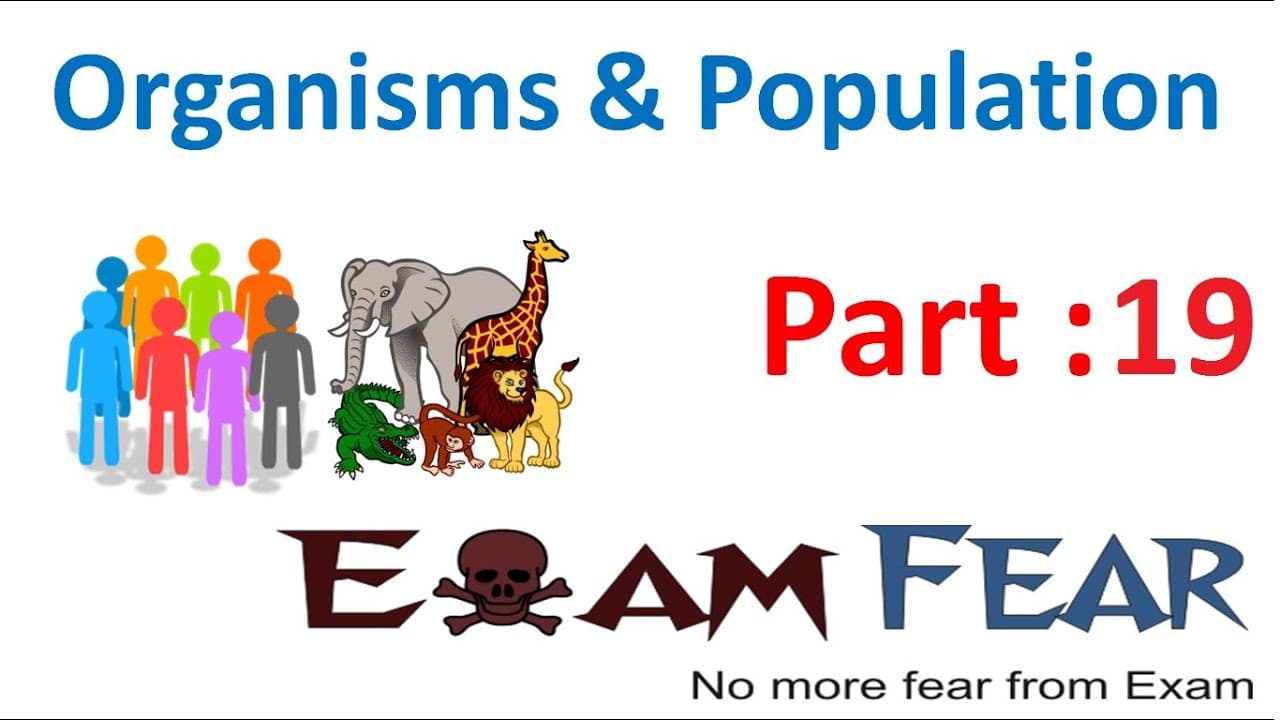
Biology Organisms & Population part 19 (Population density: Natality, Mortality) class 12 XII
TL;DR
Population density is a measure of how many organisms are present in a given area, and factors such as birth rate, death rate, immigration, and emigration determine whether the population is increasing or decreasing.
Transcript
hello friends this video on organisms and population part 19 is brought to you by exam fear calm no more fear from exam so now that we have been talking about population it is important to introduce population density that is how many organisms per unit area or per unit volume is present because many a times it happens that defining population beco... Read More
Key Insights
- 🔇 Population density is a measure of the number of organisms per unit area or volume.
- 🧑🏭 Factors such as natality, mortality, immigration, and emigration determine population growth or decline.
- ❓ Natality and immigration increase the population, while mortality and emigration decrease it.
- 🥳 Calculating population density involves considering the initial population density and accounting for changes in births, deaths, immigration, and emigration.
- 💨 Population density is important for studying and analyzing populations in a more manageable way.
Install to Summarize YouTube Videos and Get Transcripts
Explore YouTube Video Summarizer or Get YouTube Transcript Extractor
Questions & Answers
Q: What is population density and why is it important?
Population density is a measure of the number of organisms per unit area or volume, helping us understand how many individuals exist in a given space. It is important because it allows us to calculate the total population based on a small area, making it easier to study and analyze.
Q: How do factors like natality and mortality affect population growth?
Natality refers to the birth rate, so an increase in births will lead to population growth. Conversely, mortality, which is the death rate, will reduce the population as individuals die. These factors determine whether the population is increasing or decreasing.
Q: What is the difference between immigration and emigration?
Immigration is the entry of individuals into a specific area, which increases the population. Emigration, on the other hand, is when individuals leave an area, reducing the population. Both factors influence population size and growth.
Q: How can population density be calculated?
Population density can be calculated by considering the initial population density and accounting for changes due to natality, mortality, immigration, and emigration. The formula is: population density at time T+1 = population density at time T + births + immigrants - deaths - emigrants.
Summary & Key Takeaways
-
Population density is a way to measure the number of organisms per unit area or volume, since counting the total population is often difficult.
-
Factors such as natality (birth rate), mortality (death rate), immigration, and emigration play a critical role in determining population growth or decline.
-
Natality refers to the number of births in a given period, mortality is the number of deaths, immigration is the entry of individuals into an area, and emigration is when individuals leave.
Read in Other Languages (beta)
Share This Summary 📚
Summarize YouTube Videos and Get Video Transcripts with 1-Click
Try YouTube Summary with ChatGPT & Claude or YouTube Transcript Generator
Explore More Summaries from LearnoHub - Class 11, 12 📚


Summarize YouTube Videos and Get Video Transcripts with 1-Click
Try YouTube Summary with ChatGPT & Claude or YouTube Transcript Generator