30.3 Cross Product in Cartesian Coordinates
TL;DR
The video explains how to compute the cross-product of two vectors in different coordinate systems, with the use of the right hand rule.
Transcript
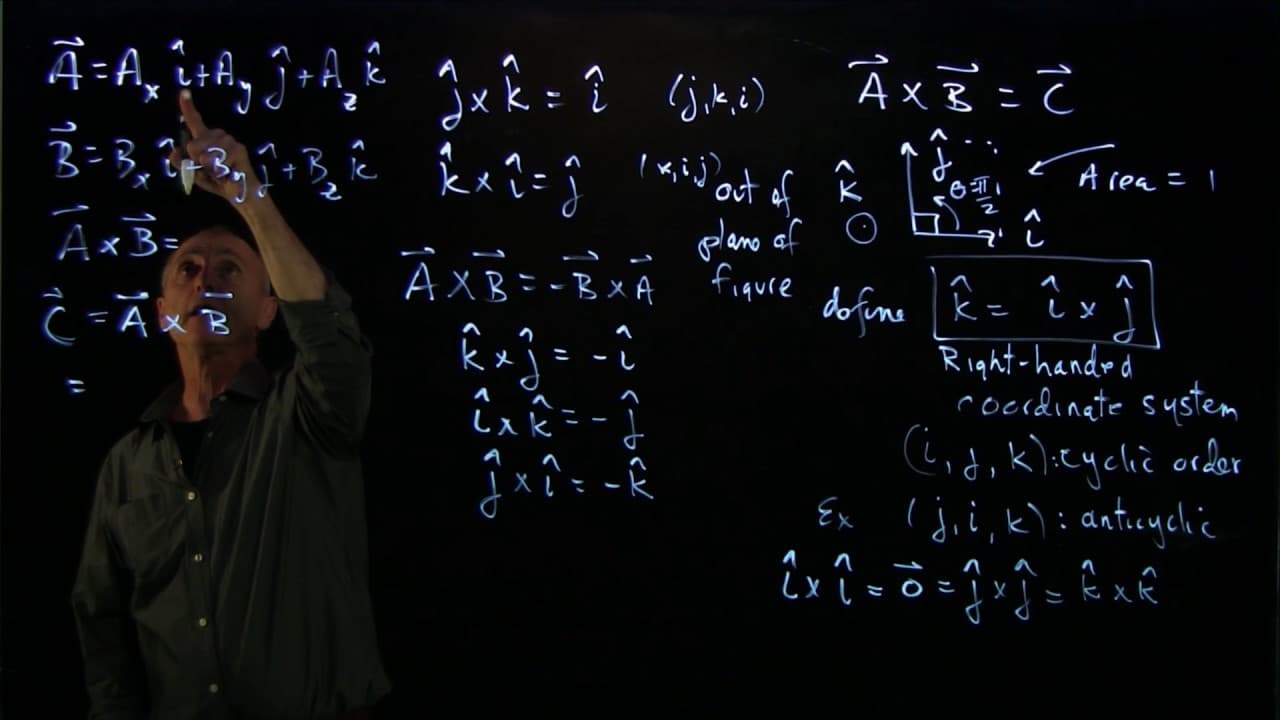
So when we have a vector product of two vectors, A cross B equals C, let's compute that vector product in different coordinate systems. So let's begin by choosing two vectors. I hat, and J hat. And notice they're at a right angle, and because there is a unit vector, the area here is equal to and 1. And I want to define K hat to be equal to I hat cr... Read More
Key Insights
- 🫱 The right-hand rule helps determine the direction of the unit normal vector.
- 😵 The cross product follows a cyclic order (IJK) and satisfies the anti-cyclic rule.
- 😵 In Cartesian coordinates, computing the cross product involves six terms, with three being zero.
Install to Summarize YouTube Videos and Get Transcripts
Explore YouTube Video Summarizer or Get YouTube Transcript Extractor
Questions & Answers
Q: What is the right-hand rule used for in computing the cross-product?
The right-hand rule is used to determine the direction of the unit normal vector in the cross-product, depending on the angle between the vectors.
Q: What is the significance of the cyclic order in the cross product?
The cyclic order (IJK) helps define the relationships between the cross products of the unit vectors. By interchanging the order, the resulting value will have a minus sign.
Q: How many terms are involved in computing the cross product in Cartesian coordinates?
There are six terms involved in computing the cross product in Cartesian coordinates. Three terms are zero, and the other three follow the cyclic or anti-cyclic rules.
Q: Can the cross product be calculated in other coordinate systems?
Yes, the cross product can be calculated in different coordinate systems, provided the right-hand rule and the cyclic/anti-cyclic rules are applied correctly.
Summary & Key Takeaways
-
The cross-product of two vectors can be calculated in different coordinate systems.
-
The right hand rule helps determine the direction of the unit normal vector.
-
The cross product follows a cyclic order and satisfies the anti-cyclic rule.
Read in Other Languages (beta)
Share This Summary 📚
Summarize YouTube Videos and Get Video Transcripts with 1-Click
Try YouTube Summary with ChatGPT & Claude or YouTube Transcript Generator
Explore More Summaries from MIT OpenCourseWare 📚



Summarize YouTube Videos and Get Video Transcripts with 1-Click
Try YouTube Summary with ChatGPT & Claude or YouTube Transcript Generator