Lecture 12: Blob Analysis, Binary Image Processing, Green's Theorem, Derivative and Integral
TL;DR
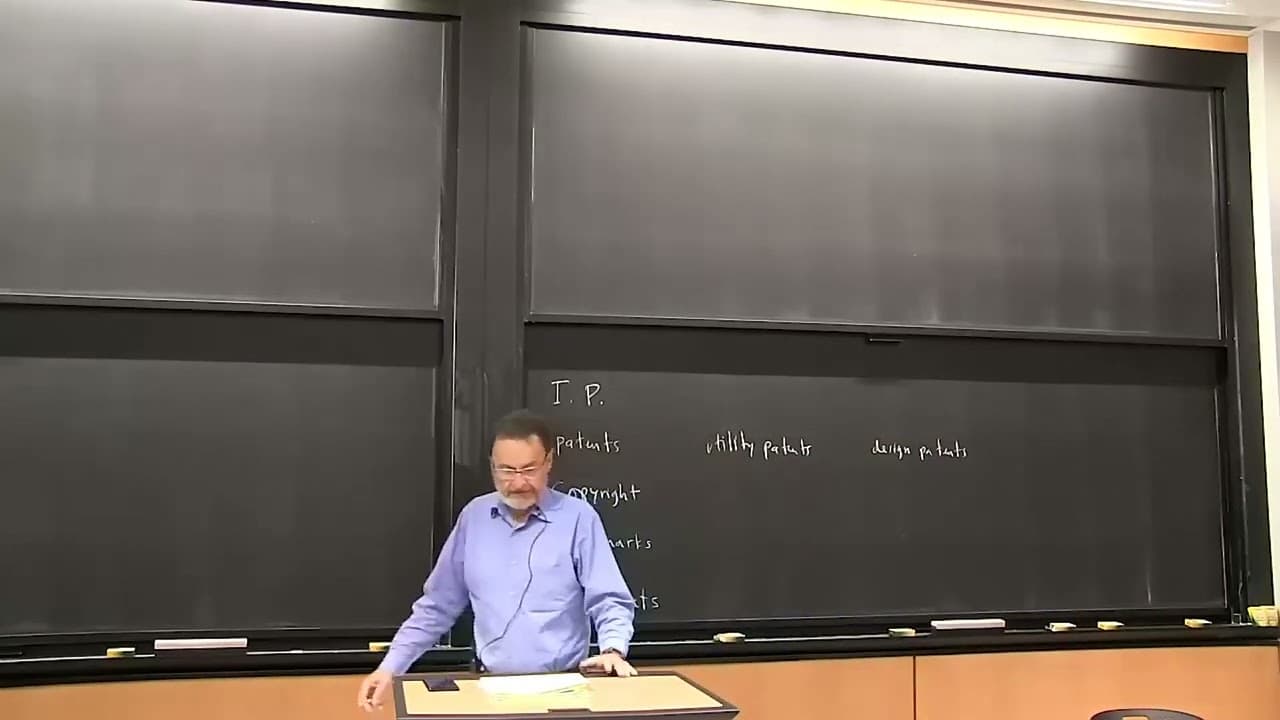
This content provides an analysis of intellectual property and explains the subpixel edge detection method.
Transcript
[SQUEAKING] [RUSTLING] [CLICKING] BERTHOLD HORN: This quiz one, which will be out today. And the rules for that are slightly different from the homework problems. It counts twice as much as a homework problem. And it's longer. Not twice as long, but something like that. And so you have also a little bit more time to do it. It's not just one week. B... Read More
Key Insights
- 👻 Intellectual property is an important legal concept that allows individuals and companies to protect their creations.
- ™️ Patents, copyrights, trademarks, and trade secrets are various forms of intellectual property, each serving different purposes and providing different types of protection.
- 🦔 Subpixel edge detection involves the use of edge operators, non-maximum suppression, and interpolation to achieve high-accuracy edge positions.
Install to Summarize YouTube Videos and Get Transcripts
Explore YouTube Video Summarizer or Get YouTube Transcript Extractor
Questions & Answers
Q: What are the different types of intellectual property mentioned in the content?
The content mentions utility patents, design patents, copyright, trademark, and trade secrets as different types of intellectual property.
Q: Why are ideas treated as intellectual property?
Ideas are treated as intellectual property to allow individuals or companies to have exclusive rights and benefits from their creations, inventions, or innovations for a limited period of time.
Q: How is subpixel edge detection performed?
Subpixel edge detection involves applying edge operators, such as the gradient and derivative estimators, and then using non-maximum suppression to identify potential edge points. Subpixel interpolation is used to obtain accurate edge positions.
Q: What is the purpose of non-maximum suppression in edge detection?
Non-maximum suppression is used to locate the maximum edge response in the gradient direction and remove other potential edge points that have weaker responses.
Summary & Key Takeaways
-
The content explains different types of intellectual property, including utility patents, design patents, copyright, trademark, and trade secrets.
-
It discusses the concept of intellectual property and the need for formalizing ideas as property for legal purposes.
-
The content also explains the process of subpixel edge detection, including the use of non-maximum suppression and interpolation to obtain high-accuracy edge positions.
Read in Other Languages (beta)
Share This Summary 📚
Summarize YouTube Videos and Get Video Transcripts with 1-Click
Try YouTube Summary with ChatGPT & Claude or YouTube Transcript Generator
Explore More Summaries from MIT OpenCourseWare 📚



Summarize YouTube Videos and Get Video Transcripts with 1-Click
Try YouTube Summary with ChatGPT & Claude or YouTube Transcript Generator