Data flow and Behavioral modelling of verilog | Digital Systems Design | Lec-23
TL;DR
This video explains data flow and behavioral modeling techniques in Verilog coding for combinational and sequential logic.
Transcript
hi everyone in this video I'm going to explain about data flow modeling and behavior modeling of we log coding so first we will see data flow modeling which is very easy in the data flow modeling of vhdl programming we have learned how the programs are going to be written in terms of just assignment that means uh based on the output Po in expressio... Read More
Key Insights
- 😒 Data flow modeling uses continuous assignments to represent combinational logic circuits simply and effectively.
- 👨💻 Behavioral modeling in Verilog can accommodate both combinational and sequential circuit designs, enhancing flexibility in coding.
- 🛟 The
initialstatement is unique to test benches and cannot be synthesized into hardware, serving a simulation-focused purpose. - ⌛ The
alwaysstatement is essential for describing time-dependent behavior, especially in sequential circuits, making it synthesizable. - 💼 Verilog distinguishes between case sensitivity in keywords and variable names, requiring precise adherence to syntax.
- 🤬 Assignment operators in Verilog are different from those in VHDL, using symbols for logical operations instead of explicit names.
- 🔁 Procedural statements can incorporate various programming structures, including loops and conditionals, within both
initialandalwayscontexts.
Install to Summarize YouTube Videos and Get Transcripts
Explore YouTube Video Summarizer or Get YouTube Transcript Extractor
Questions & Answers
Q: What is data flow modeling in Verilog?
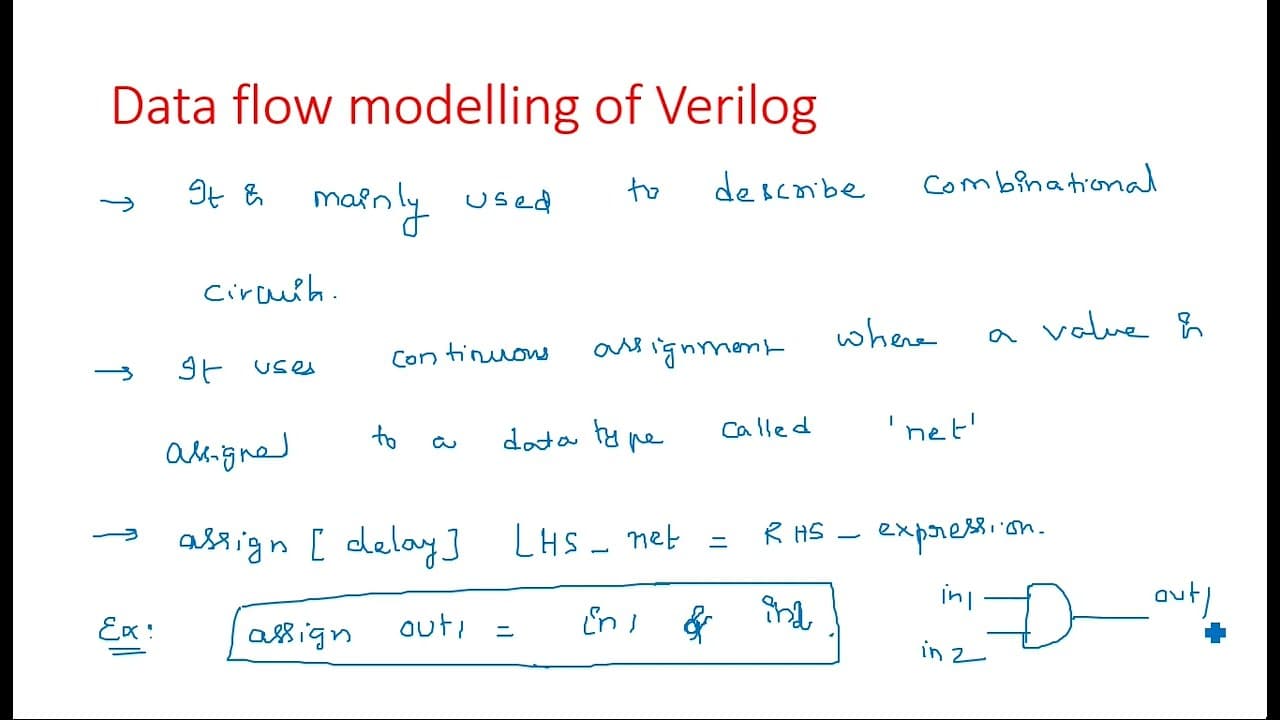
Data flow modeling in Verilog allows programmers to describe combinational logic circuits using continuous assignments. It simplifies the representation of logic functions with Boolean expressions by directly assigning values to output nets based on input signals. This approach focuses on how data moves through the circuit, making it easier to visualize and implement.
Q: How does behavioral modeling differ from data flow modeling?
Behavioral modeling can describe both combinational and sequential circuits, contrasting with data flow modeling, which is limited to combinational logic. Behavioral modeling involves writing procedural statements and using constructs like initial and always, making it more versatile for complex circuit designs, including sequential elements like flip-flops.
Q: What are the roles of initial and always statements in behavioral modeling?
The initial statement is executed only once at the start of simulation, often used in test benches for initializing values. The always statement, however, executes continuously or in response to specific events like clock edges, allowing for dynamic behavior in sequential circuits. Together, they form the backbone of behavioral modeling.
Q: Why is the initial statement considered non-synthesizable?
The initial statement is deemed non-synthesizable because it is mainly used during simulation for setting initial states or conditions in test benches and not intended for hardware implementation. This means it cannot be directly translated into actual hardware circuits, contrasting with synthesizable constructs like the always statement.
Summary & Key Takeaways
-
The video introduces data flow modeling as a straightforward method for writing combinational logic in Verilog, using assignment operators to create output Boolean expressions based on inputs.
-
It contrasts data flow modeling with behavioral modeling, highlighting that behavioral modeling can describe both combinational and sequential circuits through procedural statements.
-
Key components of behavioral modeling are the
initialandalwaysstatements, which dictate how and when procedural statements are executed during simulation.
Read in Other Languages (beta)
Share This Summary 📚
Summarize YouTube Videos and Get Video Transcripts with 1-Click
Try YouTube Summary with ChatGPT & Claude or YouTube Transcript Generator