12. Numerical Examples of Activity, Half Life, and Series Decay
TL;DR
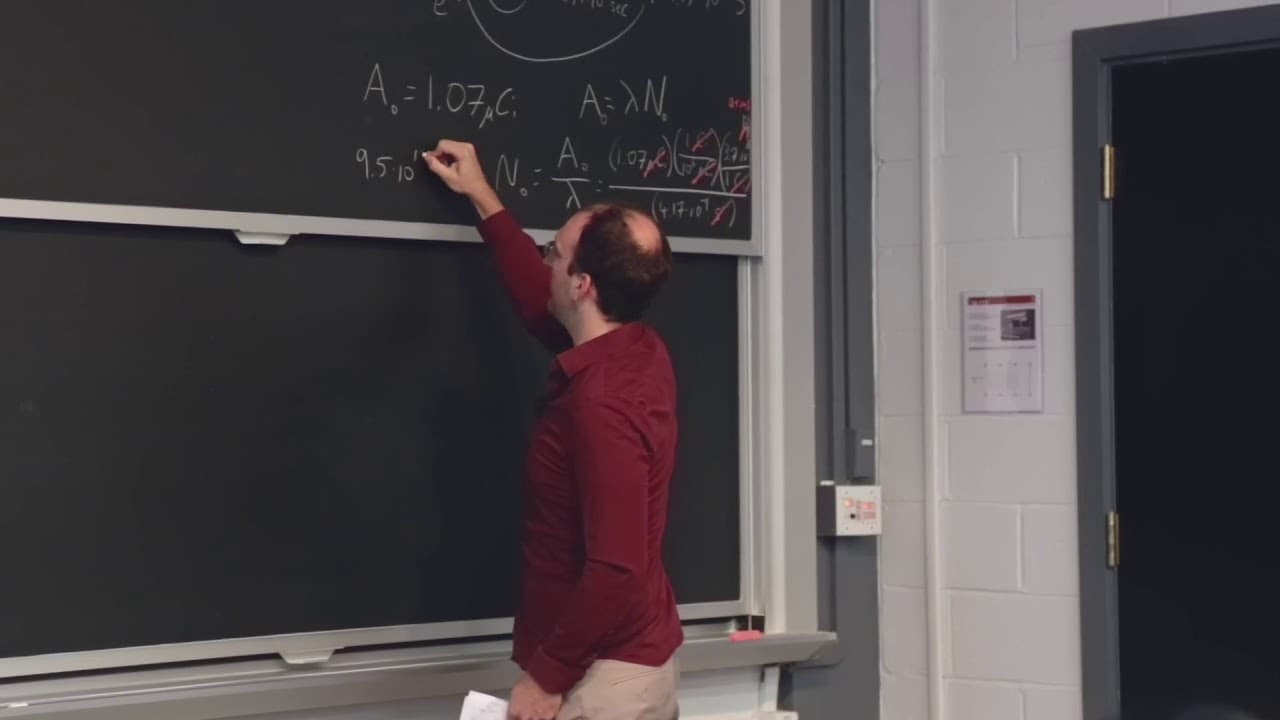
The content explores the process of radioactive decay and discusses the production of cobalt-60 through neutron bombardment of cobalt-59. It also delves into the calculation of key parameters and the determination of profit from operating a reactor.
Transcript
The following content is provided under a Creative Commons license. Your support will help MIT OpenCourseWare continue to offer high quality educational resources for free. To make a donation or to view additional materials from hundreds of MIT courses, visit MIT OpenCourseWare at ocw.mit.edu. MICHAEL SHORT: You guys asked to do some numerical exam... Read More
Key Insights
- ☠️ Half-life is a critical parameter in radioactive decay calculations, as it determines the rate at which a substance decays over time.
- ☢️ Significant figures are important in determining the uncertainty and accuracy of measured values in radioactive decay.
- ⛔ The licensing and regulation of radioactive sources are crucial to ensure that they are safely calibrated and operate within specified limits.
- ☢️ Cobalt-60 production is achieved through neutron bombardment of cobalt-59, resulting in the conversion of stable cobalt-59 to radioactive cobalt-60.
Install to Summarize YouTube Videos and Get Transcripts
Explore YouTube Video Summarizer or Get YouTube Transcript Extractor
Questions & Answers
Q: How is the actual activity of a radioactive source calculated when significant figures are used?
The actual activity is determined by considering the number of significant figures in the given activity value. A value of 1 microcurie would have an uncertainty of ±0.5 microcurie, resulting in an actual activity of 1 plus or minus 0.5 microcurie.
Q: What is the role of lambda in radioactive decay calculations?
Lambda, also known as the decay constant, represents the probability of decay per unit time for a radioactive substance. It is used in the activity equation, where the current activity equals the initial activity multiplied by e to the power of minus lambda t.
Q: How can the number of cobalt-60 atoms or the mass of cobalt-60 be determined?
The number of cobalt-60 atoms can be calculated by dividing the initial activity by the decay constant. Once the number of atoms is known, it can be converted to mass using Avogadro's number and the atomic mass of cobalt-60.
Q: How is the efficiency of a Geiger counter determined for measuring cobalt-60 activity?
The efficiency of a Geiger counter is determined by knowing the distance between the source and the detector, the number of gamma rays emitted by cobalt-60 per disintegration, and the number of gamma rays detected by the Geiger counter. By accounting for these factors, the efficiency of the detector can be calculated.
Summary & Key Takeaways
-
The video discusses the concept of radioactive decay and its application to cobalt-60, which undergoes beta decay to produce nickel-60.
-
It demonstrates the calculation of activity, uncertainty, and number of atoms/mass of cobalt-60 using the half-life and atomic mass.
-
The content further explores the mathematical derivation of the differential equations that model cobalt-60 production and decay in a reactor.
-
The video presents the scenario of a reactor operating to maximize profit and prompts viewers to determine the optimal operating time.
Read in Other Languages (beta)
Share This Summary 📚
Summarize YouTube Videos and Get Video Transcripts with 1-Click
Try YouTube Summary with ChatGPT & Claude or YouTube Transcript Generator
Explore More Summaries from MIT OpenCourseWare 📚


Summarize YouTube Videos and Get Video Transcripts with 1-Click
Try YouTube Summary with ChatGPT & Claude or YouTube Transcript Generator