Bidirectional shift register | Circuit Diagram | STLD | Lec-132
TL;DR
Bidirectional shift registers allow data shifting in both left and right directions.
Transcript
hi everyone in this video I'm going to explain about bidirectional shift register by directional shift register the meaning of this by directional is the data can be shifted in both right side and as well as left side okay that means one top meant for two different operations this shift register is used to shift the data from left to right or from ... Read More
Key Insights
- 👻 A bidirectional shift register allows simultaneous control of data flow in two directions, enhancing its utility in digital circuits.
- 🎮 The control pin "right by left bar" is critical for selecting the shift direction, showcasing the importance of control signals in digital electronics.
- ®️ Bidirectional shift registers are categorized primarily as serial-in serial-out devices, distinguishing them from other types of shift registers with varying data input/output configurations.
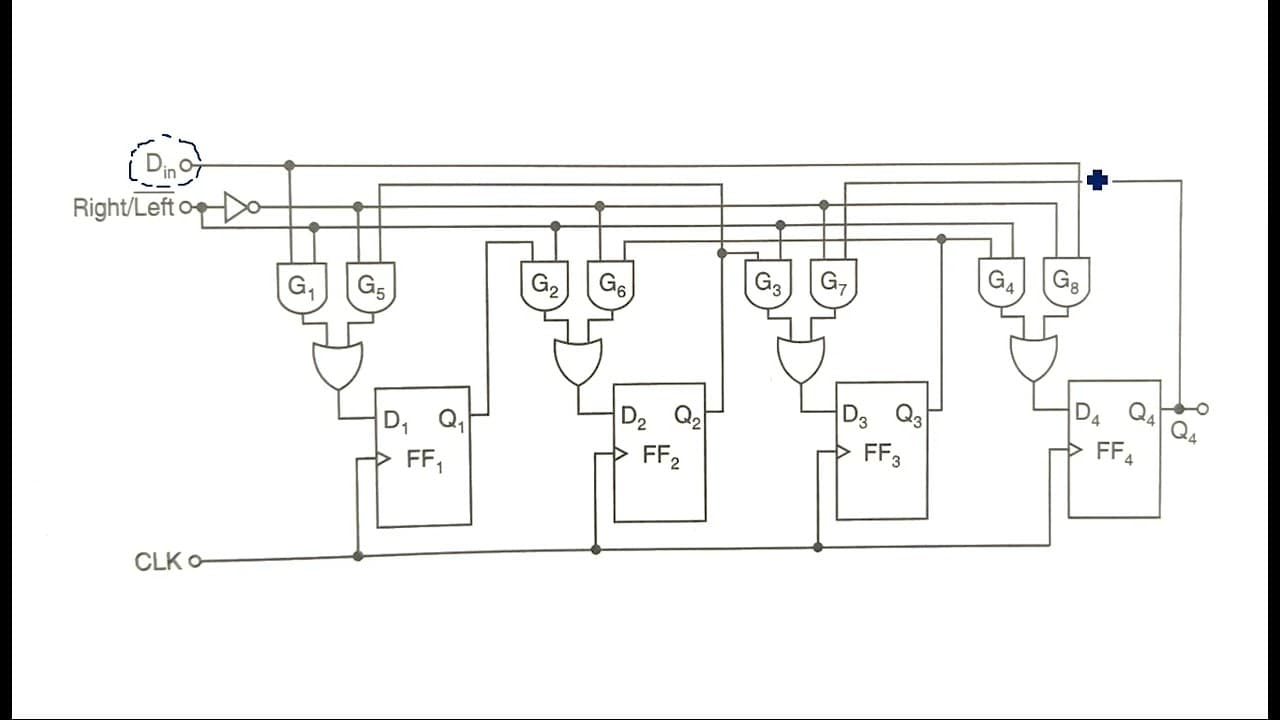
- 🔬 The logic design of these registers involves several gates, including AND and OR gates, highlighting the complexity of their operation despite seeming straightforward.
- 🏑 Applications of bidirectional shift registers extend to various fields, including communications, data storage, and electronic circuit design.
- 🖐️ Understanding the operation principles of a bidirectional shift register lays the foundation for grasping more complex digital systems and their functionalities.
- 🥺 In practice, each clock pulse leads to a systematic shift of data either left or right, emphasizing the synchronized nature of operations in digital circuits.
Install to Summarize YouTube Videos and Get Transcripts
Explore YouTube Video Summarizer or Get YouTube Transcript Extractor
Questions & Answers
Q: What is a bidirectional shift register?
A bidirectional shift register is a type of digital memory circuit that allows data to be shifted both left and right. This functionality is crucial in applications where flexibility in data movement is required, enabling different operations based on control signals. Typically, it facilitates serial data input/output, making it versatile for various electronic applications.
Q: How does the control signal determine the direction of data shifting?
The direction of data shifting in a bidirectional shift register is determined by the control pin "right by left bar." When this pin is set to zero, the register performs a left shift operation, while setting it to one triggers a right shift operation. This dual functionality enables efficient data manipulation for different applications.
Q: What are the types of shift registers discussed in the video?
The video mentions four types of shift registers: serial-in serial-out, serial-in parallel-out, parallel-in serial-out, and parallel-in parallel-out. Among these, the bidirectional shift register falls under the serial-in serial-out category, where data enters and exits the register serially, regardless of the shift direction.
Q: Why are additional gates necessary in the bidirectional shift register's logic diagram?
The inclusion of additional gates in the logic diagram of a bidirectional shift register is essential for controlling the shifting operations. These gates determine which data paths are activated based on the control signals, thus managing the direction of data flow and facilitating efficient shifts in both left and right directions.
Q: Can you explain how data is shifted during left and right operations?
During a left shift operation, data is moved from right to left, with each bit being transferred one position leftward upon each clock pulse. Conversely, during a right shift operation, data shifts from left to right, effectively moving each bit one position rightward. This process continues with each clock pulse, demonstrating the dynamic data manipulation capability of the register.
Q: What are the potential applications of a bidirectional shift register?
Bidirectional shift registers can be used in various applications including data storage, data manipulation in digital circuits, and communication systems where data needs to be transferred in both directions. They are particularly useful in microcontroller and FPGA designs, as well as in serial communication protocols where data needs to be efficiently managed and transmitted.
Summary & Key Takeaways
-
A bidirectional shift register allows data movement in both the left and right directions using control pins to select the operation mode.
-
The register operates as a serial-in serial-out device, meaning data enters and exits the register in a serial format based on the selected shift direction.
-
The logic circuit for a bidirectional shift register includes specific gates to handle the control signals, enabling either left or right shifts while maintaining the integrity of the data being processed.
Read in Other Languages (beta)
Share This Summary 📚
Summarize YouTube Videos and Get Video Transcripts with 1-Click
Try YouTube Summary with ChatGPT & Claude or YouTube Transcript Generator