3. Budget Constraints and Constrained Choice
TL;DR
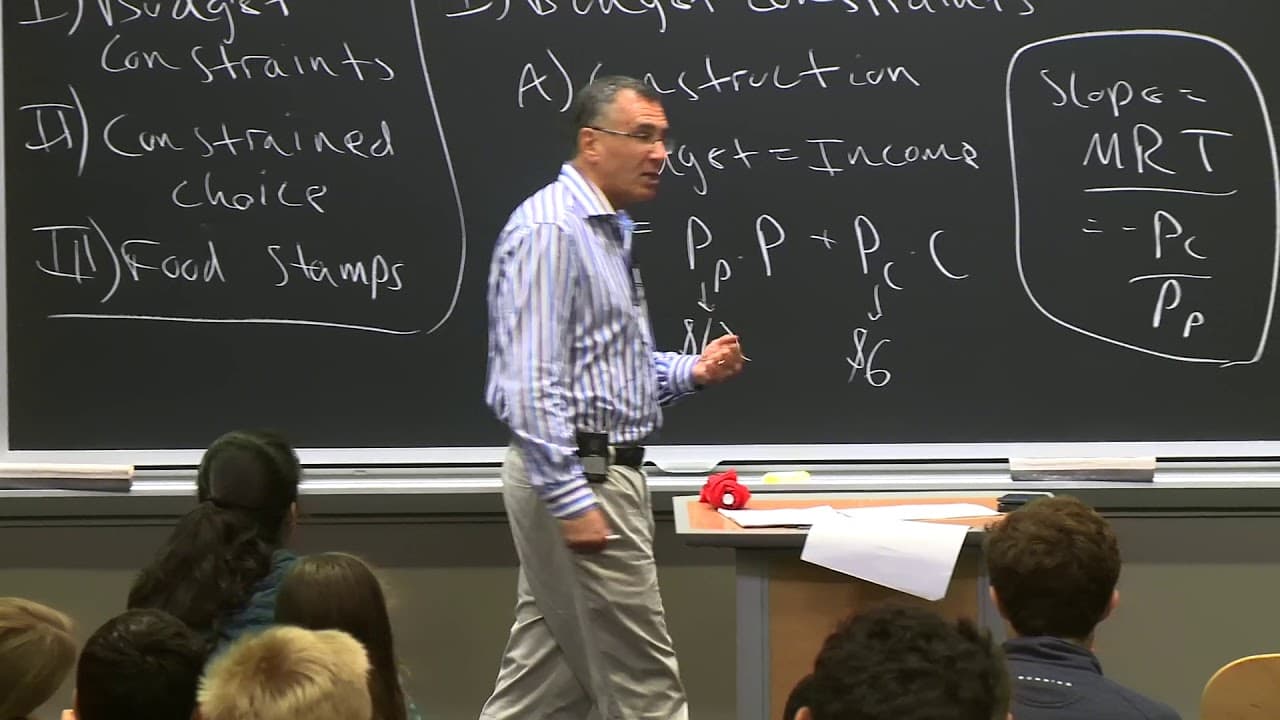
Consumers make choices based on their budget constraints, with the goal of maximizing utility. This can be seen in examples such as food stamps and cash transfers.
Transcript
[SQUEAKING] [RUSTLING] [CLICKING] JONATHAN GRUBER: Today, we're going to continue our discussion of consumer choice. And we're going to talk now about what happens when we take that unconstrained choice we talked about on Monday and impose budget constraints. We'll talk about what budget constraints are. We'll then come to talking about how consume... Read More
Key Insights
- 👋 Budget constraints play a crucial role in shaping consumer choices, as they force individuals to consider the cost of goods and services.
- ☠️ The relationship between the marginal rate of substitution and the marginal rate of transformation determines optimal consumer choices.
- 😋 Food stamps are a form of paternalism, where the government influences individuals' spending decisions for their own well-being.
Install to Summarize YouTube Videos and Get Transcripts
Explore YouTube Video Summarizer or Get YouTube Transcript Extractor
Questions & Answers
Q: How do consumers make constrained choices?
Consumers make constrained choices by considering their budget constraints and the trade-offs between different goods. They aim to maximize their utility by making decisions that align with their preferences and limitations.
Q: What is the relationship between the marginal rate of substitution and the marginal rate of transformation?
The marginal rate of substitution represents the rate at which a consumer is willing to trade one good for another to maintain the same level of satisfaction. The marginal rate of transformation indicates the rate at which one good can be transformed into another based on their relative prices. In optimal choices, these two rates should be equal.
Q: Why does the government provide food stamps instead of cash?
The government provides food stamps to ensure that individuals with low income are using their resources to purchase food. It is a form of paternalism, where the government believes they know what is best for individuals who may not make optimal choices on their own.
Q: Does the implementation of food stamps increase food consumption?
Based on empirical evidence, it has been observed that individuals receiving food stamps tend to spend more on food compared to when they are given cash. Food stamps force individuals to allocate a certain portion of their resources to food, potentially making them consume more food.
Summary & Key Takeaways
-
Budget constraints limit consumer choices, forcing them to consider the cost of goods and services.
-
The slope of the budget constraint represents the trade-off between different goods.
-
Consumer preferences are represented by indifference curves, and the optimal choice is where the indifference curve tangents with the budget constraint.
Read in Other Languages (beta)
Share This Summary 📚
Summarize YouTube Videos and Get Video Transcripts with 1-Click
Try YouTube Summary with ChatGPT & Claude or YouTube Transcript Generator
Explore More Summaries from MIT OpenCourseWare 📚



Summarize YouTube Videos and Get Video Transcripts with 1-Click
Try YouTube Summary with ChatGPT & Claude or YouTube Transcript Generator