Fukushima Water Release: BBC News Review
TL;DR
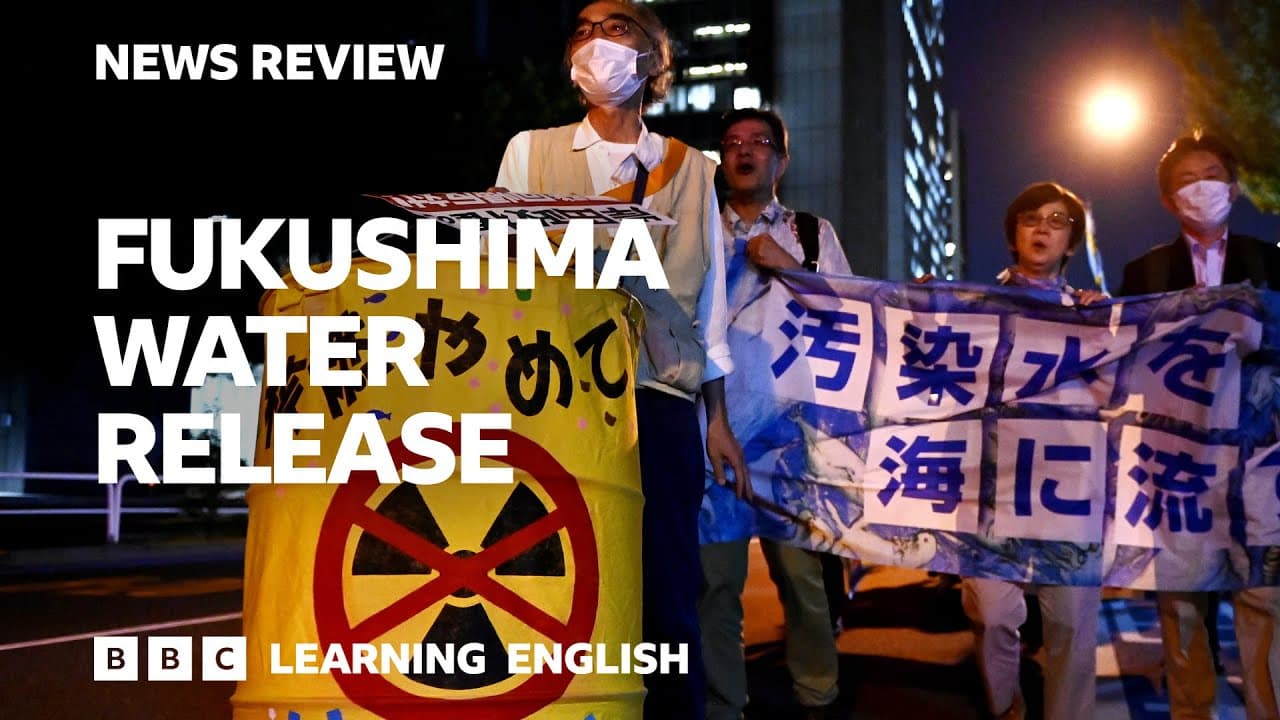
UN approves Fukushima water release; China and South Korea oppose.
Transcript
Is it safe to release water from the Fukushima nuclear plant? The UN says yes. This is News Review from BBC Learning English. I'm Neil. And I'm Beth. Make sure you watch to the end to learn vocabulary you need to talk about this story. Don't forget to subscribe to our channel, like this video and try the quiz on our website. Now, the story. Fukushi... Read More
Key Insights
- The UN has approved Japan's plan to release wastewater from the Fukushima nuclear plant, deeming it safe.
- The Fukushima nuclear disaster in 2011 was the worst since Chernobyl, caused by a tsunami-induced radiation leak.
- China and South Korea oppose the wastewater release, raising regional environmental concerns.
- The term 'watchdog' refers to organizations ensuring other entities adhere to safety and ethical standards.
- The IAEA, a nuclear safety watchdog, plays a crucial role in overseeing the Fukushima water release process.
- Greenlighting involves granting permission, akin to a green traffic light signaling 'go'.
- Japan is urged to use scientific evidence to refute claims that the wastewater release is dangerous.
- The word 'refute' is often used in formal contexts to strongly deny or disprove claims or opinions.
Install to Summarize YouTube Videos and Get Transcripts
Explore YouTube Video Summarizer or Get YouTube Transcript Extractor
Questions & Answers
Q: What is the UN's stance on the Fukushima water release?
The UN has approved Japan's plan to release wastewater from the Fukushima nuclear plant into the ocean, stating that it is safe. This decision comes after extensive assessments to ensure that the release meets international safety standards, despite opposition from neighboring countries like China and South Korea.
Q: Why is the term 'watchdog' relevant in this context?
The term 'watchdog' is relevant because it describes organizations like the International Atomic Energy Agency (IAEA) that oversee and ensure compliance with safety and ethical standards. In the context of Fukushima, the IAEA acts as a nuclear safety watchdog, monitoring the water release process to ensure it adheres to safety protocols.
Q: What does 'greenlighting' mean in the article?
'Greenlighting' in the article refers to granting permission for an action to proceed, similar to a green traffic light signaling 'go'. It is used metaphorically to describe the UN and IAEA's approval for Japan to release the Fukushima wastewater, indicating that the necessary safety checks have been completed and the action is authorized.
Q: How should Japan address opposition to the water release?
Japan should address opposition to the water release by using scientific evidence to refute claims that the release is dangerous. This involves presenting data and research findings that demonstrate the safety of the release, countering misinformation, and engaging in diplomatic dialogue with concerned countries like China and South Korea.
Q: What historical event is the Fukushima disaster compared to?
The Fukushima disaster is compared to the Chernobyl disaster of the 1980s, as both are considered major nuclear accidents. Fukushima's disaster occurred in 2011 when a tsunami flooded the nuclear plant, causing a significant radiation leak. This comparison underscores the severity and impact of the Fukushima incident on global nuclear safety discussions.
Q: What role does the IAEA play in the Fukushima water release?
The IAEA, as a nuclear safety watchdog, plays a critical role in overseeing the Fukushima water release. It ensures that the release adheres to international safety standards, providing independent assessments and monitoring to reassure the international community that the process is safe and controlled, despite regional opposition.
Q: Why is the word 'refute' used in the discussion?
The word 'refute' is used to describe the formal act of denying or disproving claims, particularly in official or academic contexts. In the discussion about Fukushima, Japan is encouraged to refute misinformation by presenting scientific evidence that contradicts claims about the dangers of the wastewater release, reinforcing the credibility of their actions.
Q: What are some key vocabulary terms used in the BBC News Review?
Key vocabulary terms used in the BBC News Review include 'watchdog', 'greenlighting', and 'refute'. 'Watchdog' refers to oversight organizations like the IAEA, 'greenlighting' signifies granting permission, and 'refute' denotes the formal denial of claims. These terms are crucial for understanding the nuances of the Fukushima water release discussion.
Summary & Key Takeaways
-
The UN has approved the release of wastewater from Japan's Fukushima nuclear plant, a decision met with opposition from China and South Korea. The term 'watchdog' describes organizations like the IAEA that ensure safety standards. 'Greenlighting' signifies permission, while 'refute' is a formal denial.
-
Fukushima's 2011 nuclear disaster, the worst since Chernobyl, resulted from a tsunami-induced radiation leak. Despite UN approval, regional tensions persist as China and South Korea oppose the wastewater release. Japan is advised to counter misinformation with scientific evidence, utilizing formal language like 'refute'.
-
The BBC News Review discusses the Fukushima water release, highlighting vocabulary such as 'watchdog', 'greenlighting', and 'refute'. These terms relate to safety oversight, permission granting, and formal denial respectively. The discussion emphasizes the importance of scientific evidence in addressing public concerns.
Read in Other Languages (beta)
Share This Summary 📚
Summarize YouTube Videos and Get Video Transcripts with 1-Click
Try YouTube Summary with ChatGPT & Claude or YouTube Transcript Generator
Explore More Summaries from BBC Learning English 📚
Summarize YouTube Videos and Get Video Transcripts with 1-Click
Try YouTube Summary with ChatGPT & Claude or YouTube Transcript Generator