Shear Strain and Shear Strain Rate in the Metal Cutting - Metal Cutting - Production Process 2
TL;DR
Understanding shear strain, tool properties, types of tools, and cutting fluids in metal cutting operations.
Transcript
so now we'll see the shear strain and the shear strain rate in the metal cutting operation let us see the diagram here we can have thick tuned workpiece and cheap okay and the tool is even filled in this direction length wise direction now let us see here the dotted tool is the previous position of the tool at a before 8 reaching 2.0 and had that m... Read More
Key Insights
- 🤘 Shear strain is a vital factor in understanding metal cutting deformation.
- 😅 Tool materials should possess properties like hot hardness and toughness for effective metal cutting.
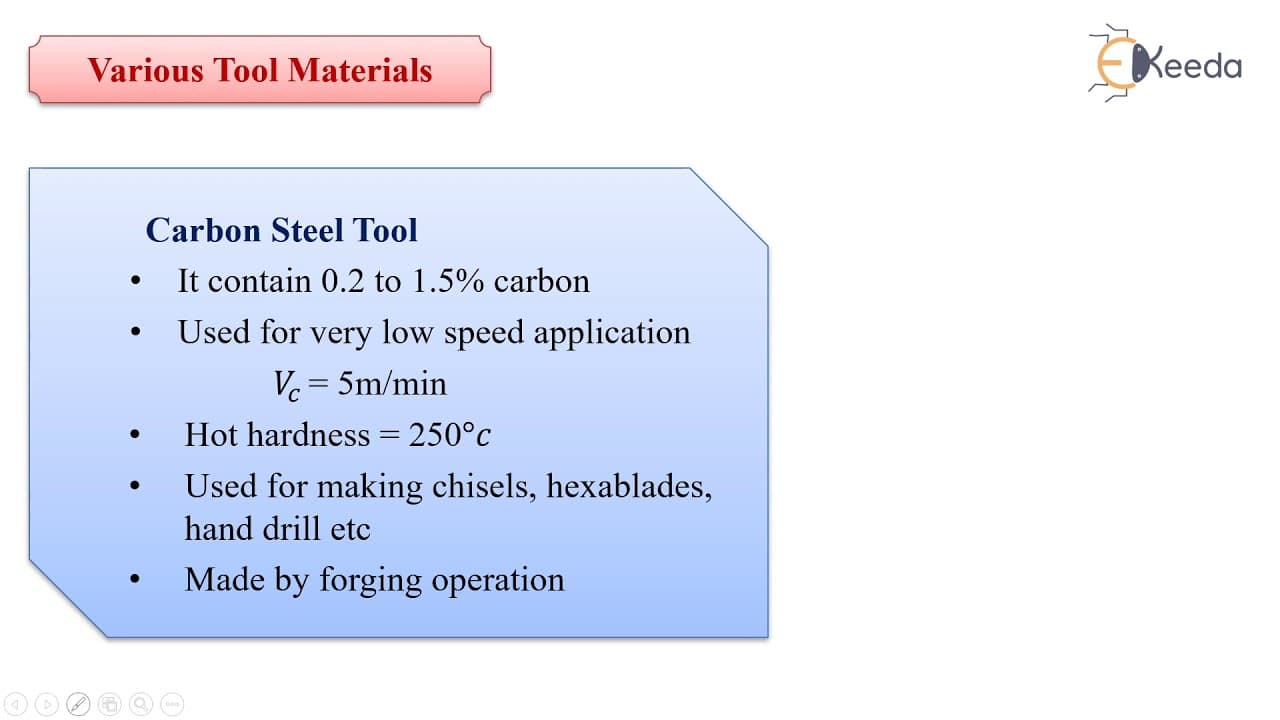
- 🚄 Various types of cutting tools such as high-speed steel, ceramics, and diamond offer unique advantages.
- 😎 Cutting fluids are essential for cooling, lubrication, and surface protection in metal cutting.
- 🤘 Cutting tools are classified based on composition and application for specific metal cutting tasks.
- 📢 Cemented carbides and cubic boron nitride are advanced tool materials with superior properties.
- 🤘 Cutting forces are essential in metal cutting to control chip flow and protect workpiece surfaces.
Install to Summarize YouTube Videos and Get Transcripts
Explore YouTube Video Summarizer or Get YouTube Transcript Extractor
Questions & Answers
Q: What is shear strain in metal cutting?
Shear strain is the ratio of deformation just before fracture to the shortest distance between two shear planes, indicating the extent of deformation in metal cutting.
Q: What are the key properties of tool materials in metal cutting operations?
Tool materials should exhibit properties like hot hardness, wear resistance, toughness, and thermal conductivity to withstand high temperatures and stresses during metal cutting.
Q: How are cutting tools classified in metal cutting operations?
Cutting tools are classified into categories like high carbon steel, high-speed steel, cemented carbides, ceramics, diamond, cubic boron nitride, and more based on their composition and application in metal cutting.
Q: Why are cutting fluids important in metal cutting operations?
Cutting fluids play a crucial role in metal cutting by cooling the tool-chip interface, carrying away heat, protecting surfaces from corrosion, improving finish, and preventing built-up edge formation.
Summary & Key Takeaways
-
Explanation of shear strain and shear strain rate in metal cutting operations.
-
Overview of tool material properties and their significance in metal cutting.
-
Different types of cutting tools and the role of cutting fluids in metal cutting operations.
Read in Other Languages (beta)
Share This Summary 📚
Summarize YouTube Videos and Get Video Transcripts with 1-Click
Try YouTube Summary with ChatGPT & Claude or YouTube Transcript Generator
Explore More Summaries from Ekeeda 📚






Summarize YouTube Videos and Get Video Transcripts with 1-Click
Try YouTube Summary with ChatGPT & Claude or YouTube Transcript Generator