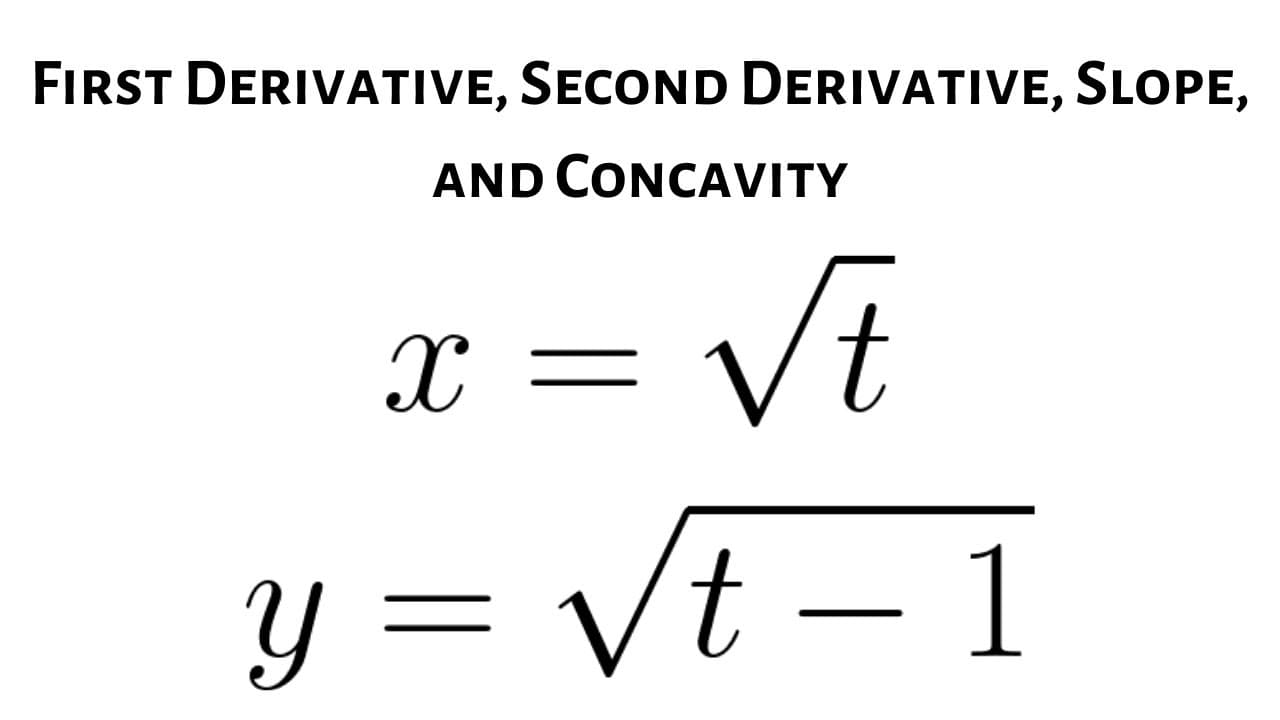
Slope, Concavity of Parametric Equations x = sqrt(t), y = sqrt(t - 1)
TL;DR
Calculating derivatives, slope, concavity for parametric equations involving square roots.
Transcript
and this problem we're given two parametric equations and we have to find a few things we have to find dy/dx the second derivative and then these slope and concavity at the value of the parameter T equals 5 let's go ahead and work through this so first let's find dy/dx so the formula for dy/dx is the following so it's dy over DT divided by DX DT it... Read More
Key Insights
- 📏 Calculating derivatives in parametric equations requires understanding the chain rule and power rule for exponents.
- 🫚 Simplifying square roots and manipulating exponents are essential skills when dealing with parametric equations involving square roots.
- 🍉 The quotient rule is crucial for finding the second derivative in parametric equations, requiring careful handling of terms and exponents.
Install to Summarize YouTube Videos and Get Transcripts
Explore YouTube Video Summarizer or Get YouTube Transcript Extractor
Questions & Answers
Q: What is the formula for calculating dy/dx in parametric equations?
The formula for dy/dx in parametric equations is dy/dt divided by dx/dt, which can be thought of as y over x. This formula simplifies finding the derivative in parametric equations involving square roots.
Q: How is the slope of the parametric equations calculated at a specific value of the parameter?
The slope at a specific value of the parameter is found by plugging in the value into the derivative expression obtained earlier. This gives the slope of the parametric equations at that particular point.
Q: Explain the process of finding the second derivative in parametric equations.
To find the second derivative in parametric equations, the quotient rule is applied to the derivative of dy/dx. This involves careful manipulation of exponents and simplifying terms to arrive at the final second derivative expression.
Q: How is concavity determined in parametric equations involving square roots?
Concavity in parametric equations is determined by plugging in the value of the parameter into the second derivative expression. The result, whether positive or negative, indicates whether the curve is concave up or down at that point.
Summary & Key Takeaways
-
Parametric equations involving square roots are analyzed to find derivatives like dy/dx and concavity.
-
The process involves simplifying square roots, applying the quotient rule for derivatives, and solving for slope and concavity.
-
Understanding the chain rule, power rule, and simplifying exponents are key to solving the equations effectively.
Read in Other Languages (beta)
Share This Summary 📚
Summarize YouTube Videos and Get Video Transcripts with 1-Click
Try YouTube Summary with ChatGPT & Claude or YouTube Transcript Generator
Explore More Summaries from The Math Sorcerer 📚


Summarize YouTube Videos and Get Video Transcripts with 1-Click
Try YouTube Summary with ChatGPT & Claude or YouTube Transcript Generator