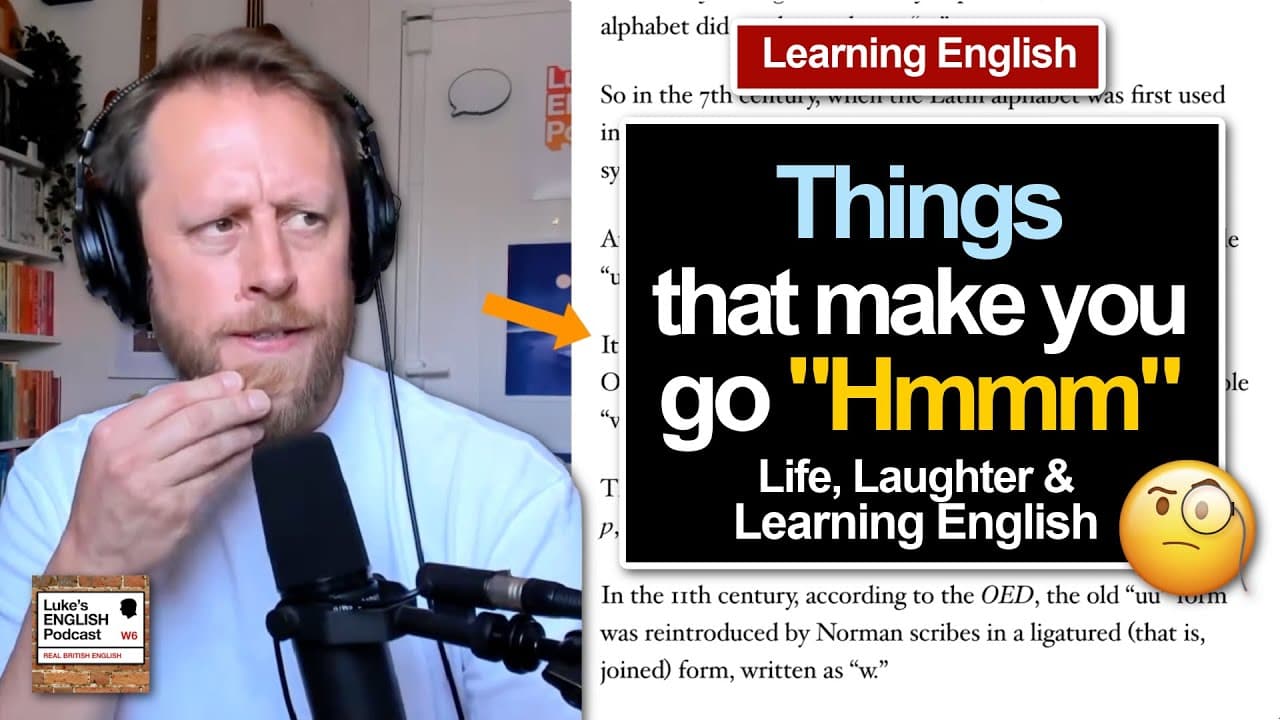
840. Things that make you go "Hmmm" 🤔😅 Life, Laughter & Learning English
TL;DR
A collection of whimsical jokes and musings about the English language and life in general.
Transcript
hello welcome back to Luke's English podcast how are you doing today I hope you're doing fine ready yeah ready ready for another episode okay let's do it come on then let's talk about some stuff okay here's some more stuff to help you learn English right that's what this podcast is all about stuff to help you learn English so what kind of stuff hav... Read More
Key Insights
- 😑 Language is full of peculiarities, such as contradictory idiomatic expressions and unnecessary letters in words.
- 🛟 Observations about everyday life can provide opportunities for learning and amusement.
- ⌛ Vocabulary and language can be quirky and nonsensical at times, but these idiosyncrasies contribute to the richness of language.
- 🙂 Understanding the origins of words and expressions can shed light on their unusual usage.
- 💨 English learners can benefit from exploring humorous observations as a way to enhance vocabulary and language skills.
- ❓ Many linguistic quirks and curiosities have historical or cultural explanations.
- 🥺 Mispronunciations or different spellings can evolve over time, leading to confusion and humorous observations.
Install to Summarize YouTube Videos and Get Transcripts
Explore YouTube Video Summarizer or Get YouTube Transcript Extractor
Questions & Answers
Q: Why do fat chance and slim chance mean the same thing?
The idiomatic expressions "fat chance" and "slim chance" both convey a low probability of something happening, despite their contradicting adjective meanings. It's an example of the idiosyncrasies of the English language.
Q: Why is the word "queue" spelled with unnecessary letters?
The word "queue" comes from the French word "kagar," which means "to load." Over time, additional letters were added to the word as it evolved from Old English to its current form, creating a unique spelling.
Q: Why does the last 10% of a toothpaste tube last as long as the first 90%?
People tend to use more toothpaste than necessary, assuming that they need a large amount to effectively brush their teeth. However, the last 10% of a toothpaste tube is often sufficient for the same number of brushing sessions, as people tend to extract more than they need from the tube.
Q: Why is a fireman not called a water man?
The term "fireman" originates from historic firefighting practices, which involved extinguishing fires rather than focusing primarily on prevention. While "water man" would be more fitting from a literal perspective, the term "fireman" has historical significance and is commonly used.
Key Insights:
- Language is full of peculiarities, such as contradictory idiomatic expressions and unnecessary letters in words.
- Observations about everyday life can provide opportunities for learning and amusement.
- Vocabulary and language can be quirky and nonsensical at times, but these idiosyncrasies contribute to the richness of language.
- Understanding the origins of words and expressions can shed light on their unusual usage.
- English learners can benefit from exploring humorous observations as a way to enhance vocabulary and language skills.
- Many linguistic quirks and curiosities have historical or cultural explanations.
- Mispronunciations or different spellings can evolve over time, leading to confusion and humorous observations.
- Finding humor in linguistic oddities brings joy to language learners and deepens their connection to the language.
Summary & Key Takeaways
-
A listener named Hannah sent in a list of funny observations about life and peculiarities of the English language.
-
Examples include the oddity of "fat chance" and "slim chance" meaning the same thing, the origins of the word "queue," and the curious longevity of the last 10% of a tube of toothpaste.
-
These whimsical observations provide light-hearted entertainment and opportunities to learn English vocabulary.
Read in Other Languages (beta)
Share This Summary 📚
Summarize YouTube Videos and Get Video Transcripts with 1-Click
Try YouTube Summary with ChatGPT & Claude or YouTube Transcript Generator
Explore More Summaries from Luke's English Podcast 📚




![Technology in Everyday Life (Part 2) 👨💻 The Choices We Make / Topic Discussion & Vocabulary [947] thumbnail](/_next/image?url=https%3A%2F%2Fi.ytimg.com%2Fvi%2FsC1wZ1w2OvY%2Fhqdefault.jpg&w=750&q=75)
Summarize YouTube Videos and Get Video Transcripts with 1-Click
Try YouTube Summary with ChatGPT & Claude or YouTube Transcript Generator