What Happens During the Cell Cycle?
TL;DR
The cell cycle involves critical processes like DNA replication, cell growth, and mitosis, regulated by cyclin-dependent kinases and cyclin proteins. Cyclins oscillate in concentration due to regulated proteolysis, ensuring proper timing of cell division and allowing checkpoints to prevent errors, like DNA damage, from compromising cell integrity.
Transcript
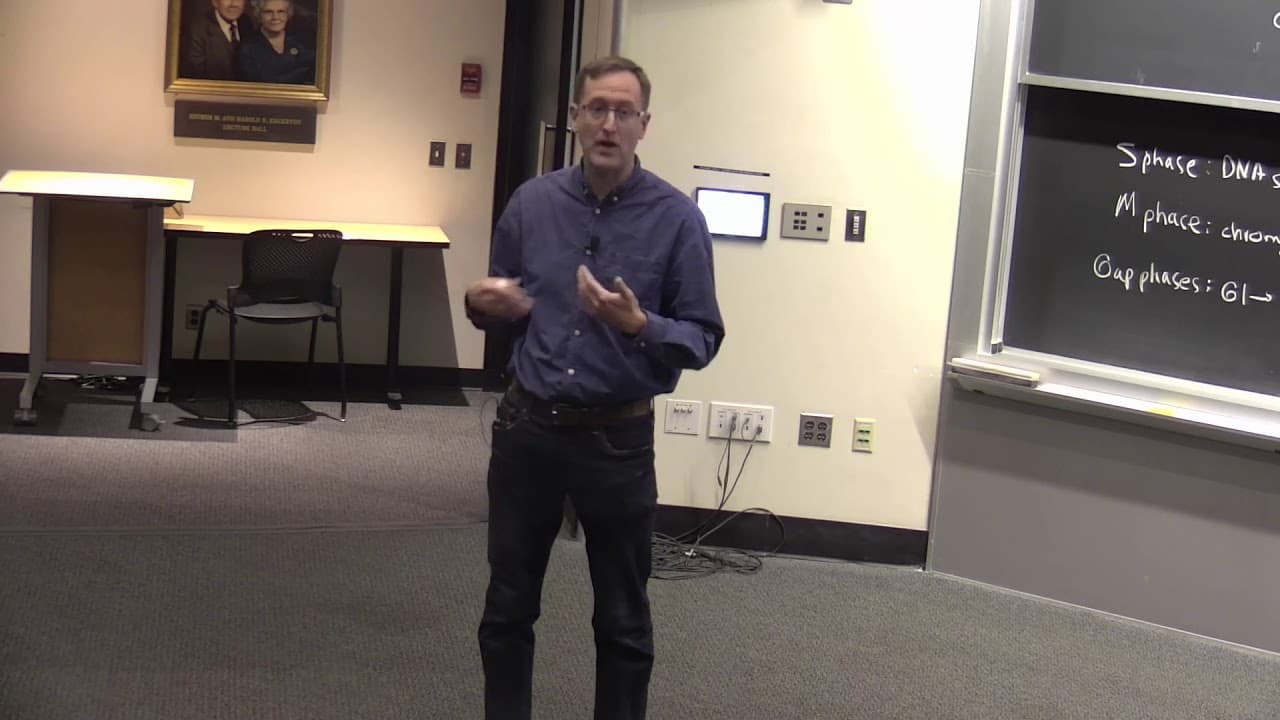
ADAM MARTIN: And so today and for the remainder of the week, the theme is going to be the cell division cycle. And so we're going to really talk about the cell division cycle in every lecture this week with the penultimate lecture talking about how dysregulation of the cell division cycle results in a pathological condition known as cancer. OK, so ... Read More
Key Insights
- ➗ The cell division cycle involves DNA replication, growth, and mitosis, leading to the division of a cell into two cells.
- ♻️ Cyclin-dependent kinase and cyclin proteins play a crucial role in regulating the cell division cycle.
- ⚡ Regulated proteolysis, through the addition of ubiquitin tags, controls the oscillation of cyclin levels.
- 🏍️ Checkpoints in the cell cycle prevent the progression of events before the preceding event has occurred correctly.
- 🧬 DNA damage activates a DNA damage checkpoint, which delays the cell cycle to allow for DNA repair.
Install to Summarize YouTube Videos and Get Transcripts
Explore YouTube Video Summarizer or Get YouTube Transcript Extractor
Questions & Answers
Q: What are the key events that occur during the cell division cycle?
The cell division cycle involves events such as DNA replication, growth, and mitosis. During DNA replication, the chromosomes are duplicated. The cell also needs to grow in size before dividing. The final stage is mitosis, where the chromosomes are segregated and the cell physically divides.
Q: How is the cell division cycle regulated?
The cell division cycle is regulated by cyclin-dependent kinase and cyclin proteins. Cyclin proteins activate CDK, which then phosphorylates proteins involved in cell cycle events. The cyclin proteins oscillate in their levels due to regulated proteolysis, where ubiquitin tags are added to the cyclin proteins and target them for degradation.
Q: What happens if DNA damage occurs during the cell division cycle?
In response to DNA damage, the cell activates a DNA damage checkpoint. This checkpoint delays the cell cycle progression, allowing time for DNA repair. If the checkpoint is disrupted, the cell may undergo premature mitosis with damaged DNA, leading to cell death.
Q: How was the role of cyclin proteins in the cell division cycle discovered?
Through experiments with temperature-sensitive mutants, it was found that the CDC 28 gene in yeast is essential for the transition from G1 to S phase. This gene was identified as the gene encoding cyclin-dependent kinase. Further experiments in frog egg extracts and mRNA depletion showed that specific cyclin proteins are required for the oscillation of the cell cycle.
Summary & Key Takeaways
-
The cell division cycle consists of phases such as DNA replication, growth, and mitosis.
-
CDK and cyclin proteins play a crucial role in regulating the cell division cycle.
-
Regulated proteolysis, which involves the degradation of cyclin proteins by ubiquitin, controls the oscillation of cyclin levels.
Read in Other Languages (beta)
Share This Summary 📚
Summarize YouTube Videos and Get Video Transcripts with 1-Click
Try YouTube Summary with ChatGPT & Claude or YouTube Transcript Generator
Explore More Summaries from MIT OpenCourseWare 📚



Summarize YouTube Videos and Get Video Transcripts with 1-Click
Try YouTube Summary with ChatGPT & Claude or YouTube Transcript Generator