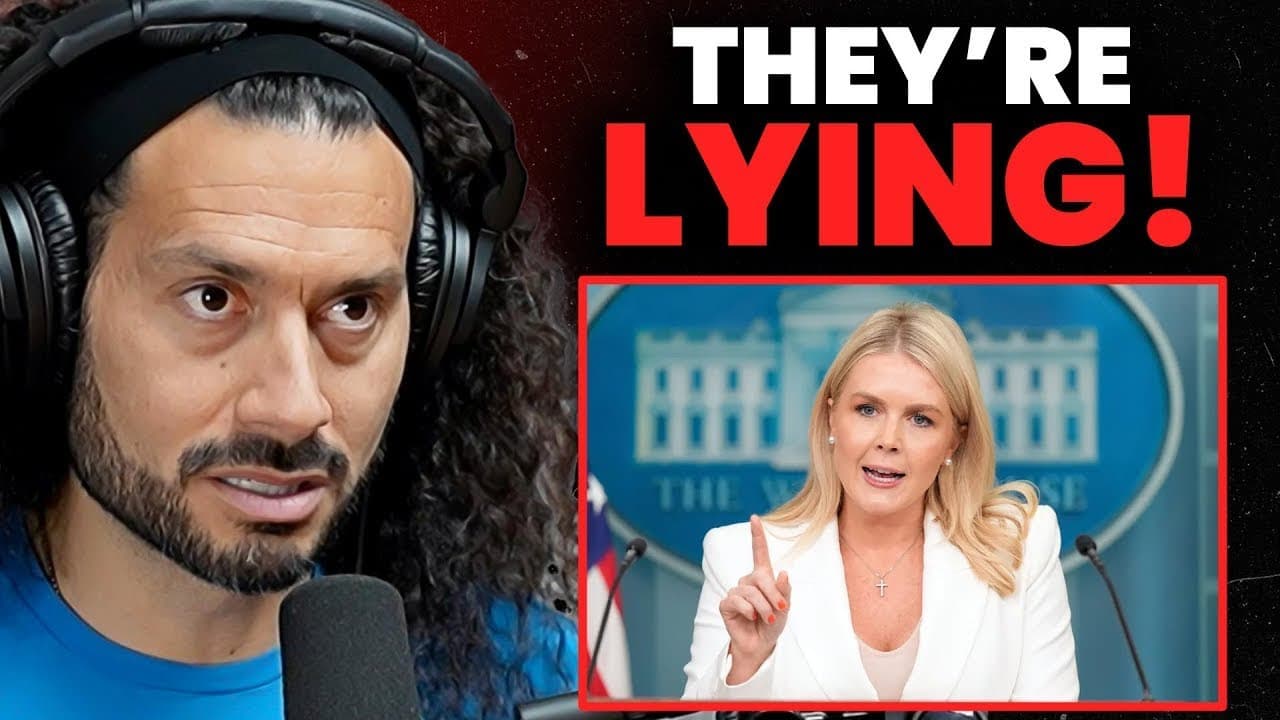
Psychological Warfare: How Government Brainwashes the Public in 2025
TL;DR
Government narratives manipulate public perception through emotional messaging.
Transcript
there's an intention that governments are taking There's an intention that leaders are taking that's different from the stated intention that they're telling the public And then from that division there's a third narrative that comes out from media right and that media narrative is partially crafted by by big media and partially organic and undirec... Read More
Key Insights
- Governments use a three-layer narrative system: true intentions, public statements, and media narratives, creating confusion about the truth.
- Media narratives are influenced by both traditional and new media, each with biases and varying levels of journalistic integrity.
- The CIA distinguishes between 'messaging' (emotional) and 'narrative' (logical), both used to shape public perception.
- Emotional messaging is prevalent in various sectors, including business and politics, to create a sense of identity and power.
- Journalism has shifted from fact-reporting to storytelling, often driven by the need for engaging narratives to attract audiences.
- New media offers more independence from traditional media constraints but is often criticized for lacking journalistic rigor.
- The geopolitical strategies of countries like Israel and the U.S. involve leveraging crises to advance national interests.
- Public perception is often shaped by crafted images and narratives, which may not align with reality.
Install to Summarize YouTube Videos and Get Transcripts
Explore YouTube Video Summarizer or Get YouTube Transcript Extractor
Questions & Answers
Q: How do governments use narratives to influence public perception?
Governments create narratives by using emotional messaging to evoke specific responses from the public. These messages are designed to appeal to emotions, which then lead individuals to form logical narratives that align with the government's goals. This process manipulates public perception and can be seen in various sectors, including politics and business.
Q: What is the difference between messaging and narrative according to the CIA?
The CIA differentiates between 'messaging' and 'narrative' by focusing on their psychological impact. Messaging is emotional and aims to elicit an immediate emotional response, while narrative is logical and constructed by individuals based on the emotional messages they receive. Together, they shape how people perceive events and concepts.
Q: How has journalism changed in recent years?
Journalism has shifted from straightforward fact-reporting to creating engaging narratives to capture audience attention. This change is driven by the need to compete for clicks and views, leading journalists to craft stories rather than simply report facts. This narrative-driven approach often prioritizes audience engagement over objective reporting.
Q: What role does new media play in shaping narratives?
New media offers a platform for more independent voices, free from traditional media constraints. While it provides a space for diverse opinions, it is often criticized for lacking journalistic rigor. New media focuses on opinion and speculation, allowing for open discussions about facts, but also contributing to the proliferation of varied and conflicting narratives.
Q: How do geopolitical strategies utilize crises?
Countries like Israel and the U.S. use crises as opportunities to advance their national interests. For example, Israel's response to threats from Iran involves strategic actions to deplete Iran's capabilities. These strategies leverage public support during crises to implement actions that may not be possible under normal circumstances, influencing geopolitical dynamics.
Q: What challenges arise from crafted public perceptions?
Crafted public perceptions can lead to a disconnect between the perceived and actual geopolitical realities. Narratives shaped by emotional messaging and strategic storytelling may not accurately reflect the true state of affairs, leading to misunderstandings and misinformed public opinions. This complexity poses challenges in discerning the truth in international relations.
Q: How do emotional messages influence identity and power perceptions?
Emotional messages are used to create a sense of identity and power. For instance, military recruitment campaigns use emotional appeals to convey strength and independence, leading individuals to associate these qualities with national power. This perception is then internalized by both domestic and international audiences, shaping how power is viewed globally.
Q: What impact does the narrative-driven approach have on journalism?
The narrative-driven approach in journalism impacts the integrity and objectivity of reporting. By focusing on storytelling, journalists may prioritize engaging narratives over factual accuracy, potentially leading to biased or incomplete representations of events. This shift affects public trust in media and challenges the role of journalism in providing unbiased information.
Summary & Key Takeaways
-
Governments and media create layered narratives that shape public perception, often leading to confusion and manipulation. Emotional messaging is used to evoke responses and construct logical narratives, influencing how people perceive power and identity.
-
Journalism has evolved from fact-reporting to narrative-driven storytelling, competing for audience engagement. New media, while more independent, is criticized for lacking traditional journalistic standards, leading to diverse and sometimes conflicting narratives.
-
Geopolitical strategies, such as those by Israel and the U.S., leverage crises to further national interests. Public perceptions are influenced by crafted narratives, which may not reflect the true geopolitical realities, highlighting the complexity of international relations.
Read in Other Languages (beta)
Share This Summary 📚
Summarize YouTube Videos and Get Video Transcripts with 1-Click
Try YouTube Summary with ChatGPT & Claude or YouTube Transcript Generator
Explore More Summaries from Andrew Bustamante 📚


Summarize YouTube Videos and Get Video Transcripts with 1-Click
Try YouTube Summary with ChatGPT & Claude or YouTube Transcript Generator