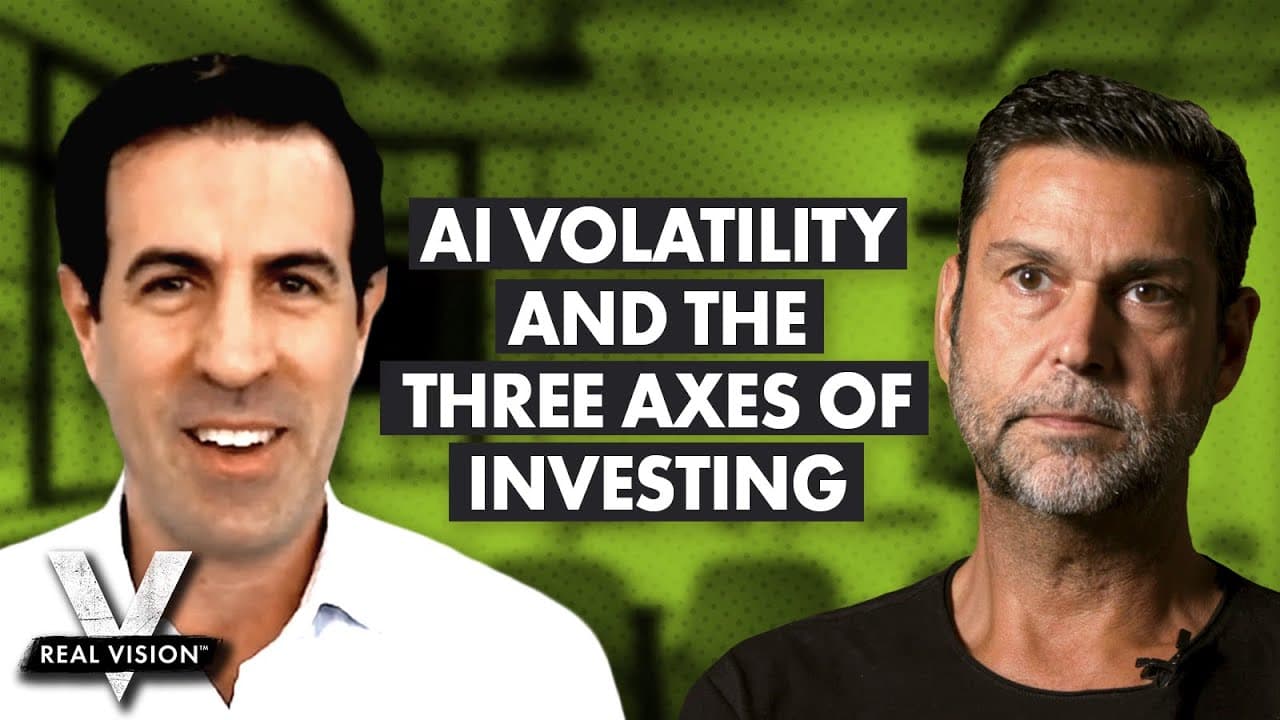
Volatility and What the Future Holds (w/ Raoul Pal & Trevor Mottl)
TL;DR
Quantitative and fundamental strategies will converge in the future, leading to more repeatable and data-driven investment processes.
Transcript
RAOUL PAL: And so typically the kind of strategies that you're looking at, again, you're running a range of strategies, what kind of vol are they, and have you experimented with high-vol strategies using AI, which tend to be longer-term time horizon strategies? Because one of my beliefs is that it's much harder to compete with humans on a longer ti... Read More
Key Insights
- 🥹 There is value in finding an edge in pricing, holding period, and liquidity within the three-dimensional space of investing.
- 🍉 Longer-term time horizons offer unique advantages for investors, especially when competing against algorithms.
- 🥺 Crowding in certain investment strategies can create opportunities in other areas, leading to market evolution.
- 🎰 Machines trading against machines is more prevalent in high-frequency trading, whereas longer time horizons still involve variant perceptions among investors.
Install to Summarize YouTube Videos and Get Transcripts
Explore YouTube Video Summarizer or Get YouTube Transcript Extractor
Questions & Answers
Q: Have you experimented with higher-volatility strategies using AI?
Yes, we have explored higher-volatility strategies, but our focus primarily lies on lower-volatility strategies in the short to medium term.
Q: Why do your strategies tend to be lower-volatility?
Lower-volatility strategies provide potential for variant perception within the one week to one month timeframe, where our algorithms can outperform other investors.
Q: Is it advisable for individual investors to consider longer-term time horizons?
Yes, longer-term time horizons can be advantageous as they minimize competition with algorithms and allow individuals to capitalize on their own expertise and intuition.
Q: How do you see the future of investing evolving?
I anticipate a convergence of quantitative and fundamental strategies, with more quantitative tools influencing the fundamental investment process. This will lead to enhanced repeatability and reduced emotional bias.
Summary & Key Takeaways
-
Trevor Mottl discusses low-volatility strategies and the challenges with longer-term time horizons when using AI in investing.
-
He emphasizes the importance of finding an edge in pricing, holding period, and liquidity in the three-dimensional space of investing.
-
Mottl predicts a convergence of quantitative and fundamental approaches, resulting in more granular data integration and increased understanding of markets.
Read in Other Languages (beta)
Share This Summary 📚
Summarize YouTube Videos and Get Video Transcripts with 1-Click
Try YouTube Summary with ChatGPT & Claude or YouTube Transcript Generator
Explore More Summaries from Raoul Pal on Real Vision 📚


Summarize YouTube Videos and Get Video Transcripts with 1-Click
Try YouTube Summary with ChatGPT & Claude or YouTube Transcript Generator