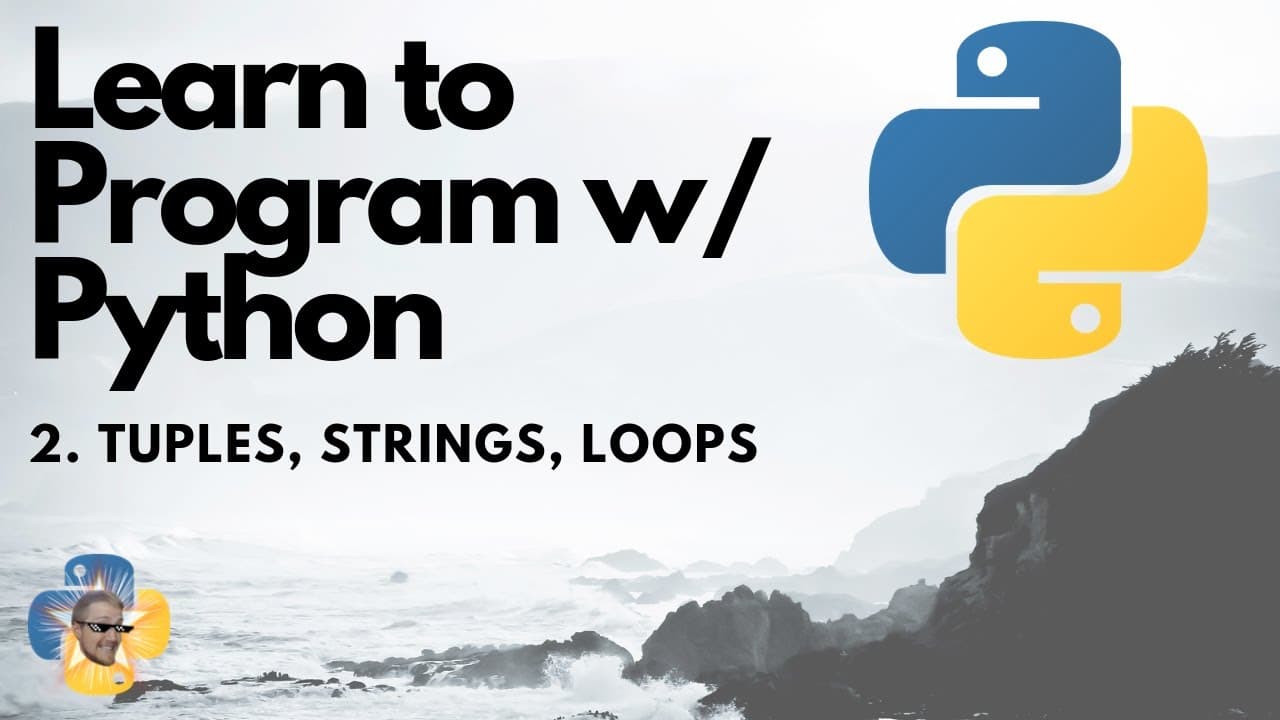
Tuples, Strings, Loops - Python 3 Programming Tutorial p.2
TL;DR
This video covers the basics of Python 3, including variables, tuples, strings, and loops, in an easy-to-understand manner.
Transcript
what's going on everybody and welcome to part two of the updated Python 3 basics series in this video I'd like to talk about variables tuples strings and loops all in one go let's get started so first of all I'm gonna make a new directory I'm just gonna call this tutorials then I'm gonna open up sublime here and I'm just gonna do a file save as we'... Read More
Key Insights
- ❓ Variables in Python are used to represent objects and can be assigned values using the assignment operator (=).
- 🪈 Tuples in Python are collections of ordered, immutable objects and are often used to represent sequences of values.
- 🅰️ The type() function can be used to determine the type of a variable in Python.
- 👂 Lists and tuples are different in that lists are mutable, while tuples are immutable.
- 👂 The for loop in Python is used to iterate over a sequence of values, such as a list or tuple.
- 🎮 The Python 3 Docs can be a valuable resource for learning more about topics covered in this video.
- 👾 The next tutorial will cover creating a simple text-based tic-tac-toe game in Python.
Install to Summarize YouTube Videos and Get Transcripts
Explore YouTube Video Summarizer or Get YouTube Transcript Extractor
Questions & Answers
Q: What is a variable in Python?
In Python, a variable is a word representation of an object. It can be assigned a value using the assignment operator (=) and follows certain rules, such as not starting with a number.
Q: How can you determine the type of a variable in Python?
The type of a variable can be determined using the built-in type() function. For example, type(variable_name) will return the type of the variable.
Q: What is a tuple in Python?
A tuple is a collection of ordered, immutable objects, defined by enclosing the objects in parentheses or separated by commas. Tuples are often used to represent a sequence of values.
Q: What is the difference between a list and a tuple in Python?
The main difference between a list and a tuple in Python is that a list is mutable, meaning items can be added, removed, or modified, while a tuple is immutable and cannot be changed after creation.
Q: How can a for loop be used in Python?
A for loop in Python is used to iterate over a sequence of values, such as a list or a tuple. It consists of the "for" keyword, followed by a temporary variable, the "in" keyword, and the sequence to iterate over.
Summary & Key Takeaways
-
The video starts by discussing variables in Python, explaining how they are used to represent objects.
-
The concept of tuples is introduced, with examples of how to define and use them.
-
The video then moves on to discussing loops, specifically the for loop, and demonstrates how to iterate over items in a tuple.
Read in Other Languages (beta)
Share This Summary 📚
Summarize YouTube Videos and Get Video Transcripts with 1-Click
Try YouTube Summary with ChatGPT & Claude or YouTube Transcript Generator
Explore More Summaries from sentdex 📚
Summarize YouTube Videos and Get Video Transcripts with 1-Click
Try YouTube Summary with ChatGPT & Claude or YouTube Transcript Generator