Does the USMCA Have a Future in North America?
TL;DR
Yes, the USMCA has a future as it strengthens North American economic integration and addresses challenges from globalization and the pandemic. The agreement fosters regional resilience, improves labor protections, and encourages cooperation among the US, Mexico, and Canada, positioning them to effectively counter threats from non-market economies.
Transcript
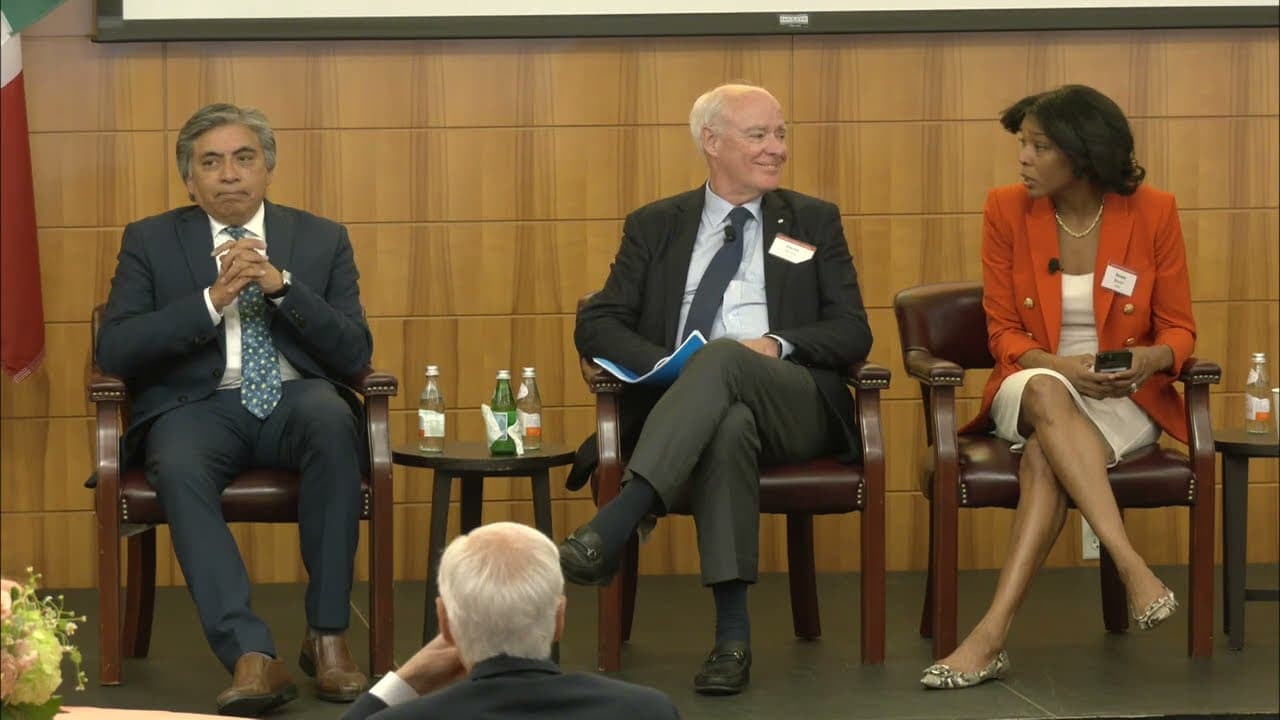
okay so my name is Melanie Morton I'm a professor in the economics department and it's my pleasure to be with you today to have a panel on does the U.S Mexico Canada agreement have a future so looking at the most recent attitude data the most recent Gallup Poll for March 2022 shows that only 61 percent of the US population views foreign trade as an... Read More
Key Insights
- 🏈 The USMCA has a future in strengthening North American economic integration and addressing challenges posed by globalization and the pandemic.
- ⛓️ Enhancing regional resilience and diversifying supply chains are crucial for mitigating disruptions and decreasing dependence on specific countries.
- 🗯️ USMCA's inclusion of stronger labor protections and the rapid response mechanism demonstrates a commitment to addressing worker rights and reducing inequality.
- 🖐️ The shared democratic values of the US, Mexico, and Canada play a significant role in promoting economic cooperation and countering non-market economies' influence.
Install to Summarize YouTube Videos and Get Transcripts
Explore YouTube Video Summarizer or Get YouTube Transcript Extractor
Questions & Answers
Q: How has the perception of foreign trade changed in the US since the implementation of USMCA?
Recent data shows that 61% of the US population views foreign trade as an opportunity for economic growth rather than a threat. This level of support is consistent with attitudes before the USMCA came into effect in 2020.
Q: What are the key changes introduced by USMCA compared to NAFTA?
USMCA includes new rules of origin for the auto industry, strengthened labor laws, extended intellectual property protection, and a sunset provision clause, which allows for reviews every six years. These changes aim to address labor concerns and improve regional integration.
Q: How has the pandemic impacted global supply chains, and how does USMCA address this issue?
The pandemic disrupted global supply chains, resulting in increased costs and dependence on certain countries. USMCA aims to enhance supply chain resilience by encouraging regional collaboration, diversifying sources of supply, and strengthening coordination among North American partners.
Q: How does USMCA promote labor rights and address concerns about inequality?
USMCA includes a rapid response mechanism that allows any entity to lodge a complaint against labor rights violations in Mexico. This mechanism ensures quick response and compliance. The alignment of the US and Mexican governments' focus on workers' rights also supports the improvement of labor conditions and reduced inequality.
Summary & Key Takeaways
-
The USMCA has replaced NAFTA and provides a new framework for understanding free trade in North America.
-
Complementary factor endowments, geographic proximity, and historical trade relationships have made the US and Mexico natural trade partners.
-
USMCA has resulted in a trade surplus for Mexico with the US, encouraging the export of manufacturing goods.
-
The future of USMCA depends on strengthening regional integration, considering geopolitical shifts, and building alliances based on shared values.
Read in Other Languages (beta)
Share This Summary 📚
Summarize YouTube Videos and Get Video Transcripts with 1-Click
Try YouTube Summary with ChatGPT & Claude or YouTube Transcript Generator
Explore More Summaries from Stanford Institute for Economic Policy Research (SIEPR) 📚





Summarize YouTube Videos and Get Video Transcripts with 1-Click
Try YouTube Summary with ChatGPT & Claude or YouTube Transcript Generator