Bunsen Burner (THERMAL IMAGING) - Periodic Table of Videos
TL;DR
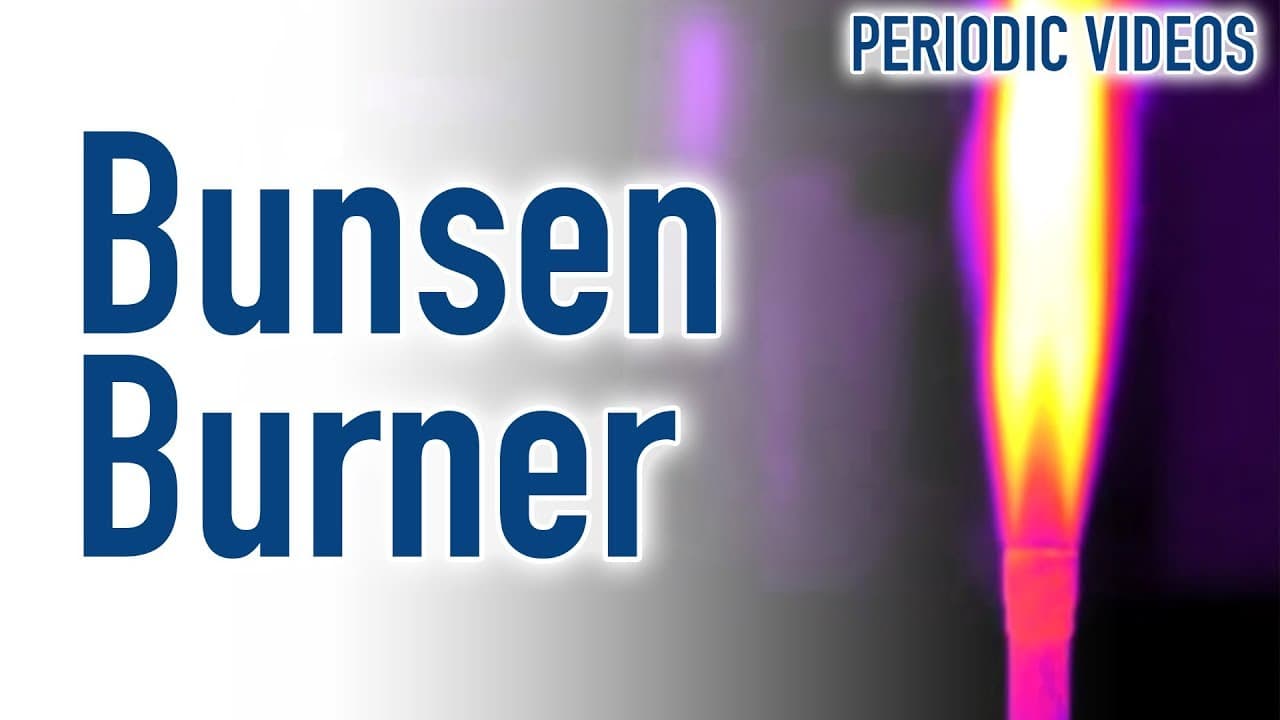
A detailed exploration of the Bunsen burner, its modes, flame colors, and heat conduction with insightful thermal imaging.
Transcript
Bunsen burner is perhaps one of the most iconic symbols of chemistry. A Bunsen burner, just to remind you, consists of a small jet down here with two holes, and a metal cylinder that you can rotate so that you can open and shut those holes. And the gas comes down the tube, up the jet, and air comes through these big holes, and the flame comes out o... Read More
Key Insights
- 🥵 Bunsen burners consist of a tube, metal cylinder, and air holes that control flame color and heat.
- 😅 Flame color varies due to the presence of hot carbon particles from incomplete combustion.
- 😅 The blue cone in a Bunsen burner doesn't consistently denote the hottest point in the flame.
- 🥵 Heat conduction along a carbon rod illustrates the transfer of heat through materials.
- 🥵 Thermal imaging can reveal the intricate structure of a Bunsen burner flame, showcasing heat variations.
- 👱 Bunsen burners operate in covered air hole mode for a yellow wavy flame or in a cooler mode with reduced air for a hotter, blue flame.
- 🤘 The Bunsen burner design includes a double layer of metal to prevent extreme burns.
Install to Summarize YouTube Videos and Get Transcripts
Explore YouTube Video Summarizer or Get YouTube Transcript Extractor
Questions & Answers
Q: What are the two modes in which Bunsen burners are usually operated?
Bunsen burners can operate in a mode with covered air holes, resulting in a large, yellow wavy flame, or in a cooler mode with reduced air, producing a hotter, blue flame.
Q: Why does the Bunsen burner flame exhibit a yellow color?
The yellow color in the Bunsen burner flame is due to hot carbon particles formed from incomplete combustion with methane, present in the gas utilized.
Q: What does the blue cone on a Bunsen burner signify?
While commonly believed to denote the hottest point in the flame, the blue cone actually experiences turbulence, resulting in varying hotspots within the flame.
Q: How does the Bunsen burner exhibit heat conduction along a rod?
By conducting heat along a carbon rod, the Bunsen burner demonstrates the transfer of heat through materials, showcasing how heat gradually increases along the rod.
Summary & Key Takeaways
-
The Bunsen burner comprises a tube, metal cylinder, and air holes, showcasing various flame colors representing different heat levels.
-
The flame exhibits yellow color due to hot carbon particles, while the blue cone doesn't exactly pinpoint the hottest spot.
-
Thermal imaging shows the intricate flame structure, highlighting heat variations and air layers around the flame.
Read in Other Languages (beta)
Share This Summary 📚
Summarize YouTube Videos and Get Video Transcripts with 1-Click
Try YouTube Summary with ChatGPT & Claude or YouTube Transcript Generator
Explore More Summaries from Periodic Videos 📚

Summarize YouTube Videos and Get Video Transcripts with 1-Click
Try YouTube Summary with ChatGPT & Claude or YouTube Transcript Generator