Convert JK Flip flop to D Flip flop | STLD | Lec-126
TL;DR
This video explains how to convert a JK flip flop into a D flip flop using Boolean expressions.
Transcript
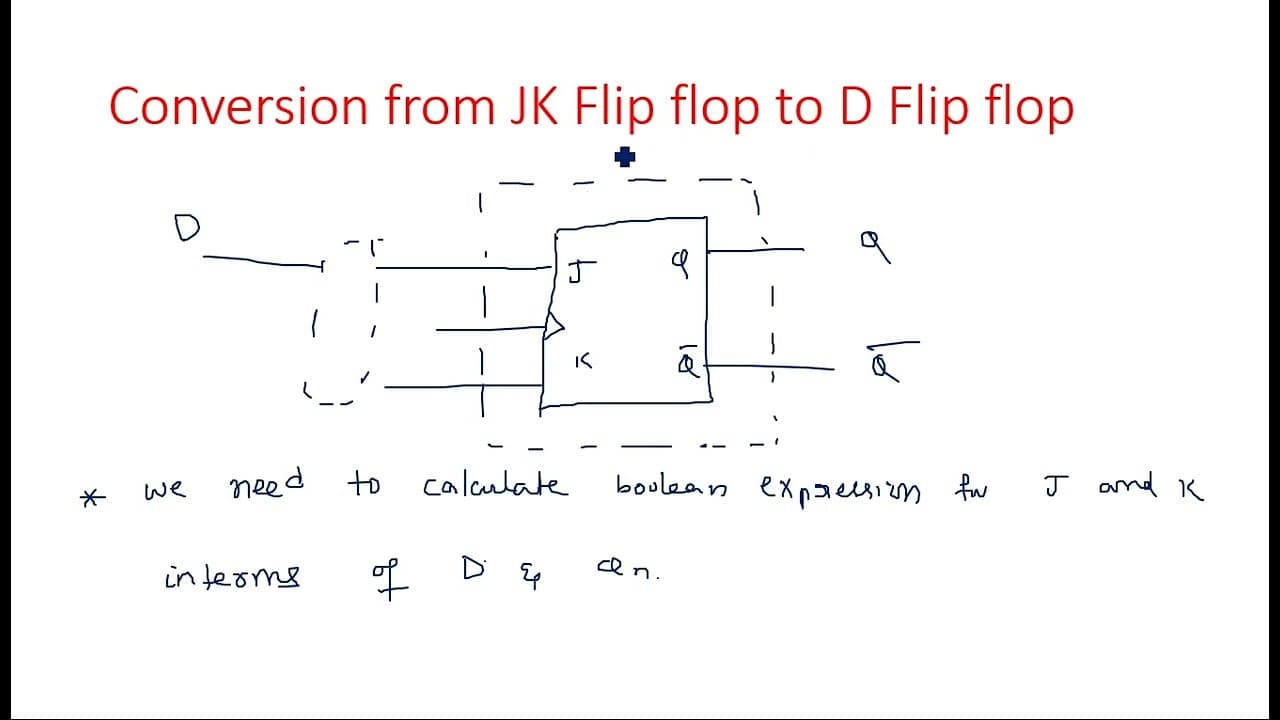
hi everyone in this video I'm going to explain about the conversion from a JK flip flop into D flip Lop that means we are having JK flip Lop with us we have a JK flip Lop sorry we have a JK flip flop this JK flip flop now needs to be converted into D flip flop so what are the additional logic circuits we should provide that will decide the operatio... Read More
Key Insights
- 🐬 Understanding the characteristics of different flip flops is crucial for digital circuitry design.
- 🔠 The conversion process focuses on creating simpler circuits by minimizing inputs.
- 🔨 Boolean algebra is a powerful tool for deriving circuit functionality in digital electronics.
- 🐬 The JK flip flop is versatile but can be more complex than necessary for some applications.
- 🎨 A thorough grasp of excitation and truth tables is essential for effective digital logic design.
- 🐬 The need for additional components, such as inverters, is a common requirement in flip flop conversions.
- 🔠 The conversion process illustrates the importance of accurate input-output relationships in digital systems.
Install to Summarize YouTube Videos and Get Transcripts
Explore YouTube Video Summarizer or Get YouTube Transcript Extractor
Questions & Answers
Q: What is the main purpose of converting a JK flip flop into a D flip flop?
The primary purpose of converting a JK flip flop into a D flip flop is to simplify circuit design. The D flip flop has a single input, making it easier to control the output based on the current state and input signal, which can reduce complexity in digital systems.
Q: What two tables are essential for deriving the conversion table from JK to D flip flop?
The essential tables for deriving the conversion table are the truth table of the D flip flop and the excitation table of the JK flip flop. These tables provide the necessary state transitions and conditions needed to formulate the Boolean expressions for the conversion process.
Q: How do you derive the Boolean expressions for J and K during the conversion?
The Boolean expressions for J and K can be derived using Karnaugh maps (K-maps). By mapping the inputs D and Qn, the expressions for J and K can be simplified. J is found to be directly connected to D, while K requires an inverter to connect it to D, resulting in K being D bar.
Q: What is the logic diagram for the conversion process from JK to D flip flop?
The logic diagram includes the JK flip flop, with an external input D directly connected to the J input. The K input is connected through an inverter derived from D, completing the conversion to create the D flip flop structure. This diagram visually represents the necessary changes in logic.
Summary & Key Takeaways
-
The video outlines the process of converting a JK flip flop into a D flip flop using additional logic circuits.
-
It emphasizes the importance of understanding both the truth table of the D flip flop and the excitation table of the JK flip flop for accurate conversion.
-
The presentation covers the derivation of Boolean expressions for J and K from the input D and previous state Q, providing necessary circuit connections.
Read in Other Languages (beta)
Share This Summary 📚
Summarize YouTube Videos and Get Video Transcripts with 1-Click
Try YouTube Summary with ChatGPT & Claude or YouTube Transcript Generator